
VEVOR Metal Container
4.5Editor score
Twenty-liter steel capacity
Integrated pouring spout
Portable carry handle
Yellow utility-style finish
Our All Metal Jerry Can Fuel Container guide compares 10 steel cans for capacity, fuel type, safety certifications, pouring control, portability, and secure
An all-metal jerry can fuel container offers a durable way to store and transfer gasoline, diesel, and other flammable liquids. A worthwhile model should combine rugged steel construction with secure closures, reliable handles, and a design suited to the fuel, quantity, and dispensing method you need.
This guide compares ten metal jerry cans using the specifications and product details supplied for each listing. We considered capacity, steel gauge, corrosion protection, flame-arresting features, industry certifications, spout or hose arrangements, venting, portability, and ease of controlled fuel transfer.
The selections show why a five-gallon workhorse, a compact reserve can, and a flexible hose-equipped Type II container serve very different needs. Ratings reflect the supplied listing data, while current prices and availability can change, so confirm the latest offer before purchasing.
4.5Editor score

4.7Editor score

4.6Editor score
This side-by-side comparison highlights the major differences among the ten containers, including capacity, intended fuel, construction, closure system, dispensing method, and safety certifications.



The 5.3 Gallon Metal Jerry Can is a rugged general-purpose fuel container built around high-grade cold-rolled steel. Its supplied rating is 4.0, the lowest among this group, but the product information emphasizes a combination of impact resistance, rust-resistant coating, a heavy-duty gasket, and a precision sealed locking cap. Those qualities make it especially relevant to truck, SUV, workshop, garage, and overlanding use.
We may earn a commission when you buy through this link, at no additional cost to you.
The rectangular profile is one of its most practical traits. Instead of relying on a cylindrical shape, it is designed to fit truck beds, SUV trunks, and off-road mounting racks while conserving space. An integrated handle supports carrying and pouring, and the locking closure is intended to resist spills and vapor escape when the container is closed. The listing also states that it is compatible with most standard transfer accessories, adding flexibility for different refueling routines.
The tradeoff is that the supplied details do not list the specific OSHA, NFPA, FM, UL, ULC, EPA, or CARB credentials found on several certified alternatives. It also offers less detail about venting and flame-arresting construction than the Type I and Type II safety cans. For buyers who require documented industrial approvals, those omissions are meaningful and may justify a different selection.
It remains a compelling choice for people seeking a large, sturdy steel can with a familiar jerry-can shape and a straightforward closure. It is especially suitable when durability, useful capacity, rack or bed fit, and accessory compatibility matter more than a factory spout and hose system. For regulated workplaces, choose a model with clearly stated certifications instead.
The cold-rolled steel body and rust-resistant coating are intended to tolerate demanding environments, including high temperatures, impacts, and repeated storage. The integrated rectangular handle and compact profile also support secure placement in vehicle beds, trunks, or off-road racks.
A locking cap and heavy-duty gasket help contain fuel and limit vapor escape during transport. Compatibility with standard transfer accessories gives users more control over how the container is filled or dispensed.
We may earn a commission when you buy through this link, at no additional cost to you.
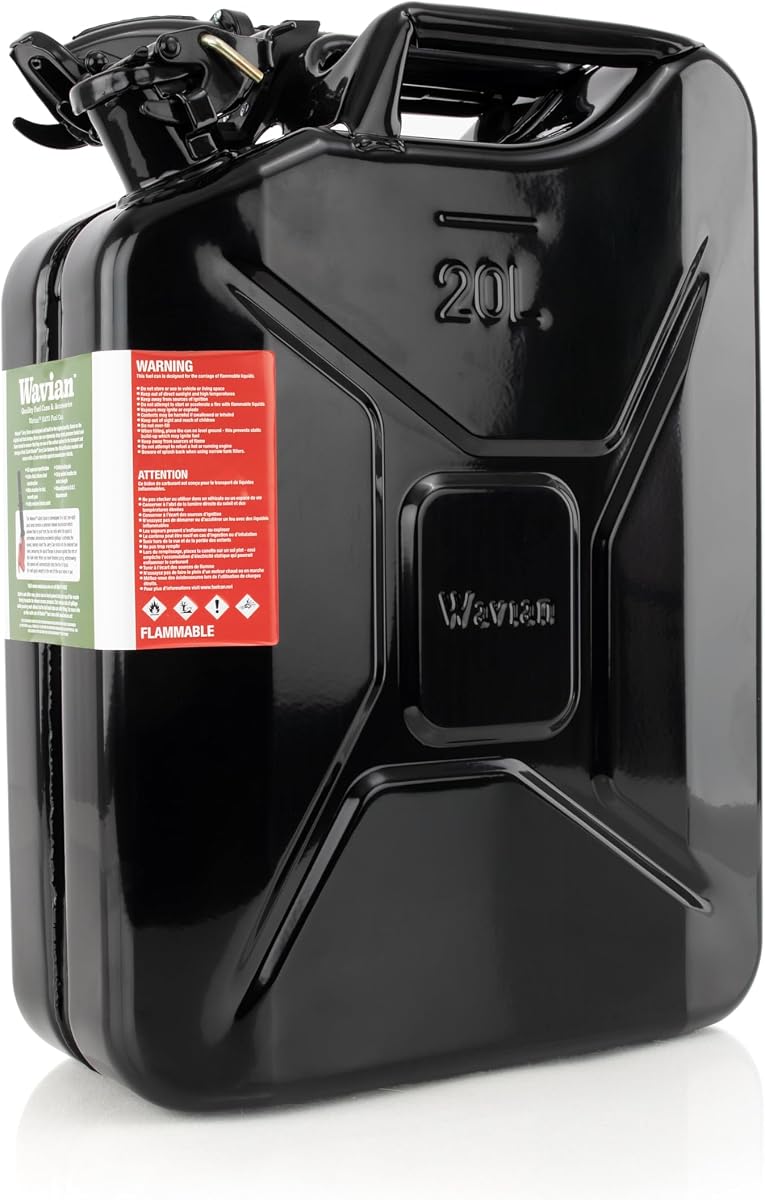
The Wavian USA Authentic NATO Jerry Can and Spout System combines a five-gallon steel can with a dedicated transfer spout. Its supplied rating is 4.4, and its strongest distinguishing feature is the documented regulatory positioning: the listing identifies it as EPA and CARB compliant and supplies the relevant EO and EPA reference numbers. That makes it a serious option for users who care about formal compliance.
We may earn a commission when you buy through this link, at no additional cost to you.
The body is made from 0.9mm cold-rolled steel with an anti-corrosive coating. Its bayonet-style quick-release nozzle allows the spout system to connect securely, while the safety lock helps prevent unintended release. The supplied details describe the design as leak-proof and suitable for long trips, outdoor adventures, or emergency fuel storage, with a five-gallon capacity that balances useful volume with a substantial steel body.
The main consideration is that this is a more specialized system rather than a basic open-and-pour safety can. Its NATO-inspired rectangular form may not fit every storage location as neatly as a smaller model, and the detailed regulatory information requires a careful distinction from general workplace approvals. The listing identifies EPA and CARB compliance but does not present the same FM, UL, and ULC approval combination listed for the Eagle and Justrite options.
Choose this model when you want gasoline storage with a coherent spout system and documented emissions compliance. It is particularly relevant for long-distance, outdoor, or preparedness use where a secure quick-release connection is desirable. Buyers whose priority is broad industrial certification should examine the certified Type I and Type II alternatives in the comparison.
The bayonet-style nozzle is designed for fast, secure attachment and removal. A safety lock adds another layer of control when the spout is connected or the can is being transported.
The listing states that the container is EPA and CARB compliant and provides its EO and EPA reference numbers. Those details can be useful when verifying suitability for regulated transportation or storage requirements.
We may earn a commission when you buy through this link, at no additional cost to you.
The Eagle 5 Gallon Type I is a gasoline safety can with a 4.7 supplied rating, the highest in this roundup. It combines a familiar five-gallon format with a self-closing gasketed spout, automatic vapor venting, a non-sparking flame arrestor, and extensive safety approvals. That combination makes it the most broadly convincing everyday choice for users who value recognized standards as much as rugged construction.
We may earn a commission when you buy through this link, at no additional cost to you.
Its Type I design uses one opening for filling and pouring, and the included funnel simplifies those tasks. The gasketed spout cap self-closes to help prevent leaks and spills, while the cap assembly automatically vents internal vapors. A fixed handle, double-interlock no-weld bottom seam, and flame arrestor form the core safety package. The can is made in America from hot-dipped galvanized steel with a baked-on powder-coat finish.
The listing states compliance with OSHA Standard 1910.106 and NFPA code 30, as well as FM, UL, and ULC approval. It also describes the steel as lead-free and designed to resist rust, dents, scratches, chipping, and fading. As with any Type I can, however, users pour through a relatively narrow spout rather than a flexible hose, and the fixed handle does not offer the positional adjustment associated with a Type II design.
This is the recommendation for garages, maintenance shops, farms, and home users who want a certified five-gallon gasoline can without a hose system. It is especially useful when one opening, a self-closing cap, and automatic venting align with the way you fill and dispense fuel. It is less compelling for very precise transfers into unusually small openings, where a Type II hose would be easier to position.
The self-closing gasketed cap, automatic vapor venting, and non-sparking flame arrestor address different aspects of safe gasoline handling. The no-weld double-interlock bottom seam and fixed handle add structural security during repeated use.
Hot-dipped galvanized steel resists rust, dents, and certain chemicals, while the powder-coat finish helps limit scratches, chipping, and fading. These features support repeated workshop and maintenance use.
We may earn a commission when you buy through this link, at no additional cost to you.
The Justrite Type II Gasoline Safety Can is the premium choice for controlled transfer into smaller openings. Its 4.6 supplied rating reflects a well-specified design built around galvanized steel, a chemical-resistant powder coat, a patented manifold, the Safe-Squeeze trigger, and a flexible metal hose. The result is a fuel can designed to improve flow control and reduce the chance of messy pours.
We may earn a commission when you buy through this link, at no additional cost to you.
The flexible hose directs fuel toward the receiving opening with greater accuracy, while the trigger provides a more controlled dispensing action. The ergonomic lift lever makes refilling more convenient, and the self-closing, leak-tight lid helps protect stored fuel. A stainless steel flame arrester is included to reduce flashback ignition risk, adding another layer of protection during flammable-liquid handling.
The supplied information also gives this can substantial professional credentials: it is FM Approved, UL/ULC Listed, and TÜV Certified, with a design intended to support OSHA and NFPA requirements. The body is pressure-tested for reliability and intended for repeated industrial and commercial use. The tradeoff is a more substantial and complex product than a simple Type I can, so the hose-and-trigger format is not necessary for every task.
Buy this model when accurate, repeatable transfer matters more than minimum cost. It is a natural fit for professional shops, fleet operations, machinery maintenance, and controlled refueling where the receiving port may be smaller than a standard jerry-can opening. For owners seeking the simplest certified five-gallon option, the Eagle Type I remains easier to use, while this Justrite model offers the finer dispensing control.
The patented manifold and Safe-Squeeze trigger work together to provide smoother, more controlled flow. A flexible metal hose makes it easier to place fuel accurately into smaller openings without repositioning the full container.
Galvanized steel, a chemical-resistant powder coat, pressure testing, and a stainless steel flame arrester support repeated use. The self-closing lid provides a leak-tight closure when fuel is not being dispensed.
We may earn a commission when you buy through this link, at no additional cost to you.
The VEVOR Metal Container is a straightforward twenty-litre option with a supplied rating of 4.5. Its appeal lies in the combination of metal construction, an integrated pouring spout, and an integrated carrying handle. The yellow finish also gives it a highly visible utility appearance, although the supplied product information is limited to its capacity, construction, spout, and handle.
We may earn a commission when you buy through this link, at no additional cost to you.
The twenty-litre volume is useful for people who want more than a small reserve can without moving into the five-gallon class. The integrated spout provides a defined route for pouring, and the handle makes the container easier to lift and carry between storage areas. These are practical features for workshops, farm tasks, vehicle kits, and other situations where a portable metal vessel is needed.
The limitation is documentation. Unlike the Eagle, Justrite, and Wavian models, the supplied listing does not state OSHA, NFPA, FM, UL, ULC, EPA, or CARB approvals. It also provides no detailed information about steel gauge, internal venting, flame-arresting construction, gasket design, or the exact fuel type with which it is intended to be used. As a result, it should not be assumed to equal the certified safety cans in this comparison.
This model makes the most sense for value-conscious buyers who primarily need a large metal container with a spout and handle and who have independently confirmed compatibility with the fuel and applicable safety rules. It can also serve as a general utility container where an approved flammable-liquid safety can is not required. For regulated fuel handling, select a model with clear safety credentials instead.
At twenty litres, the container offers a useful middle ground between smaller reserve cans and full five-gallon models. The integrated handle supports movement while the metal body provides a more durable vessel than a typical lightweight plastic option.
The built-in spout provides a straightforward way to direct liquid during a transfer. The integrated handle keeps handling equipment to a minimum and supports more convenient movement between locations.
We may earn a commission when you buy through this link, at no additional cost to you.
The Eagle 5 Gallon Type I Yellow Safety Gas Can is specifically presented for diesel, giving it a clear role in farm, industrial, and equipment settings. Its supplied rating is 4.6. Beyond the yellow identification and diesel designation, it shares the proven safety-oriented layout of the Eagle gasoline model: a self-closing spout cap, automatic vapor venting, a flame arrestor, and a galvanized steel body.
We may earn a commission when you buy through this link, at no additional cost to you.
The single opening handles both filling and pouring, and the included funnel supports those tasks. A fixed handle provides a secure grip, while the double-interlock no-weld bottom seam adds structural protection. The non-sparking flame arrestor helps prevent ignition inside the can and limits the spread of flames. The cap assembly automatically vents internal vapors, and the gasketed spout cap self-closes to reduce leaks and spills.
Its certification details are extensive. The listing states that the design meets OSHA Standard 1910.106 and NFPA code 30 requirements and is FM, UL, and ULC approved. It is made in America from hot-dipped, lead-free galvanized steel and receives a baked-on powder-coat finish designed to resist wear, scratches, chipping, and fading.
Choose this can when you need a clearly identified, certified five-gallon container for diesel and already know that a Type I spout fits your equipment. Its opening is simpler and more compact than a Type II hose system, which can be an advantage for storage. If you need flexible hose positioning or highly controlled delivery into a small port, the Justrite Type II diesel model is the more specialized option.
The yellow format distinguishes this model from the red Eagle gasoline can. That visible differentiation can help organize a workshop or equipment area where multiple fuel types are stored.
The self-closing gasketed cap, automatic venting, and flame arrestor support safe fuel handling through a single filling and pouring opening. Broad approval coverage strengthens its suitability for professional environments.
We may earn a commission when you buy through this link, at no additional cost to you.
The Justrite Type II Diesel Fuel Can is built for users who want precise, controlled diesel transfer rather than a basic wide-spout pour. Its supplied rating is 4.4. The defining design is a galvanized steel can with a patented manifold, Safe-Squeeze trigger, flexible metal hose, and ergonomic lift lever, all of which support careful handling of a large quantity of diesel.
We may earn a commission when you buy through this link, at no additional cost to you.
The hose directs the fuel toward smaller openings and gives the user better placement control. The Safe-Squeeze trigger is designed to produce smooth, glug-free dispensing with improved flow control, helping reduce spills and improve transfer accuracy. An ergonomic lift lever makes refilling easier, while the self-closing, leak-tight lid helps protect the contents during storage.
The product listing also emphasizes professional safety. It is FM Approved, UL/ULC Listed, and TÜV Certified, and is designed to support compliance with OSHA and NFPA requirements. A stainless steel flame arrester helps reduce flashback ignition risk, and the chemical-resistant powder coat is intended for demanding industrial and commercial environments.
This is the right choice for diesel users who transfer fuel through restricted ports or want tighter control over flow. Its hose and trigger add complexity compared with a Type I can, and the flexible hose must be stored without creating damage or a leak. If you require a simple certified container and do not need hose positioning, the Eagle five-gallon Type I offers a more conventional solution.
The flexible metal hose reaches openings that may be difficult to align with a traditional can spout. This can reduce the need to awkwardly tilt a full five-gallon container.
The patented manifold and Safe-Squeeze trigger support smooth, controlled dispensing. Combined with the stainless steel flame arrester and leak-tight lid, the system is oriented toward professional fuel-handling workflows.
We may earn a commission when you buy through this link, at no additional cost to you.
The Justrite Type I Gasoline Safety Can provides a five-gallon-class safety design with a supplied rating of 4.6. Its counterbalanced swinging handle and integrated bottom lip are particularly noticeable because they improve balance and pouring control. It is intended for storing, transporting, and dispensing gasoline in workshops, industrial facilities, and maintenance operations.
We may earn a commission when you buy through this link, at no additional cost to you.
The can is constructed from 24-gauge galvanized steel with a chemical-resistant powder-coat finish. It is described as leak-tested for dependable performance in demanding work environments. The counterbalanced handle adjusts with the pouring motion, while the bottom lip provides a controlled way to manage the final portion of the transfer. A self-closing lid uses automatic positive-pressure relief to reduce vapor release and minimize pressure buildup.
Safety credentials are another important strength. The product is FM Approved, UL/ULC Listed, and TÜV Certified, with a design intended to support OSHA and NFPA requirements. A stainless steel flame arrester helps reduce the risk of flashback ignition during handling. Compared with a fixed-handle Type I can, the swinging design offers more control over balance while filling and pouring.
This model is a strong fit for industrial users who want a certified gasoline can but do not require a flexible hose. It may be particularly useful when the pouring vessel benefits from a handle that can move with the user. Choose the Justrite Type II Gasoline instead when a hose is essential for reaching small openings or achieving particularly precise positioning.
The counterbalanced swinging handle responds to the natural motion of pouring, while the integrated bottom lip helps control the end of the flow. These are practical refinements for repetitive workshop tasks.
Automatic positive-pressure relief is designed to manage internal pressure and reduce vapor release. The lid closes after dispensing, helping protect the fuel between uses.
We may earn a commission when you buy through this link, at no additional cost to you.
The Eagle 2.5 Gallon Type I is a smaller red gasoline safety can for buyers who want certified fuel storage without carrying a full five-gallon load. Its supplied rating is 4.5. It retains the familiar Eagle safety features, including a self-closing gasketed spout cap, automatic venting, a non-sparking flame arrestor, and extensive industry approvals.
We may earn a commission when you buy through this link, at no additional cost to you.
Its 2.5-gallon capacity offers a useful middle ground between a two-gallon reserve and a full five-gallon can. The included funnel assists with filling and pouring, while the cap assembly automatically vents internal vapors. A fixed handle provides a stable grip, and the double-interlock no-weld bottom seam adds structural security. The galvanized steel is described as lead-free, resistant to rust, dents, and certain chemicals, and protected by a baked-on powder-coat finish.
The can is listed as meeting OSHA Standard 1910.106 and NFPA code 30 requirements, with FM, UL, and ULC approval. These details make it more appropriate for professional or regulated use than a generic metal vessel. The tradeoff is capacity: users who regularly move larger amounts of fuel will need more frequent refills than with a five-gallon model.
This is a versatile choice for vehicle kits, maintenance rooms, and users who want a moderate reserve that is easier to handle. It works particularly well when the single-opening and self-closing cap design match the intended dispensing setup. If minimizing the number of containers matters more than reducing carried weight, choose a five-gallon can; if a hose is needed for restricted openings, consider a Type II alternative.
The 2.5-gallon volume is large enough for a meaningful reserve but more manageable than a five-gallon container. That balance can make it convenient for transport, storage, and routine dispensing.
The self-closing cap, vapor venting, flame arrestor, and no-weld double-interlock bottom seam retain the safety characteristics associated with larger Eagle Type I cans.
We may earn a commission when you buy through this link, at no additional cost to you.
The Eagle 2 Gallon Type I is the most compact gasoline can in this comparison, offering two gallons of capacity with a supplied rating of 4.6. It is a sensible selection for a vehicle emergency kit, small workshop, or any application where a full-size can would be awkward to store or carry.
We may earn a commission when you buy through this link, at no additional cost to you.
Despite its smaller volume, it retains the key safety features found in the larger Eagle Type I cans. A self-closing gasketed spout cap helps prevent leaks and spills, and the cap assembly automatically vents internal vapors. The non-sparking flame arrestor is designed to prevent ignition inside the container and stop flames from spreading. A fixed handle and double-interlock no-weld bottom seam support secure handling.
The listing states that the can meets OSHA Standard 1910.106 and NFPA code 30 requirements and is FM, UL, and ULC approved. It is made in America from hot-dipped galvanized steel, using lead-free technology, and receives a baked-on powder-coat finish designed to resist scratches, chipping, fading, and other wear. An included funnel assists with filling and pouring.
The primary limitation is obvious: two gallons will not support the same operating range as a five-gallon can. It is best treated as a manageable reserve rather than a high-volume supply container. Choose it when portability, certified construction, and compact storage matter most, and move up to the 2.5-gallon or five-gallon Eagle models when you need more fuel between refills.
The two-gallon capacity reduces the amount of fuel that must be stored and moved at one time. That makes the container easier to fit into a vehicle kit, cabinet, or compact workshop area.
The self-closing cap, automatic venting, flame arrestor, and certified galvanized-steel construction remain available in the smaller format. Buyers do not have to surrender the core Type I safety features merely to reduce capacity.
We may earn a commission when you buy through this link, at no additional cost to you.
The right metal fuel container depends on the fuel you store, the volume you need, the regulatory environment, and how precisely you must dispense it. Use the following factors to narrow the field before making a final selection.
Capacity should match both your operating needs and the weight you can handle safely. Five-gallon cans are the standard choice for longer trips, larger machinery, and fewer refills, while two-gallon and 2.5-gallon models are more convenient for vehicle reserves, small workshops, and compact storage. The 20-litre VEVOR container and 5.3-gallon steel can offer larger volumes for users who prioritize fewer fill-ups or greater on-hand fuel.
Choose enough capacity to avoid inconvenient refills without carrying more than necessary. Consider the receiving equipment, available storage footprint, and whether multiple smaller cans are more practical than one large container.
The listing's intended fuel should match the liquid you plan to store. Red models in this guide are designated for gasoline, while yellow models are presented for diesel. Type I cans use a single opening for filling and pouring, whereas Type II cans add a flexible hose and trigger-based dispensing system. Wavian's gasoline system takes a different approach with a bayonet-style quick-release spout.
Confirm the intended fuel and the design of the receiving equipment before buying. Do not assume a can can be switched between fuel applications without considering the manufacturer's instructions, residual fuel, cleaning, and local requirements.
Approvals can be decisive in garages, industrial facilities, farms, and other professional settings. The Eagle and Justrite models list OSHA and NFPA requirements along with FM, UL, or ULC approvals; the Wavian listing states EPA and CARB compliance and provides regulatory identifiers. These claims are more useful than a generic description such as safety can because they identify the standards and approvals claimed for the exact product.
For regulated work, verify the certification and any required approval marking on the container before use. Choose documentation that matches your workplace and local obligations, and retain purchase records and product labels for reference.
A flame arrestor, automatic venting, and a self-closing gasketed cap are valuable features for flammable-liquid storage. The Eagle Type I products use a non-sparking flame arrestor, while the Justrite products specify a stainless steel flame arrester. Several models also state that their cap assemblies vent internal vapors automatically or use positive-pressure relief to reduce pressure buildup.
Look for a closure system that returns to a secure position after filling and dispensing. A self-closing cap helps limit spills and vapor release, while automatic venting can prevent a sealed container from becoming unnecessarily difficult to open.
A Type I can is generally more compact and straightforward because it pours through a single spout. It suits standard openings and users who value simple operation. A Type II can adds a flexible hose and controlled trigger, making it easier to place fuel accurately into smaller or awkward openings and often reducing the need to tilt a full can. Wavian offers a distinct NATO-style spout and bayonet connection.
Choose Type I for familiar, portable storage and routine transfers. Choose Type II when positioning, flow control, and reduced spillage are more important than the simplest possible configuration. Test the intended receiving opening against the supplied design information.
Metal construction provides a durable base, but the steel specification and finish affect long-term resilience. The Wavian can uses 0.9mm cold-rolled steel with an anti-corrosive coating. Eagle products are described as hot-dipped 24-gauge galvanized steel, while Justrite products use galvanized steel with chemical-resistant powder-coat finishes. The first metal can in the ranking is built from high-grade cold-rolled steel with a rust-resistant coating.
For damp, dusty, outdoor, or workshop use, look for galvanization or another clearly stated corrosion-resistant treatment. A powder coat can also reduce scratches, chipping, and fading, but exposed steel should still be inspected periodically for rust, dents, or coating damage.
A jerry can must be moved, lifted, and stored securely, so handle design matters. Fixed handles are simple and dependable, while counterbalanced swinging handles can improve balance during pouring. The first ranked can has an integrated sturdy handle and a rectangular profile intended for truck beds, SUV trunks, and off-road racks. The Wavian container uses a recognizable NATO-style shape that is optimized around its spout system.
Measure the intended storage area before ordering. Check the can's full dimensions, the clearance needed to open the cap or disconnect a hose, and whether the color will help you identify the fuel type in a shared storage area.
Detailed listings can help distinguish safety-oriented products from general-purpose metal vessels, but the amount of information varies. The VEVOR listing, for example, provides a concise description of its twenty-litre metal body, spout, and handle without listing recognized safety approvals. The first ranked can offers details about steel, coatings, gaskets, and closure but similarly does not state formal certifications. More detail is not automatically a certification, but it can make verification easier.
Read the complete listing, check the product label, and compare the promised construction with your safety requirements. For high-volume professional use, formal approvals and clear fuel identification should outweigh convenience features alone.
Before first use, confirm that the can is intended for the fuel you will store and that its condition, closure, gasket, flame arrestor, and spout are clean and undamaged. Use the supplied funnel where a funnel is provided, fill only to the level recommended by the manufacturer, and avoid overfilling. Keep the can upright and stable during filling so that the spout or hose remains properly seated and the closure system can engage.
When dispensing, place the receiving vessel in a stable, ventilated location away from ignition sources. Open the cap only when ready to pour, maintain a clear view of the transfer, and use a Type I spout or Type II hose according to its intended operation. After use, wipe away exterior fuel residue, close the cap fully, and confirm that the lid or nozzle is securely locked before moving the container.
Store the can in a cool, well-ventilated area appropriate for the fuel and any applicable workplace rules. Do not expose a closed fuel container to excessive heat or direct flame, and do not use it to hold incompatible substances. Inspect periodically for rust, dents, leaking, corrosion, damaged hoses, worn gaskets, and blocked venting. Empty and clean the container according to the manufacturer's guidance before changing fuel types or storing it long term.
A Type I can has one opening used for both filling and pouring, usually through a self-closing spout. A Type II can adds a flexible dispensing hose and trigger-based flow control, making it easier to direct fuel accurately into smaller openings. Type I models are often simpler and more compact, while Type II models are better suited to controlled professional transfers.
No. The intended fuel appears in the product name and description, with red cans generally presented for gasoline and yellow cans for diesel. Buyers should also check the manufacturer label, because appearance alone is not proof of compatibility. Never transfer a container between fuel types without following the manufacturer instructions and safely cleaning any residual fuel.
For professional or regulated use, look for clearly stated OSHA and NFPA compliance along with relevant FM, UL, ULC, or other approvals. Some listings provide specific EPA or CARB compliance details instead. Certification requirements vary by location and workplace, so verify the markings and current rules before using a container for regulated fuel handling.
A full five-gallon container has a meaningful weight, and a fixed handle can be less comfortable during a long carry. The listed products address handling in different ways, including integrated handles, counterbalanced swinging handles, and Type II designs that let you pour through a hose without fully tipping the can. Choose based on how frequently the container must be moved.
It depends on the vehicle, the fuel, local rules, and the manufacturer instructions. Some products are marketed for truck beds, SUV trunks, and off-road mounting racks, but safe storage also requires attention to heat, ventilation, ignition sources, and secure restraint. Never treat a passenger compartment as automatically suitable and do not leave a fuel container unsecured.
A flame arrestor is designed to help prevent a flame from igniting vapors inside the container and spreading back through the opening. Both the Eagle Type I models and the Justrite Type II models include flame-arresting features in their supplied descriptions. It is one important layer of safety, but it does not replace proper ventilation, careful handling, or correct storage.
Check the body for rust, dents, cracks, corrosion, and damaged coatings. Inspect the cap, gasket, nozzle, or hose for leaks and wear, and confirm that flame-arrestor and venting openings are not blocked. Clean or replace damaged parts according to the manufacturer's instructions, and retire the container if its structural condition cannot be confirmed.
Choose two gallons when compact storage, lower carried weight, and a small emergency reserve are more important than maximum runtime. Choose five gallons for longer trips, larger equipment, and fewer refills. The 2.5-gallon Eagle provides a middle option, while the 20-litre models suit users who want substantial capacity in a non-NATO or general utility format.
The VEVOR Metal Container stands out as the budget-oriented option with a 20-litre capacity, integrated spout, and handle, while the Eagle 5 Gallon Type I is the editor's choice for its 4.7 supplied rating and extensive safety features. For premium controlled dispensing, the Justrite Type II Gasoline provides a flexible hose, Safe-Squeeze trigger, stainless steel flame arrester, and multiple industry certifications.
Prioritize the factors that match your actual use: correct fuel designation, sufficient capacity, recognized safety credentials, secure venting, and a closure that suits the storage environment. A Type I model is convenient for standard openings, whereas a Type II model offers better placement and flow control when precision matters. For professional applications, documented approvals should be a non-negotiable part of the decision.
Before ordering, review the current listing, product dimensions, intended fuel, and certification information, and confirm that the can is suitable for your local regulations. Product ratings and prices can change, so check the latest offer and availability before making a purchase.