
Mechanical Metronome with Loud Sound
3.8Editor score
40-208 BPM tempo range
Five beat configurations
Battery-free wind mechanism
Explore the best mechanical metronome for piano, comparing accuracy, tempo range, bell options, durability, ease of use, and ideal features for practice.
A mechanical metronome gives pianists a consistent, visible pulse without requiring batteries or an app. The best models for piano practice combine an accurate tempo, an easy-to-read scale, audible beats, and enough winding time to cover a complete lesson. Appearance and compactness can also matter when the instrument lives in a home or studio.
This guide compares ten mechanical metronomes using the specifications and customer feedback supplied for each product. It examines tempo range, beat and bell settings, movement construction, operation, sound, portability, durability, and suitability for students, teachers, and experienced performers. Every model is designed to support repeated, focused practice rather than simply fill a music stand.
Each review identifies the strongest reason to consider a particular metronome, along with relevant limitations. The top selections show the most balanced option for general piano study, a practical choice for beginners, and a premium traditional model. Product availability and pricing can change, so readers should verify the current listing and specifications before purchasing.
3.8Editor score

4.5Editor score

4.6Editor score
The comparison below places all ten metronomes side by side, with attention to tempo, beat selection, sound features, construction, and practical use. Ratings reflect the supplied customer feedback and should be considered alongside sound preference, ease of operation, and expected practice duration.



The Ueteto Mechanical Metronome Black/Loud Sound Piano Drum Violin Guitar has a 4.4 customer rating and offers a notably flexible set of practice controls. Its 40-208 BPM range covers slow technical studies, moderate tempos, and faster performance passages. Both an audible click and a bell ring help pianists follow the pulse, while the visible pendulum reinforces the timing physically.
We may earn a commission when you buy through this link, at no additional cost to you.
The mechanism uses a wind-up spring rather than batteries, which keeps operation uncomplicated and dependable. A full winding is described as producing approximately 2,160 clicks and lasting at least 18 minutes, depending on the selected tempo. Beat options include 0, 2, 3, 4, and 6, allowing the accent pattern to suit common meters and different practice goals.
Its main trade-off is that practice sessions are interrupted when the spring needs rewinding. The product information also emphasizes general durability and customer support without listing the same formal guarantee offered by some alternatives. For a pianist who values a loud, steady reference and multiple bell settings more than an extended uninterrupted run, those limitations are reasonable.
This is a strong general recommendation for home practice, lessons, and multi-instrument households. Beginners can use the visible movement to internalize the beat, while more experienced pianists can select a precise tempo and accent pattern. It is especially attractive for anyone who prefers a traditional mechanical instrument over a phone or electronic metronome.
The visible pendulum and distinct tick give beginners two ways to follow time. That combination can make gradual tempo increases less intimidating during scales, hand studies, and simple etudes.
The selectable beat configurations accommodate several common time signatures. Turning the bell off can also make the metronome less intrusive while a pianist works on note accuracy or articulation.
We may earn a commission when you buy through this link, at no additional cost to you.
The Wood Grain Metronome has a 4.4 rating and emphasizes a metal movement designed for long-term use. That internal construction is its defining feature, particularly for buyers who want a metronome that feels more substantial than a simple plastic exercise tool. The 40-208 BPM range and selectable 0, 2, 3, 4, or 6 beat settings are versatile enough for piano and other instruments.
We may earn a commission when you buy through this link, at no additional cost to you.
Its practical controls follow a familiar mechanical format. The user removes the bottom stopper, winds the mechanism, takes off the cover, and then adjusts the beat and speed. This straightforward process is suitable for beginners and children, while the visible pendulum continues to provide a visual timing cue during more concentrated practice.
The product description does not provide a formal warranty or exact operating duration, so buyers should not expect more information than the listing states. Metal components can add heft, and a conventional wind-up spring still requires attention during long sessions. However, neither issue undermines the central benefit of a stable, high-precision rhythm source.
This model suits students who are ready to practice with a proper traditional metronome and teachers who want a dependable classroom tool. It also works for guitar, violin, bass, drums, and other instruments. For pianists, its key attraction is the reported precision and durable movement rather than any unusual digital feature.
A movement made entirely from metal is presented as resistant to long-term errors. For regular users, that construction can support the stability expected from a permanent practice accessory.
The setup process uses familiar mechanical actions rather than menus or charging. Beginners can therefore concentrate on tempo and repetition instead of learning a complicated digital interface.
We may earn a commission when you buy through this link, at no additional cost to you.
The Tempi Metronome for Musicians has a 4.5 rating, placing it among the strongest customer-rated options in this roundup. It combines a classic brown veneer appearance with practical specifications: a 40-208 BPM range, steel gears, selectable bell accents, and a wind-up mechanism that averages about 20 minutes per winding. Those qualities make it particularly balanced for daily piano study.
We may earn a commission when you buy through this link, at no additional cost to you.
The metronome is designed to improve timing, rhythmic awareness, and precision while remaining approachable for adults and children. Its pendulum supplies a visual sense of timing, and the selectable 0, 2, 3, 4, or 6 beat arrangements support common accent patterns. A transparent or removable cover is not emphasized in the supplied information, so the focus is clearly on the movement and playing function.
An average winding time of around 20 minutes is the primary inconvenience. Pianists working through longer sessions may rewind more often than they would with an electronic unit, although the mechanical simplicity and attractive appearance may compensate. The included microfiber cleaning cloth is a small convenience, but the two-year warranty is a more meaningful ownership benefit.
This is the most versatile recommendation for someone who wants equal emphasis on function, durability, and presentation. It suits a living-room practice space, a lesson room, or a display near a digital piano. Students can benefit from the visual pendulum, while advanced pianists can use the broad range and bell controls for structured metronome exercises.
The mechanical interface keeps attention on the music rather than a phone or app. Its visible movement also provides an intuitive cue for students who are still learning how a steady beat relates to evenly spaced notes.
The brown grain veneer and classic silhouette are intended to look attractive as well as functional. That makes it a practical choice when a metronome will remain on display between lessons.
We may earn a commission when you buy through this link, at no additional cost to you.
The AUPHY M350 has a 4.4 rating and offers unusually specific information about its movement and accuracy. Its metal clockwork and POM gears are designed for durable, consistent operation, while a lowered center of gravity helps the unit remain stable on a piano or desk. The stated metronome error is controlled within 1%, giving practice sessions a clear timing reference.
We may earn a commission when you buy through this link, at no additional cost to you.
Its 40-208 BPM range matches the common specification of many mechanical models in this guide. Users can select 0, 2, 3, 4, or 6 beats, with the accent bell active for the numbered settings except zero. A full winding is described as producing approximately 2,160 clicks and lasting 10 to 40 minutes, depending on the tempo.
Operation requires pulling out the bottom brake, positioning the unit horizontally, moving the pendulum weight, choosing the beat setting, winding it, and starting the pendulum. That is more involved than operating an app but remains straightforward. The main limitation is its variable run time, especially at faster tempi, where the spring unwinds more quickly.
The M350 is a convincing choice for pianists who want a traditional metronome with a stable footprint and clear specification emphasis. It can support a range of instruments, making it useful for teachers, family practice sessions, and performers who need a dependable accent bell. The transparent dust cover also allows the pendulum to remain visible during use.
The lowered center of gravity helps the metronome remain steady while it operates. That practical detail is useful on crowded music stands or wherever a surface may not be perfectly level.
A stated error within 1% makes the unit appealing for focused tempo work. The combination of a visible scale, adjustable weight, and controlled movement supports repeatable practice habits.
We may earn a commission when you buy through this link, at no additional cost to you.
The Walnut Mechanical Metronome carries a 4.2 rating and is explicitly designed with beginner practice in mind. Its recognizable beat, visible metal movement, and straightforward setup help new musicians establish an intuitive understanding of tempo. A 40-208 BPM range, high-strength PC body, and stated error within 1% add useful technical substance.
We may earn a commission when you buy through this link, at no additional cost to you.
The traditional operating sequence is explained clearly: release the brake, remove the transparent cover, wind clockwise, choose among 0, 2, 3, 4, or 6 beats, adjust the pendulum weight, and release the pendulum. This step-by-step design reduces setup uncertainty for students and teachers. A winding is said to support 15 to 45 minutes of practice, depending on tempo.
The 4.2 rating is lower than those of several alternatives, so buyers may want to pay close attention to customer feedback. The 0 setting also disables the accent bell, which is useful for quiet work but means it does not offer a bell-enabled version of every pattern. The walnut-style finish is decorative, while the body itself is PC.
Despite those limitations, this metronome is well matched to students developing their internal sense of pulse. It is also suitable for a broad range of instruments and can serve as a straightforward teaching aid. For adults who want a traditional device with minimal complication, the clear setup sequence and audible movement make it a practical choice.
The moving metal mechanism creates a visual and audible relationship between beat and tempo. That dual cue is especially helpful when a beginner is learning to align notes with a regular pulse.
A reported 15 to 45 minutes of operation can cover many focused practice blocks. The range illustrates the usual mechanical trade-off: slower tempi generally preserve power longer than faster settings.
We may earn a commission when you buy through this link, at no additional cost to you.
The Universal Black Metronome has a 4.6 rating, tying for the highest customer rating among the listed products. It offers a 40-208 BPM range, selectable 0, 2, 3, 4, or 6 beat settings, and audible bell accents. Its combination of metal and high-hardness plastic is described as providing durable, precise, and stable performance.
We may earn a commission when you buy through this link, at no additional cost to you.
Ease of use is a central selling point. The listing specifically says beginners and children can use it to improve their sense of rhythm, while its straightforward mechanical design avoids digital menus. Multiple colors are also mentioned, although the reviewed listing is the standard black version. That gives shoppers a basic choice without complicating the core operation.
The exact winding duration is not provided, so users should not assume how long it will run at a given tempo. The product also uses a mixed metal and plastic movement rather than an entirely metal mechanism, which may matter to buyers focused on internal construction. In return, the listing includes a one-year manufacturer warranty and 30-day unconditional returns.
This metronome is an excellent general choice because it combines a strong rating with broad instrument compatibility and a traditional format. It is well suited to piano lessons, family practice, and performers who need a reliable tempo reference. Its warranty and straightforward controls further strengthen the case for buyers who want minimal setup complexity.
The simple controls and clear beat choices make the device suitable for students of different ages. A teacher can introduce the pendulum and bell without a complicated setup process.
A one-year manufacturer warranty and 30-day returns provide more reassurance than a listing without stated support. These terms also make the metronome easier to assess as a household or teaching accessory.
We may earn a commission when you buy through this link, at no additional cost to you.
The Ueteto Mechanical Metronome, Wood Grain has a 4.3 rating and is distinguished by its reported endurance. A full winding can last about 54 minutes at 40 BPM or around 10 minutes at 208 BPM, providing a clear picture of how operating time changes with tempo. It also supports a 40-208 BPM range and selectable bell settings for 2, 3, 4, or 6 beats.
We may earn a commission when you buy through this link, at no additional cost to you.
The loud, crisp tick is designed to cut through practice, while the visible pendulum and wind-up operation remove any need for batteries. Beginners are guided through removing the bottom stopper, winding gently, and sliding the weight to set the tempo. Detailed winding advice warns against forcing the key once resistance is felt, helping protect the mainspring.
The principal trade-off is the difference between slow- and fast-tempo run times. Pianists working at brisk tempi will wind more often, while a learner practicing slow études can enjoy a much longer continuous session. The 4.3 rating is solid, though not as high as the leading customer-rated alternatives in the list.
This model is a good match for pianists who want an audible, no-fuss reference and value a traditional wood-grain appearance. It is equally useful for violin, guitar, drums, saxophone, banjo, and other instruments. The included user manual and explicit winding guidance make it approachable for less experienced buyers.
The long reported duration at 40 BPM suits deliberate work on scales, fingering, and difficult passages. It reduces the likelihood that a useful practice interval ends simply because the spring has run down.
A loud, crisp tick helps pianists hear the pulse while the instrument is sounding. That makes the metronome useful in shared homes, rehearsal rooms, and lessons where external noise can obscure quieter clicks.
We may earn a commission when you buy through this link, at no additional cost to you.
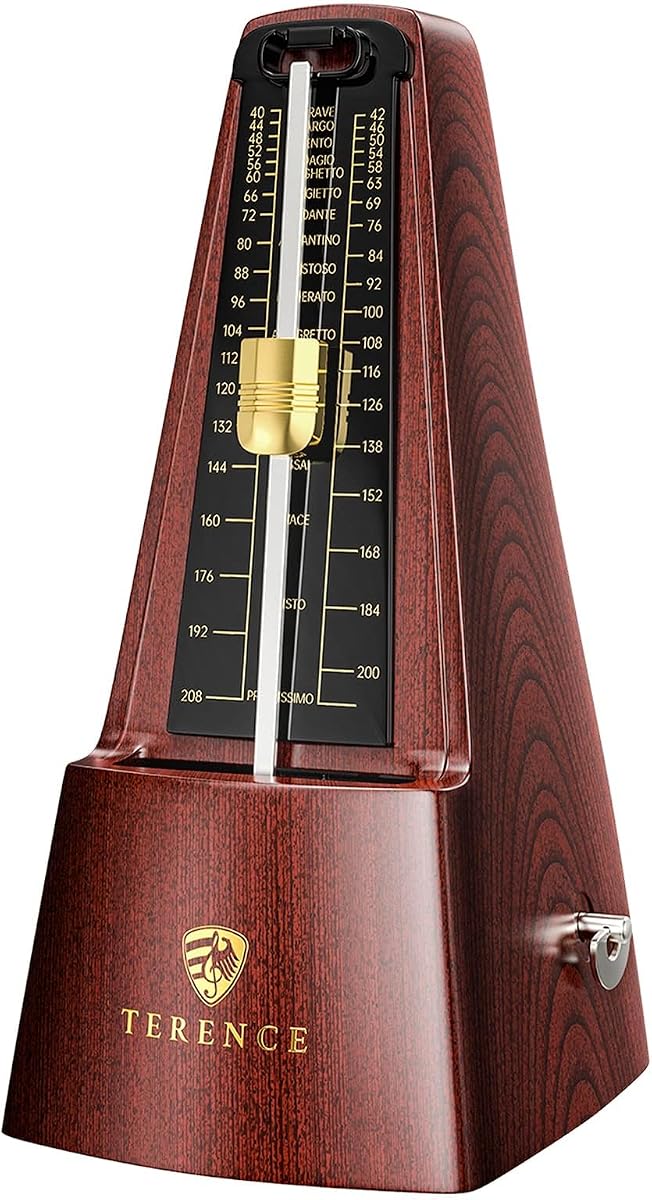
The TERENCE Transparent Metronome has a 4.0 rating and is visually distinctive because of its transparent ABS body. The supplied information also highlights an upgraded all-metal movement, a metal accent bell, and a copper pendulum. These details are intended to provide a clear sound and sturdy performance without relying on batteries.
We may earn a commission when you buy through this link, at no additional cost to you.
Its tempo scale is clearly marked and adjustable from 40 to 208 BPM. The visible scale and copper pendulum offer useful timing references for beginners, while the metal accent bell is designed to cut through practice. The product is listed for piano, violin, guitar, saxophone, other instruments, and dance training, giving it broader classroom appeal.
The 4.0 rating is lower than those of most competing products, making the detailed construction claims worth comparing carefully with customer feedback. The listing does not state a precise winding duration, and the material claims do not guarantee a specific lifespan. A potential concern for buyers is whether the transparent appearance suits a traditional home or studio better than a conventional wood-grain enclosure.
This metronome is most compelling for users who prioritize its transparent design and upgraded internal components. It can serve as a clear visual teaching aid, especially for students learning to associate a moving arm with audible beats. Buyers who value conventional appearance or published run-time details may prefer one of the more explicitly documented alternatives.
The clear casing exposes more of the mechanism than an opaque traditional model. That visual openness can make the relationship between pendulum movement and the beat easier for beginners to observe.
Metal movement, a copper pendulum, and a metal bell are positioned as durable upgrades. These materials also contribute to the model's distinctive sound and mechanical character.
We may earn a commission when you buy through this link, at no additional cost to you.
The Wittner 836 Taktell Piccolo Metronome, Black has a 4.6 rating and stands apart through its compact traditional format. Its black plastic casing gives it a recognizable classic appearance, while its small size makes it convenient to move between a piano bench, rehearsal space, and music stand. It is a focused mechanical tool rather than a feature-heavy modern design.
We may earn a commission when you buy through this link, at no additional cost to you.
The supplied product information is notably brief, listing the plastic casing, black color, and absence of a bell. It does not provide a tempo range, beat configuration, or winding duration, so those details should be verified before purchase. Those unknowns do not erase its high customer rating or appeal as a simple, established style of metronome.
The absence of a bell is the most important limitation for some pianists. Players who rely heavily on accented beats may prefer a model that explicitly includes selectable bell settings. The limited published specification also makes it harder to compare this metronome directly with the more thoroughly documented products in the roundup.
This model is best for pianists who value portability, traditional styling, and a straightforward mechanical object. It can complement a larger studio setup without visually dominating the instrument, and it may be especially appealing to users who do not need advanced accents. Checking the current specification and sound preference before buying is advisable.
The piccolo format is useful when a full-size metronome would crowd the music stand. Its compact casing also makes it easier to carry between lessons and rehearsals.
The restrained design reflects the basic purpose of a mechanical metronome. It offers a traditional visual experience without the bells, controls, or connectivity found in more elaborate digital instruments.
We may earn a commission when you buy through this link, at no additional cost to you.
The Mechanical Metronome with Loud Sound for Piano Guitar Drum Violin has a 3.8 rating, making it the least highly rated option in this comparison. Nevertheless, it provides the fundamentals needed for regular practice: a 40-208 BPM range, five beat configurations, a loud clear beat, and engraved markings that help users set the pendulum accurately.
We may earn a commission when you buy through this link, at no additional cost to you.
Its operation is uncomplicated. The user removes the dust cover, pulls out the bottom slot, adjusts the tempo slider, chooses the beat, winds the mainspring clockwise, and releases the pendulum hook. Because the device requires no batteries, it avoids charging and app compatibility concerns. It is also presented as suitable for beginners, exam candidates, professional performers, and music educators.
The 3.8 rating suggests that some customers may have found aspects of its construction or performance less satisfactory than those of higher-rated models. The exact winding duration is not specified, and the claim of lasting durability is not supported by detailed operating data in the supplied listing. Prospective buyers should therefore consider recent customer feedback carefully.
This metronome is best positioned as an affordable, uncomplicated starting point for a student or casual practice routine. Its loud sound and broad range remain meaningful advantages. A buyer prioritizing stronger customer feedback, longer documented operation, or a more distinctive enclosure may receive better reassurance from one of the higher-rated models.
The setup sequence is short and uses conventional mechanical controls. New pianists can start with a familiar click rather than learn an electronic interface or manage a device connection.
The clear, loud sound is intended to remain noticeable while the piano is playing. Engraved markings add practical value by keeping the selected tempo visible during practice.
We may earn a commission when you buy through this link, at no additional cost to you.
The right mechanical metronome should make time easy to see, hear, and maintain. Consider tempo control, bell behavior, movement construction, operating time, readability, and the kind of practice space in which it will be used.
A useful piano metronome should cover slow études, moderate movement work, and faster performance tempi without forcing repeated changes to another device. Most products in this roundup provide a 40-208 BPM range, which is broad enough for a wide range of classical and contemporary repertoire. The visual scale matters as much as the nominal range because a pianist should be able to set a marked tempo quickly and confirm the selected speed.
Choose a model with readable markings and a responsive pendulum weight. Fine control is especially valuable when increasing a passage by small increments during deliberate practice.
Beat selection determines how the downbeat and subsequent subdivisions are reinforced. Options such as 0, 2, 3, 4, and 6 cover many common meters and allow a student to practice with or without accented beats. A bell can clarify the start of each measure, while a steady click may be less distracting during detailed articulation or note-value exercises.
Look for both audible click and bell functions if you want flexibility. Models with a zero setting can provide an unaccented rhythm when that is preferable.
A metronome should remain recognizable while the piano is sounding. A loud, crisp click is useful in a busy household, while a clear bell can make the beginning of a measure easier to perceive. The pendulum adds a second visual reference, allowing the pianist to watch the arm and relate each movement to the beat. Transparent or wood-grain housings affect appearance more than function, but they influence how comfortably the device fits a room.
Prioritize sound clarity and scale readability before decorative finishes. The most useful metronome is one whose signal can be followed without repeatedly looking down or straining to read the scale.
The movement determines how consistently the beat is produced. All-metal movements are presented as durable and resistant to corrosion, while models using metal with high-hardness plastic seek a balance of stability, weight, and manufacturing practicality. Steel gears, POM gears, and copper pendulums are also highlighted in various listings. No construction is maintenance-free, but a robust mechanism can support years of regular use when handled carefully.
Read the description for specific materials rather than relying on generic durability language. A well-regarded mechanism with clear operating instructions is usually a more useful indicator than an unsupported claim of longevity.
Mechanical metronomes run on a wound spring, so operating time varies with tempo. Faster settings consume the spring more quickly, while slow tempi can run much longer. Published figures range from about 10 minutes at a fast tempo to roughly 54 minutes at a slow one on the most generously documented model in the list. Other products provide broad estimates rather than exact endpoints.
Estimate the length of a typical lesson and choose a model that can cover most of it. If uninterrupted operation matters more than simplicity, a digital metronome may deserve consideration instead.
Most models follow a similar process: release a bottom brake or stopper, remove the cover, wind the key, select the beat, adjust the pendulum, and start the movement. Beginner-friendly models make each step explicit in the product information. Clear instructions are especially helpful for children, teachers introducing rhythm exercises, and anyone returning to practice after a long break.
Look for guidance about winding gently and stopping when resistance is felt. Forcing the mechanism can damage the mainspring, so a simple operating habit protects long-term performance.
A full-size metronome has a reassuring presence and may be easier to read, while a compact model can move easily between lessons and rehearsals. The traditional Wittner option is especially compact, whereas several other products use wood-grain, walnut, or transparent housings. Appearance is secondary to accuracy, but a metronome kept permanently beside a piano should also feel appropriate in the room.
Consider shelf space, music-stand clearance, and whether a prominent traditional design complements or conflicts with your practice space. Portability should be assessed together with scale size and sound level.
Mechanical products can last for many years, but clear support terms add confidence. The Universal Black Metronome includes a one-year manufacturer warranty and 30-day returns, while the Tempi model lists a two-year warranty and a cleaning cloth. Other products emphasize customer support without providing the same formal terms in the supplied information.
Check the current listing for the exact warranty and return conditions. Keep the packaging and proof of purchase, and avoid using solvents or moisture that could damage the finish, bell, or internal gears.
Place the metronome on a level, stable surface near the piano but outside the range of the falling-board or pedal mechanism. Release the bottom brake or stopper, remove the dust cover, and wind the key gently clockwise. Stop when resistance is felt rather than forcing the spring, then select the required beat configuration.
Move the pendulum weight to the tempo marking that matches the passage. Start the pendulum by moving it to one side and releasing it, then allow it to settle into a consistent swing. For a new piece, begin below the target tempo and increase the speed gradually as accuracy improves. Use the bell to identify measure boundaries, and use an unaccented setting when the bell becomes distracting.
After practice, remove any remaining tension according to the model's instructions and handle the pendulum by its mechanism rather than the weight. Keep the casing dry, avoid dusty or damp locations, and clean the exterior with a soft, dry cloth. Wind the unit again as needed during a session, and store it where it will not be knocked from a shelf or exposed to excessive heat.
A well-adjusted mechanical metronome can provide a consistent pulse for scales, etudes, sight-reading, and performance preparation. Accuracy depends on the mechanism, calibration, surface stability, and correct tempo setting. Models that publish a controlled timing error can offer additional reassurance, but consistent use and careful adjustment remain important.
The 40-208 BPM range shared by most products in this guide covers very slow technical work through moderately fast performance tempi. Beginners may begin around 60 BPM, while advanced repertoire may require considerably faster settings. The most useful range is one that lets a pianist raise the tempo in small, controlled steps.
A bell is useful for hearing the beginning of each measure, especially during complex rhythms or sectional work. A click-only setting can reduce distraction when the student is concentrating on note values, articulation, or pedaling. Trying both settings during practice can help the student develop flexibility and a stronger internal sense of meter.
Runtime depends on the model and tempo because faster beats use the mainspring more quickly. The supplied product information includes examples ranging from about 10 minutes at a fast setting to as much as 54 minutes at a slow setting. Many shorter lessons can be completed after one winding, while extended practice may require a quick rewind.
No. These products use a wound spring and mechanical movement rather than electronic timing. That removes charging and battery replacement concerns, although the spring must be wound periodically and the movement still requires sensible handling. The absence of batteries also means there is no app connection or software update to manage.
Yes, because the basic procedure is consistent across most models. The pianist releases or removes the bottom stopper, winds the key, chooses the beat pattern, adjusts the pendulum weight, and starts the arm. Models with explicit setup instructions and visible tempo scales are particularly approachable for children and new musicians.
Place it on a level, stable surface where it can be seen and heard but cannot be touched by moving piano parts. Some pianists keep it directly on the music stand, while others prefer a nearby shelf. The surface should be firm enough to prevent the metronome from shifting as the pendulum swings.
Wind it gently and stop when resistance appears, because forcing the key can damage the mainspring. Keep the instrument dry, dust-free, and away from excessive heat. Handle the pendulum weight by its mechanism when changing tempo, and use a soft cloth rather than harsh liquid cleaners on the casing or bell.
The Tempi Metronome for Musicians is the most balanced recommendation because it combines a 4.5 rating, steel gears, a broad tempo range, bell options, and attractive styling. The Loud Sound Metronome serves as a straightforward entry point for beginners, while the Wittner 836 Taktell offers a premium, compact traditional design for pianists who prioritize portability and classic appearance.
Choose according to your practice habits rather than specifications alone. Beginners should prioritize an easy setup, a visible pendulum, and a readable scale. Experienced players may value a stable movement, durable components, and a longer estimated operating time, while those practicing in shared rooms should pay particular attention to sound clarity.
Customer ratings and specifications can change as listings evolve, and product availability and pricing should be checked on the current retail page. Review recent customer feedback, verify the desired tempo and bell functions, and confirm the included parts before making a final purchase decision.