
GE Portable HD TV Antenna
4.2Editor score
Compact travel-friendly monopole design
Magnetic base for metal surfaces
VHF and UHF reception support
Portable TV antennas for camping give travelers a convenient way to watch local broadcasts without relying on campground Wi-Fi or a satellite connection. The best model balances compact construction, dependable broadcast reception, straightforward setup, and compatibility with the television or tuner you already own.
This guide compares ten antennas and antenna-equipped portable televisions based on their supplied specifications, including reception features, frequency support, cable length, mounting options, power requirements, and intended travel use. It covers magnetic indoor models, amplified indoor antennas, round outdoor-style antennas, and complete portable TV packages.
Each review identifies the product's strongest use case and any practical limitations, while the comparison table and buying guide help separate genuinely portable designs from larger indoor alternatives. Ratings and availability can change, and product prices should be checked on the linked retailer pages before purchasing.
4.2Editor score
4.7Editor score
4.3Editor score
As an Amazon Associate we earn from qualifying purchases.
The following side-by-side comparison covers antenna-only models and portable televisions with integrated antenna packages, highlighting portability, reception design, tuner support, and the most relevant setup details.


The GE Portable HD TV Antenna combines a compact monopole form with a strong magnetic base, making it one of the most travel-conscious options in this guide. Its 4.2 rating reflects a generally practical balance of portability, broad-spectrum reception, and modern broadcast compatibility.
We may earn a commission when you buy through this link, at no additional cost to you.
The antenna stands under seven inches high and is designed to move easily between an RV, boat, vehicle, or drawer without occupying meaningful space. Its magnetic base helps it remain in place on compatible metal surfaces, while 360-degree reception and support for HDTV, VHF, and UHF channels make it suitable for conventional over-the-air broadcasts.
ATSC 3.0 compatibility makes this model forward-looking where NEXTGEN TV service is available. The included U.S.-based technical support and limited-lifetime replacement pledge add reassurance, although the short form provides less cable flexibility than several larger indoor antennas.
This is a strong choice for campers who already own a compatible television and need the smallest dedicated antenna in the group. It is particularly appealing when every inch of packing space matters and the campground is near dependable broadcast towers. For viewers farther from transmitters, a model with a longer cable and amplification may offer more placement flexibility.
Its short monopole body and magnetic footing make placement quick when arriving at a campsite. It is easy to reposition on a metal roof, cabinet, or other compatible surface as signal conditions change.
Support for VHF, UHF, and ATSC 3.0 gives this compact antenna broader relevance than a basic legacy model. Actual channel availability still depends on broadcast coverage, terrain, and nearby obstructions.
We may earn a commission when you buy through this link, at no additional cost to you.
The HIDB Indoor TV Antenna is a slim, uncomplicated indoor model aimed at smart-TV users who want access to local broadcast channels. It carries a 3.8 rating, placing it behind several higher-rated options, but its compact construction and straightforward setup remain relevant for light-duty travel use.
We may earn a commission when you buy through this link, at no additional cost to you.
Its dual PC soft material is described as flame-retardant, moisture-resistant, and protective against lightning, although the product is intended for indoor use. Omnidirectional reception eliminates the need to rotate the antenna toward a transmitter, while the lightweight body can move easily between a table, television stand, or window ledge.
The principal limitation is that this is not presented as a rugged outdoor antenna. It works best as a secondary option for campers who spend much of their time in an RV or cabin-like shelter and can place the antenna near a window. It lacks the long cable and selectable range controls offered by some competitors.
HIDB is most appropriate for budget-conscious viewers who want a discreet indoor antenna and already understand the importance of scanning after movement. It may be less suitable for exposed camps, distant broadcast towers, or setups requiring a more flexible placement distance from the television.
The low-profile body should be easier to accommodate than a large tabletop or round antenna. It is particularly suitable when the television sits in a confined sleeping or living compartment.
Because reception is omnidirectional, the main adjustment is location rather than orientation. Mounting the antenna high and near a window facing broadcast towers gives it the best chance of finding available stations.
We may earn a commission when you buy through this link, at no additional cost to you.
This antenna stands out for its selectable short-range and long-range modes, giving users a way to tune its operation to their estimated distance from broadcast towers. Its 4.1 rating reflects a practical feature set, although correct setup remains critical to achieving good results.
We may earn a commission when you buy through this link, at no additional cost to you.
The short-range mode is intended for locations within 35 miles, while the long-range mode covers distances from 35 to 250 miles. An upgraded smart IC chip filters cellular and FM interference, and the included 16.5-foot cable offers more freedom than a compact magnetic monopole.
This is more of an indoor positioning antenna than a purpose-built weather-resistant camping unit. It also supports UHF and high-VHF but may not receive low-VHF channels 2 through 6 without another compatible antenna. The amplifier is also less likely to improve reception where the underlying signal is already weak.
Campers who travel across widely varying tower distances may value the two-mode design because it provides a clear starting point for each location. The 16.5-foot cable also makes it practical to keep the antenna near a window while placing the television elsewhere in an RV or shelter.
Checking the available broadcast map and choosing the matching range mode is a useful first step. It reduces the chance of expecting long-range amplification to solve a problem that is actually caused by an unsuitable setting.
The 16.5-foot cable gives the antenna enough separation from many televisions to remain near a window. In an RV, that flexibility can be more valuable than the smallest possible footprint.
We may earn a commission when you buy through this link, at no additional cost to you.
The 2026 round antenna is designed for users who prioritize reach and cable flexibility over a minimal footprint. Its 33-foot coaxial cable is the longest among the antenna-only products listed, and its 4.2 rating places it alongside the better-rated compact options.
We may earn a commission when you buy through this link, at no additional cost to you.
The product uses a smart IC chip and describes 360-degree reception, with support claimed for HD, 1080p, 4K, and 8K HDR broadcasts. It can connect to a television's antenna input or to a digital tuner or set-top box, making it relevant to both modern smart TVs and older systems used with a converter.
Its stated range of more than 2,200 miles should be treated as a product claim rather than a guaranteed real-world distance. Broadcast reception varies by tower power, terrain, weather, and obstructions, and the supplied guidance correctly recommends checking regional signal maps and testing multiple placements.
The long cable makes this a good option for RV users who need to place an antenna near a window or exterior surface while keeping the television in a comfortable area. It is less attractive for backpackers or anyone who prizes low packing volume, so its suitability depends on how much space the travel setup can spare.
A 33-foot lead provides practical freedom to place the antenna away from the television. That is useful in vehicles where the best window position may be several feet from the screen.
The antenna's broad format and long cable improve placement options, but no indoor antenna can guarantee distant stations everywhere. Checking local coverage and rescanning after every move remains essential.
We may earn a commission when you buy through this link, at no additional cost to you.
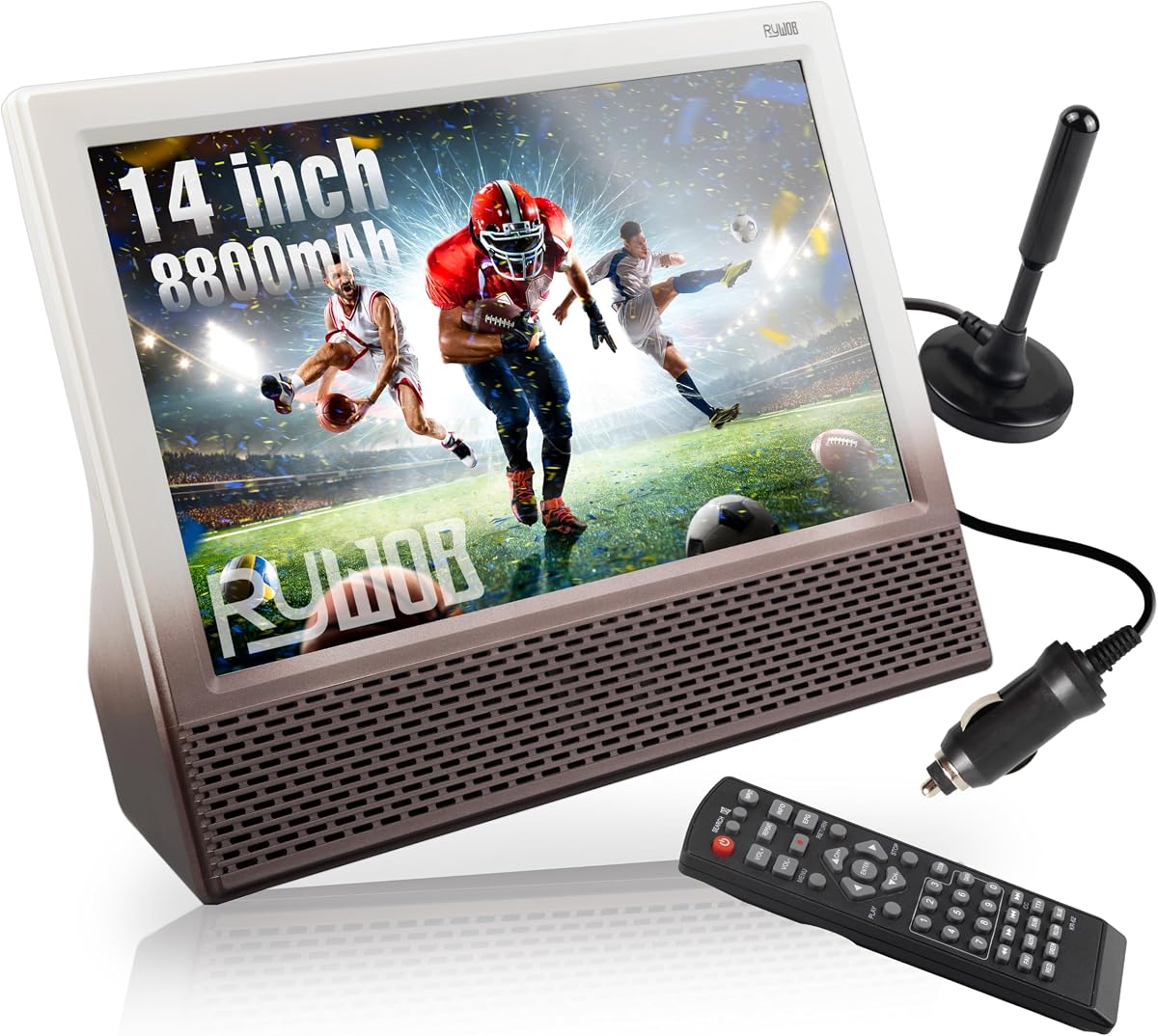
The 14-inch portable television is the highest-rated product in this guide, with a 4.7 rating. It combines a screen, built-in ATSC tuner, rechargeable battery, amplifier antenna, and flexible media connections into one package, making it the most complete solution for campers who do not already own a TV.
We may earn a commission when you buy through this link, at no additional cost to you.
Its 8800mAh rechargeable battery is stated to provide four to six hours of use, allowing broadcasts to be watched away from campsite power. Peak 20-watt speakers add stronger audio for outdoor viewing, while HDMI, USB, TF card, and AV inputs broaden its use beyond live television.
The included television and antenna system avoids the need to carry a separate tuner or connect a compact antenna to another screen. That convenience comes with a larger footprint and more weight than a dedicated antenna, while actual battery life will depend on brightness, audio volume, and use.
This is the best all-in-one choice for tent campers, road trippers, and tailgaters who value a self-contained entertainment package. The 14-inch display is a practical middle ground between a phone and a larger portable television, and the tuner opens access to available local ATSC broadcasts wherever coverage permits.
The built-in tuner, amplifier antenna, display, and battery remove several separate purchases from the packing list. That makes the system especially convenient for travelers who want television ready as soon as they arrive.
HDMI, USB, TF card, and AV inputs allow the television to serve as a media display for stored files or connected devices. The powerful speakers also make it useful for casual outdoor viewing.
We may earn a commission when you buy through this link, at no additional cost to you.
The DAANT Indoor TV Antenna is a conventional indoor model with a 16-foot cable and upgraded smart IC chip. Its 4.0 rating offers a balanced middle ground, and the design is best suited to campers who already own a digital or smart television.
We may earn a commission when you buy through this link, at no additional cost to you.
The coax cable uses a solid center conductor, dielectric insulation, three aluminum shielding layers, and a durable outer layer according to the supplied description. The antenna supports HDTV, UHD, and 1080p broadcasts, while the smart chip is intended to improve signal processing.
A clear limitation is that the antenna does not work with older analog televisions. A digital converter box or tuner is required, and even then the television must be set up correctly to scan for over-the-air channels. The product also advises trying both vertical and horizontal orientations near a window.
DAANT is a solid selection for RV and cabin users who value cable reach without moving to a large round antenna. It is less ideal for a minimalist backpacking kit, but its 16-foot lead provides enough flexibility to keep the receiver near a high window in many travel layouts.
The multi-layer shielding is intended to protect the signal during repeated connection and repositioning. This makes the model a practical indoor choice where the antenna and television may sit in separate compartments.
The product guidance recommends testing vertical and horizontal positions. This simple step can improve results in rooms whose walls, furniture, or windows interfere with a particular angle.
We may earn a commission when you buy through this link, at no additional cost to you.
The WUTAER Cylinder TV Antenna combines a modern 5.1-by-1.8-inch aluminum design with a magnetic base and 16.4-foot cable. Its 4.2 rating makes it one of the stronger-rated dedicated antennas in the group, and its clean styling suits modern RV and home interiors.
We may earn a commission when you buy through this link, at no additional cost to you.
Unlike many competing products, it uses a passive, non-amplified design intended to deliver clear reception without adding signal noise. It supports VHF and UHF broadcasts, 4K Ultra HD, 1080p, and 720p where those formats are transmitted, and works with a television's built-in tuner.
The passive approach may be attractive to viewers who want a simple unit without a powered amplifier, but it does not guarantee better results in every weak-signal area. The product is primarily described as indoor and portable rather than as a fully weather-sealed outdoor antenna.
This model works well for smart-TV owners who want a polished, compact antenna with enough cable to locate a good window position. It is also compatible with digital converter boxes for older televisions, making it a flexible option for mixed travel equipment.
The lack of an amplifier keeps the setup simple and avoids introducing powered circuitry. In areas with reasonably strong local broadcasts, that can be a cleaner way to receive channels.
The small aluminum cylinder resists looking like traditional rabbit-ear hardware. Its metal base and understated profile fit neatly on an RV shelf, desk, or cabinet.
We may earn a commission when you buy through this link, at no additional cost to you.
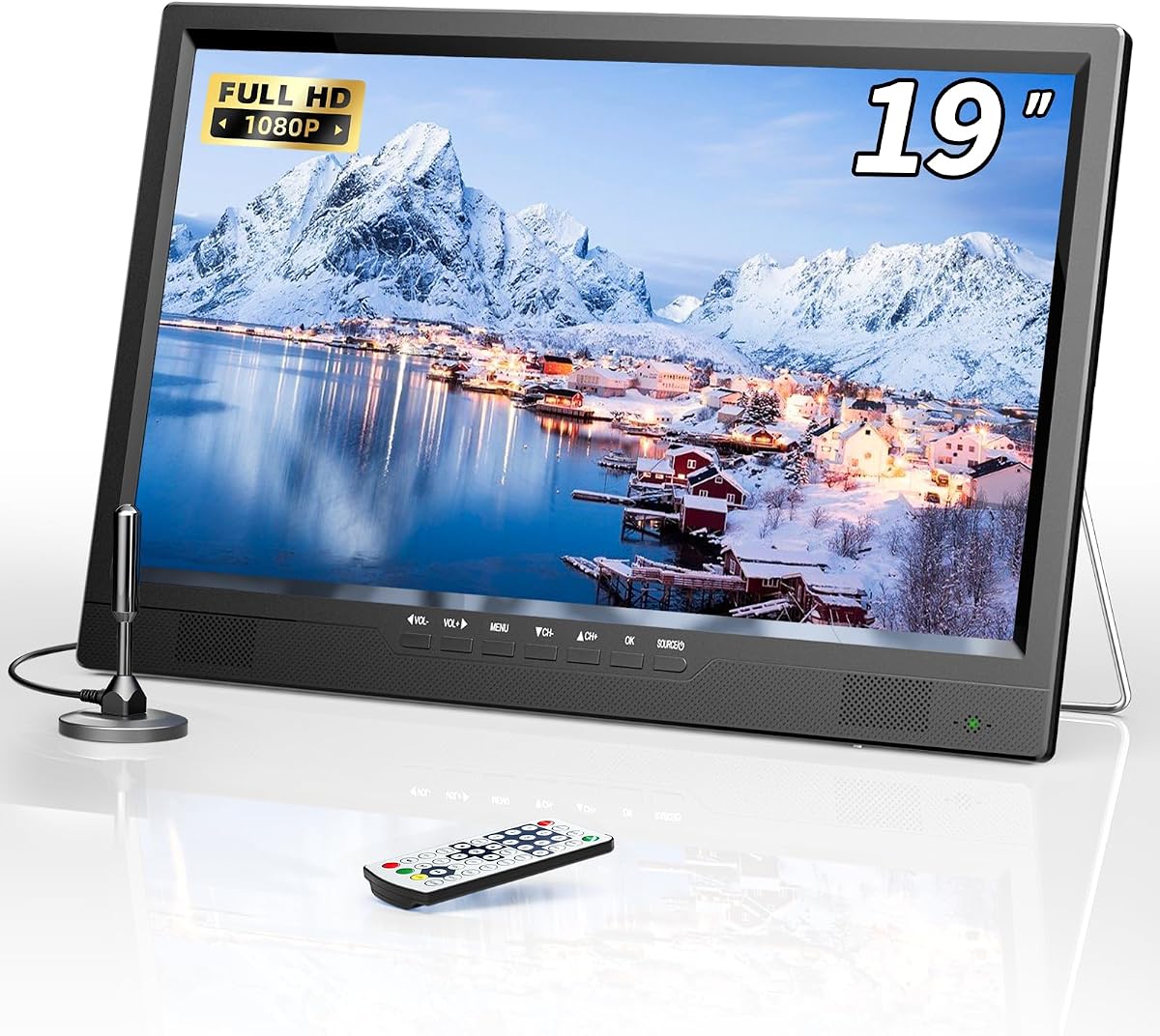
The NORTHING 19.2-inch portable television is the premium screen-focused option in this roundup. Its 4.3 rating, large LED display, and 1080P resolution make it especially attractive for campers who want a more substantial viewing experience without using a conventional home television.
We may earn a commission when you buy through this link, at no additional cost to you.
A built-in digital tuner and included antenna enable over-the-air broadcasts without a separate set-top box. The adjustable 180-degree stand provides flexibility on tables, counters, and desks, while dual speakers and a remote control make long viewing sessions more comfortable.
The television supports HDMI and AV inputs for phones, computers, TV sticks, Raspberry Pi, game consoles, and disc players. Its USB playback covers several video, music, photo, and text formats, adding value when broadcast coverage is weak or a campsite offers no internet connection.
This is the best choice for RV travelers, car campers, and outdoor spectators who can accommodate a larger screen. The trade-off is size: it is less suitable for backpacking, and the supplied data does not identify a built-in rechargeable battery, so campsite power planning remains important.
The 19.2-inch display is substantially larger than the 14-inch portable option included in the guide. It is a better fit for watching from a picnic table, RV seat, or campsite gathering.
HDMI and AV inputs support external devices, while USB playback covers common movie, music, and image files. These features extend the television's usefulness when local stations are limited.
We may earn a commission when you buy through this link, at no additional cost to you.
The 2026 Magnetic Digital Antenna emphasizes convenient, no-power operation in a small package. Its 3.8 rating is tied for the lowest score among the products, but the magnetic base, USB-free design, and 10-foot cable remain useful for campers who want easy placement.
We may earn a commission when you buy through this link, at no additional cost to you.
An upgraded smart IC chip and signal filtering are designed to process VHF and UHF signals from all directions. The product claims automatic amplification of weak signals, yet it also requires no USB power, indicating a passive design that does not draw electricity from the television.
The compact metal shell and scratch-resistant magnetic base allow placement on compatible metal surfaces such as a television stand or window frame. A 10-foot cable offers moderate flexibility, although it is shorter than the cables included with the DAANT, WUTAER, and 33-foot round antenna.
This antenna is best for travelers who value a clean, compact setup and want to avoid adding a powered accessory to their gear list. It can suit smart and older televisions, but actual channel reception depends strongly on location, terrain, and weather, and the stated 120-mile coverage should not be treated as guaranteed.
The lack of a separate power connection is valuable when campsite power is limited. It can draw from the television while leaving the travel kit without another device to recharge.
The base makes it easy to move the antenna between a window and other compatible metal surfaces. Rescanning after each move helps identify the position that receives the most channels.
We may earn a commission when you buy through this link, at no additional cost to you.
The UltraPro Portable HD Antenna closely matches the travel-oriented design of the GE model, offering a compact monopole, magnetic base, and support for modern broadcast standards. Its 4.2 rating makes it a credible choice for campers who need a dedicated antenna with minimal packing volume.
We may earn a commission when you buy through this link, at no additional cost to you.
The antenna provides 360-degree reception for HDTV, VHF, and UHF channels and is described as 4K and 8K Ultra HD-ready. ATSC 3.0 compatibility allows it to work with NEXTGEN TV service where that standard is available, although local availability remains the determining factor.
Its magnetic base helps keep it steady on most metal surfaces, and the monopole body is easy to store in an RV, boat, or vehicle. The compact design comes at the expense of cable length, so it offers less freedom to place the television away from the antenna.
UltraPro is best for minimalist campers who already own a compatible television and tuner. It is easy to deploy and equally suited to boating or tailgating, provided the unit is protected from weather and placed where local broadcast signals are strongest.
The monopole format avoids the bulk of a round dish or tabletop pedestal. It is easy to add to a vehicle, boat, or RV without dedicating a large amount of storage space.
ATSC 3.0 readiness is a meaningful advantage in areas served by NEXTGEN TV. In other areas, the antenna continues to function as a conventional over-the-air HDTV receiver.
We may earn a commission when you buy through this link, at no additional cost to you.
The best camping antenna depends on where you camp, how you travel, what television you own, and how much space or power you can devote to reception. These factors help narrow the field before you make a purchase.
Start by checking the over-the-air channel map for the areas you expect to visit. Reception depends on tower distance, terrain, elevation, weather, trees, buildings, and other obstructions, so a model that works near a major city may perform poorly in a remote valley. The distance claims in product listings are not guarantees, and the supplied specifications for several products explicitly note that actual reception varies by location.
Portability involves more than weight. Consider the antenna's dimensions, shape, base, included cable, and whether it needs separate power. Magnetic monopole models fit into glove boxes and small drawers, while round antennas with long coax cables are easier to position but occupy more room. A complete portable television package is larger still, but it can eliminate the need to carry a separate screen and tuner.
An antenna does not create a television signal; it delivers broadcasts to a tuner. Most modern smart TVs include a compatible tuner, but older analog sets generally require a digital converter box. Products advertised for smart and old televisions usually mean the antenna can work with an old television when paired with a converter. Confirm that the television has an ANT IN or CABLE-ANT IN connection before ordering.
An amplifier can help when a usable but weak broadcast signal reaches the antenna, yet it cannot create a signal that is absent. It may also amplify noise or worsen results when the input signal is already strong. Passive antennas are simpler, quieter, and require no separate power, while adjustable or amplified models can offer more options for different tower distances. Review the product guidance and start with correct placement before assuming more amplification is needed.
Camping locations can receive a mixture of VHF, UHF, high-VHF, and occasionally low-VHF stations. Most products in this guide support VHF and UHF, but one range-mode model notes that channels 2 through 6 may require an additional low-VHF antenna. For NEXTGEN locations, an ATSC 3.0-compatible model offers added relevance, though service still depends on local availability and broadcaster support.
A longer cable allows the antenna to sit near a window or higher mounting point while the television remains in a comfortable location. The 33-foot round antenna offers the greatest reach, while 16- to 16.5-foot cables cover many RV arrangements. Very compact magnetic antennas have little or no long lead and may perform best when the television is already close to the best signal zone.
A portable television with a built-in tuner, battery, and antenna is the simplest all-in-one option. It is particularly useful when no television is already available or when the campsite lacks a dependable power source. An antenna-only product is lighter, less expensive, and more flexible across different screens, but it requires a compatible television, tuner, and usually a separate way to power the display.
Many products in this roundup are designed primarily for indoor use, even though they can be taken camping. An indoor antenna generally belongs near an open window or inside a sheltered RV rather than directly in rain or strong wind. A portable TV needs a stable surface, a protected viewing area, and a clear path to its antenna. Check whether the television has a battery, what charger is included, and whether the antenna can be placed outside safely while its cable reaches the screen.
Before leaving home, check the available broadcast channels for your destination and confirm that your television has an ANT IN or CABLE-ANT IN port. Connect the antenna, place it as high as possible and near a window facing the relevant broadcast towers, and scan for channels through the television's channel-search menu.
After moving the antenna, rescan the television. Changes in location, orientation, range mode, and surrounding objects can alter the available stations, so a second scan is essential. If reception is weak, move the antenna away from metal objects, air conditioners, microwaves, thick walls, and other electronics, then test again.
Handle the antenna and portable television gently, especially when attaching magnetic bases or routing coaxial cables. Keep connectors dry, avoid sharply bending the coax, and store the unit in its case or a protected compartment. Before a trip, charge any built-in battery fully and confirm that the included power adapter and remote are packed.
Place the antenna as high as possible near an unobstructed window that faces local broadcast towers. Scan for channels after every adjustment, and test different positions rather than assuming the first placement is the only option. Trees, hills, buildings, metal surfaces, and other electronics can all reduce reception.
Yes, when a compatible television tuner is present and local broadcast stations cover the area. The antenna receives over-the-air signals and does not require a subscription or internet connection. Channel availability still depends on geography, terrain, weather, and transmitter coverage.
Usually, but the older television will need a digital tuner or converter box. The antenna connects to the converter, and the converter then connects to the television. Check the product specifications because some models explicitly do not support legacy analog televisions.
A longer cable can be useful because it allows the antenna to remain near a window or high position while the television stays elsewhere. It does not inherently create a stronger signal, however. The antenna still needs an unobstructed view of available broadcasts, and excessive cable can add clutter.
No. Amplification is most helpful when a weak but usable signal reaches the antenna, and it may not improve reception where the signal is extremely weak or already strong. Correct placement, the appropriate range mode, and a fresh channel scan are often more important than maximum amplification.
Only if the specific product is described as suitable for outdoor use, because many models are intended for indoor positioning. Even outdoor-capable models should be protected from standing water, direct impact, and strong wind. Using an indoor antenna under cover near an open window is generally the safer approach.
There is no universal number because reception varies by location and the stations available there. Check a broadcast map for the campsites you plan to visit, then compare that list with the channels found during a scan. Remote areas may offer fewer stations even when the antenna has a long advertised range.
Choose a portable television when you want a ready-to-use package and may not own a compatible screen. Choose a dedicated antenna when you already have a smart TV or digital tuner and prefer a smaller, more flexible setup. The complete system is usually easier for casual camping entertainment, while the antenna-only option is better for shared travel equipment.
The GE Portable HD TV Antenna is the strongest dedicated choice for minimalists because it combines a tiny monopole body, magnetic base, broad-spectrum reception, and ATSC 3.0 support. The 14-inch Rywob portable television is the most complete option, while the larger NORTHING model takes the premium screen-focused approach.
For everyone else, prioritize real broadcast coverage, television compatibility, and a cable length suited to the campsite layout. Place the antenna high and near a window, verify that the correct tuner is present, and be prepared to rescan and reposition it whenever the camp environment changes.
Ratings, feature details, and product prices can change over time, so check the current retailer listing and product information before buying. Also verify local channel coverage for every destination to avoid expecting a broadcast experience that is unavailable in that area.