
Portable Rehabilitation Robot Gloves
4.6Editor score
Single or multi-finger training
Mirror rehabilitation function
Compact plug-in operation
Robotic Rehabilitation Gloves are compared for training modes, adjustability, portability, mirror support, comfort, and overall suitability.
Robotic rehabilitation gloves use powered movement to guide the fingers through gripping, stretching, rotation, and other repetitive exercises. A well-designed model can support structured hand therapy at home, but comfort, control options, and appropriate exercise intensity matter more than the number of advertised modes.
We compared all ten products by examining their training patterns, finger selection, strength or speed adjustments, mirror-training support, display and controls, power systems, portability, materials, and stated compatibility with stroke or hemiplegia rehabilitation. The list also distinguishes single-glove systems from two-glove packages and highlights the trade-offs involved in each design.
Each pick below highlights a different practical strength: thorough mode selection, straightforward operation, targeted finger control, dual-hand training, or compact portability. Ratings reflect the supplied customer feedback, while detailed specifications can change. Current prices, availability, warranty terms, and seller information should always be checked before purchasing.
4.6Editor score

4.8Editor score
4.2Editor score
The following comparison shows the principal training, control, and portability features of each robotic glove. It is designed to help buyers identify the most suitable option for home use, targeted finger exercise, mirror-assisted rehabilitation, or bilateral training without overlooking important differences in operation and control.


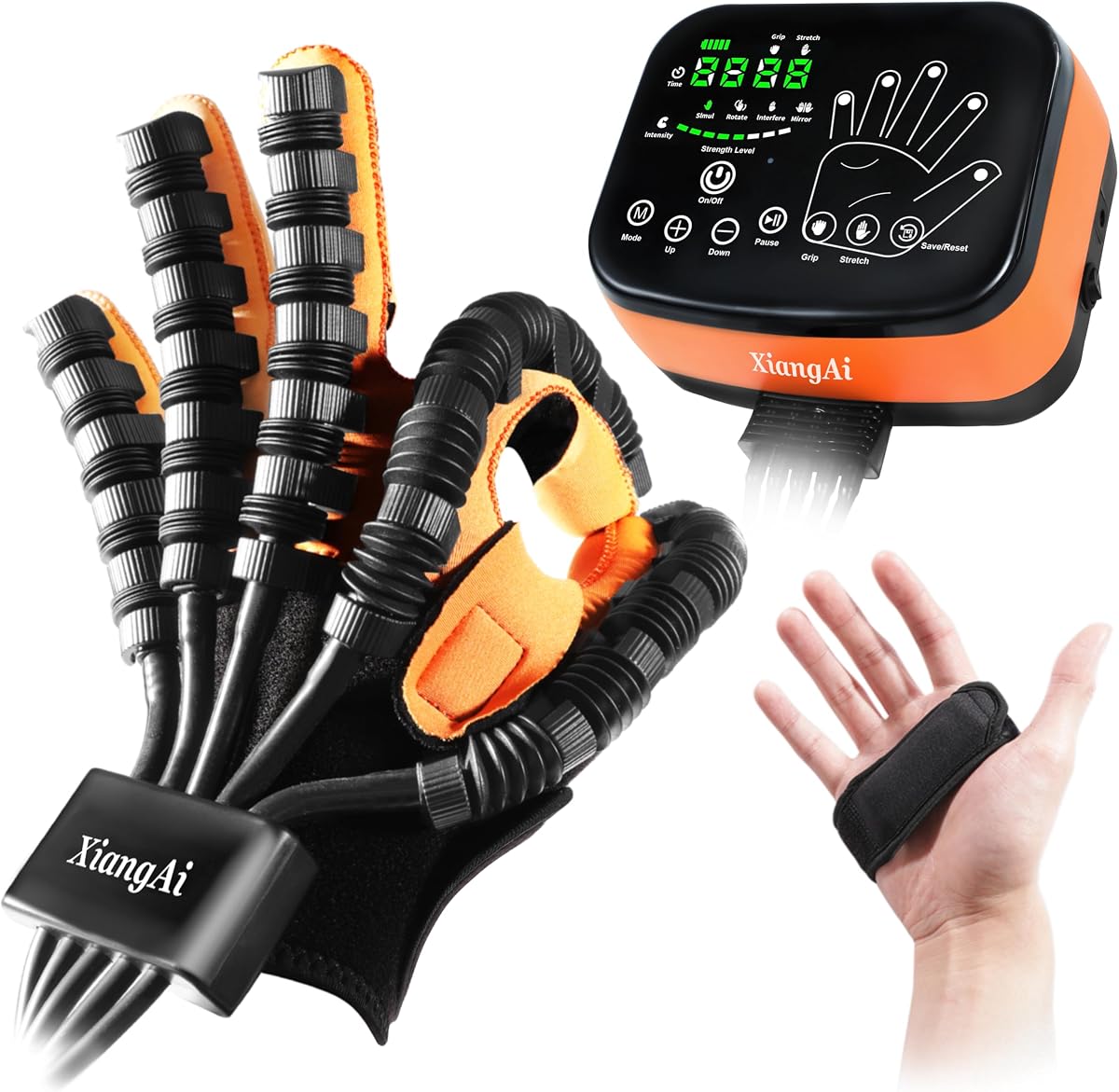
This XiangAi rehabilitation glove is designed to guide a hand through controlled gripping and stretching exercises, with a listed customer rating of 4.1. Its four modes are the main attraction: simultaneous movement, alternating rotation, thumb interference, and remote-controlled mirror gripping provide several ways to structure a home routine.
We may earn a commission when you buy through this link, at no additional cost to you.
The glove supports natural finger movement from 0 to 180 degrees and combines nine grip or stretch duration settings with eight speed settings. This range allows a user to begin with gentler motion and gradually work toward more active routines. An 11.1V, 2600mAh rechargeable battery avoids continuous tethering, while the LED touchscreen provides feedback for battery status, remaining time, and mode selection.
Comfort is addressed with a double-layer fabric construction. The inner medical-grade nylon and spandex blend is intended to reduce irritation, while the outer polyester layer adds durability and slip resistance. A wide hook-and-loop cuff and two straps help hold the glove in position. The trade-off is that users must understand the controls and choose settings carefully rather than treating the glove as an automatic therapy substitute.
This is a strong choice for stroke or hemiplegia recovery when a person wants several movement patterns in one glove and values clear status indicators. Its stated certifications, rechargeable design, and three-year warranty add confidence. Buyers should confirm hand fit, consult a qualified clinician about exercise limits, and review the manual before using the device.
Simul, Rotate, Interfere, and Mirror modes make it possible to vary the stimulation and coordination demands of a session. A user can alternate whole-hand movement with individual-finger patterns instead of relying on one repetitive cycle.
Separate duration and speed controls help users establish a more gradual routine. Starting with conservative settings and increasing only when a clinician approves is a more sensible approach than beginning with maximum intensity.
We may earn a commission when you buy through this link, at no additional cost to you.
The second XiangAi listing shares the same core rehabilitation design as the first product, including four exercise modes and independently adjustable grip duration and speed. Its 4.1 rating reflects a generally positive customer response, although the availability of closely related listings makes careful product-page comparison important.
We may earn a commission when you buy through this link, at no additional cost to you.
The glove can move the fingers from 0 to 180 degrees and includes Simul, Rotate, Interfere, and Mirror functions. The mirror mode may be particularly useful for someone practicing with the unaffected hand guiding the affected side. A rechargeable 11.1V, 2600mAh battery powers the unit, and the full-screen LED interface displays information such as battery level, remaining exercise time, and selected mode.
The double-layer glove uses a medical-grade nylon and spandex inner fabric intended to minimize irritation. Its polyester outer shell is designed for durability and grip, while the broad finger openings, hook-and-loop cuff, and two straps help prevent unwanted movement. The main limitation is that this particular listing is for a single glove, so users interested in bilateral exercise may need a separate counterpart.
This product is best for home users who want a broad range of movement settings and value an informative display. It is especially relevant to stroke, cerebral palsy, arthritis, nerve injury, or other hand-function concerns listed by the manufacturer. Because suitability depends on range of motion and muscle response, a healthcare professional should guide initial settings and frequency.
The four movement patterns let users vary coordination, repetition, and hand positioning. This makes the glove more versatile than a simple repeated open-and-close device, provided the selected sequence is appropriate for the user's condition.
Battery, time, and mode indicators help users follow the program without repeatedly guessing its status. The fingerprint-resistant screen is also practical for shared household use, although a protective case may be needed around children or pets.
We may earn a commission when you buy through this link, at no additional cost to you.
This sixth-generation robotic glove is aimed at people who want a broad exercise menu for home rehabilitation, particularly following stroke or hemiplegia. Its 4.2 rating is slightly higher than the closely related XiangAi models, and the product emphasizes improved power accessories, sequential finger movement, and easier finger selection.
We may earn a commission when you buy through this link, at no additional cost to you.
Training options include five-finger rotation, sequential finger traction, mirror practice using the supplied strap, and an anti-interference mode. Rather than relying on a rotary valve, the control panel lets the user select the desired finger directly, which can make targeted routines more intuitive. The ability to train at home or from bed is especially relevant to people with limited mobility.
The manufacturer describes an expected service life of up to five years and provides three years of quality assurance and after-sales support. An LED display, last-mode memory, and factory-reset function simplify repeated use. These are meaningful convenience features, but the generous feature set also means buyers should read the instructions carefully and avoid assuming that every mode is appropriate for every stage of recovery.
This glove is a convincing premium option for users who value multiple training styles, direct finger selection, and a dedicated home rehabilitation setup. It is less attractive for someone wanting the simplest possible appliance with only a few controls. Confirm the hand orientation, supplied accessories, warranty terms, and fit before ordering, and use it only within a professionally approved rehabilitation plan.
Sequential traction allows the program to progress through individual fingers rather than treating the hand as a single unit. That focus may be useful for coordinated routines, provided range of motion and fatigue are monitored closely.
Last-mode memory reduces the number of steps required for a recurring home routine. The included mirror hand strap also broadens training options without requiring the user to improvise a setup.
We may earn a commission when you buy through this link, at no additional cost to you.
This two-glove package is built for bilateral hand rehabilitation, providing both left and right gloves instead of a single unit. The 3.8 rating is the lowest among the listed products, so prospective buyers should inspect current reviews carefully for fit, noise, or delivery concerns, although the product itself includes a notably complete accessory set.
We may earn a commission when you buy through this link, at no additional cost to you.
The package contains two rehabilitation gloves, two hosts with 11.1V, 2600mAh rechargeable batteries, two mirror hand straps, two training balls, two portable gift boxes, two manuals, and charging accessories. Each glove supports the familiar four modes, including remote-controlled mirror gripping, with nine duration settings and eight speed levels for coordinated bilateral work.
The glove materials use an inner medical-grade nylon and spandex layer and a durable outer polyester layer. Wide finger openings, a hook-and-loop cuff, and two additional straps are intended to improve security and reduce irritation. The dual-host arrangement allows each side to be powered separately, but it also doubles the number of components that must be stored, charged, and maintained.
This package is the logical choice when the goal is synchronized left-and-right practice or when both hands need powered training. It may be unnecessary for someone using one hand as the healthy guide and needing assistance only on the affected side. The lower rating does not automatically disqualify it, but checking the current listing, included accessories, dimensions, and seller information is especially important.
Everything needed for bilateral operation is grouped together, including separate hosts and mirror straps. This avoids the need to match a second glove from a different manufacturer whose controls or fit may not correspond.
The remote mirror mode can guide one glove from the other, supporting a more symmetrical routine. A clinician can help determine whether simultaneous movement is preferable to alternating practice for the individual patient.
We may earn a commission when you buy through this link, at no additional cost to you.
This medium right-hand glove combines the highest customer rating in the group, 4.8, with a feature set aimed at accessible home rehabilitation. It is designed for stroke, hemiplegia, cerebral palsy, cerebral thrombus, cerebral infarction, cerebral hemorrhage, and other conditions that can limit hand function.
We may earn a commission when you buy through this link, at no additional cost to you.
Its four-mode system includes combined movement, rotation, sequential finger traction, and mirror-assisted training. Direct finger selection through an intuitive panel removes the need to manipulate a rotary valve, while an upgraded battery is intended to support longer sessions. The LED display provides adjustable settings, last-mode memory, and a factory-reset function, making repeated use comparatively uncomplicated.
The cotton construction and ergonomic fit prioritize a familiar textile feel. The glove can assist with natural finger movement from 0 to 180 degrees and includes independent finger operation, an anti-interference mode, and a mirror hand strap. The stated CE, FCC, and ROHS certifications and three-year warranty add reassurance, though certification claims should be verified against the current product documentation.
This is our leading all-around recommendation for someone who wants versatile training and accessible controls in a home or bedside setting. The rating is encouraging, but the right-medium configuration is a crucial limitation for buyers needing another size or hand orientation. Confirm fit and medical suitability before beginning, and progress settings gradually.
Choosing fingers directly from the control panel reduces trial and error and makes it easier to build a repeatable routine. This is especially helpful for caregivers who need to repeat the same sequence consistently.
The ability to use the device at home or while in bed supports frequent, consistent practice. Portability does not replace professional guidance, but it can make scheduled exercises more practical for people with limited travel.
We may earn a commission when you buy through this link, at no additional cost to you.
The JBMBHC Pro model is designed as a home hand and finger trainer for people recovering from stroke, arthritis, hemiplegia, cerebral palsy, dementia, cerebral infarction, cerebral hemorrhage, or nerve injury. Its 4.2 rating reflects a positive customer response, while the orange design and HD display make the product visually distinctive.
We may earn a commission when you buy through this link, at no additional cost to you.
Individual and combined finger modes allow targeted or whole-hand routines. The most notable specification is the range of 15 flexion and extension speeds combined with 15 support levels, giving users fine control over the character of each movement. Timed sessions are also included, and sequential training lets the five fingers exercise in turn during a longer program.
An upgraded air pump is stated to be three times more powerful than an earlier version, while all functions are operated from the display screen. The lightweight, soft materials are intended to improve comfort, and the product is presented as portable. Its primary drawback is the learning curve associated with numerous speed and support levels, especially for older adults or caregivers with limited technical experience.
This glove is a good fit for users who want granular control and do not mind spending time learning the interface. It is particularly compelling when progression through many intensity levels matters. Confirm that the right-medium fit is appropriate, have a therapist establish safe ranges, and avoid interpreting the largest settings as automatically providing the most effective rehabilitation.
Fifteen speed and support levels allow a routine to be adjusted in small increments. This granularity can help users and clinicians respond to fatigue, stiffness, or changes in muscle response during a session.
Users can alternate among individual, combined, and sequential finger patterns. That variety supports different goals without requiring separate equipment for every type of exercise.
We may earn a commission when you buy through this link, at no additional cost to you.
This compact rehabilitation glove is designed for customizable finger training with a listed rating of 4.6. Its central feature is straightforward operation: a valve controls whether the glove performs single-finger or multi-finger movement, helping users focus on designated fingers during a rehabilitation session.
We may earn a commission when you buy through this link, at no additional cost to you.
The mirror training function simulates movement guided by a healthy hand, with the stated aim of supporting coordination and neural retraining. Product information recommends a daily routine of approximately 15 to 20 minutes, although individual schedules should be approved by a therapist. The glove is also listed for stroke, hemiplegia, arthritis, and cerebral palsy needs.
Unlike many cordless competitors, this model uses a plug-in power design. That keeps operation stable and removes battery-management concerns, but the unit is less convenient for travel than a compact rechargeable model. The manufacturer also states that the upgraded system provides three times the operating power, making the stationary design less limiting than the size alone might suggest.
This is a compelling choice for someone who prioritizes focused finger work, mirror practice, and straightforward controls over an extensive menu of display settings. It is especially practical for a home setup where the glove will remain connected to power. Users should verify size and hand orientation, read the valve instructions, and avoid extending the suggested session without professional approval.
Single-finger selection is useful when a therapist wants to isolate a particular digit or compare movement between fingers. The simple valve-based selection also makes the system understandable without navigating a complex menu.
A plug-in supply can provide consistent operation during longer sessions. The trade-off is reduced portability, so the glove is best positioned near a comfortable, stable training area.
We may earn a commission when you buy through this link, at no additional cost to you.
This four-mode rehabilitation glove offers a clear combination of cordless convenience, mechanical drive, and adjustable exercise intensity. Its 4.4 rating places it among the stronger customer-rated products in the list, while the stated gear drive is intended to provide stronger traction and automatic switching between fingers.
We may earn a commission when you buy through this link, at no additional cost to you.
The available patterns are grasp, finger extension, single finger, and full hand. Nine adjustable force and speed levels give the user room to progress, while mirror training allows one hand to guide the other. The rechargeable 2600mAh battery removes the need to remain near a wall outlet, making this a practical option for a portable home routine.
The one-touch design uses clearly labeled onboard buttons rather than a touch display, which can be easier for elderly users or anyone who prefers tactile controls. The cordless layout also simplifies storage and transport. The main limitation is that its adjustment range is less granular than the model offering 15 speed and 15 support levels, and the listed traction specification is difficult to interpret without additional context.
This glove is a strong choice for people who want uncomplicated operation, flexible location, and several standard movement patterns. It is particularly suitable for a caregiver-assisted routine where reliability and clear labels matter more than extensive menus. Confirm the supplied charging connection, hand fit, and any applicable warranty, and have a clinician establish the appropriate force level before use.
Clearly labeled physical buttons make core functions accessible without navigating nested menus. This can reduce setup time and help the device remain practical for daily use by older adults.
The rechargeable battery allows the glove to move from a bedroom table to a living room without an external power unit. That flexibility is useful when a seated or bed-based routine is part of the rehabilitation plan.
We may earn a commission when you buy through this link, at no additional cost to you.
The C10 uses pneumatic power to flex and extend the fingers, offering a different mechanism from the gear-driven and air-pump models in the group. Its 3.9 rating is modest compared with several competitors, but the product's targeted controls and mirror sensor make it worth close consideration for users who need specific finger selection.
We may earn a commission when you buy through this link, at no additional cost to you.
A sensor on the back of the glove is designed to detect movement from the unaffected hand and drive the affected hand in mirror training. Independent air valves allow each finger to be isolated. A valve is closed when turned 90 degrees to the horizontal and opened when vertical, giving the user direct mechanical control over the selected digit.
The system provides nine intensity levels and intelligent adjustment of flexion and extension timing, allowing clenching and opening periods to reflect different muscle tension. Its upgraded pneumatic adjustment and closer-fitting fingers are intended to produce soft, controlled movement. The product is also rechargeable, portable, and listed for stroke, trauma, brain injury, cerebral palsy, orthopedic surgery, and other rehabilitation needs.
This glove is best for someone who values sensitive mirror input and precise independent-finger work. The 3.9 rating suggests buyers should examine recent customer feedback for comments about fit, air noise, and valve usability. Because pneumatic movement can feel distinctly different from motorized systems, an initial supervised session and gradual intensity progression are sensible precautions.
The movement sensor is intended to capture signals from the unaffected hand and reproduce them in mirror mode. This can create a more intuitive connection between voluntary motion and the affected hand's assisted movement.
Separate valves allow individual fingers to be opened or closed for the exercise cycle. Although the required valve position takes practice, it provides clear physical control without navigating a display.
We may earn a commission when you buy through this link, at no additional cost to you.
This compact rehabilitation glove offers a relatively simple approach to assisted hand exercise. Its 4.3 rating indicates a solid customer response, and its three training modes cover the core needs of a user who primarily wants repeatable grasping, stretching, and finger-selection exercises.
We may earn a commission when you buy through this link, at no additional cost to you.
An intuitive control screen and tactile adjustment buttons allow one-touch activation, which is useful for older adults or anyone operating the device with limited dexterity. Independent air valves let the user close the air inlet for particular fingers, enabling targeted practice. Movement strength can also be adjusted to accommodate different levels of stiffness or available movement.
The ergonomic design is described as light and comfortable, and the glove can imitate natural grasping and stretching actions. Its small size makes it easy to store and carry, while a built-in chip is intended to provide gentle movement. The trade-off is that only three modes are listed, and the product description offers less detail about session timing and adjustment depth than many competing models.
This glove is a practical choice for buyers seeking a straightforward, portable device without a complicated training menu. It may suit a user who needs targeted exercises rather than extensive program variety. Confirm the sizing, included components, charging method, and adjustment range before ordering, and use the device only within the exercise guidance provided by a qualified clinician.
The combination of an intuitive screen and tactile buttons makes the device approachable for older adults and caregivers. One-touch activation can also reduce the interruption between exercises during a scheduled routine.
Independent valves and a compact form make the glove convenient for focused work on selected fingers. Its portability allows a routine to move between rooms, although the compact controls should be checked for visible damage before each use.
We may earn a commission when you buy through this link, at no additional cost to you.
A useful robotic rehabilitation glove should provide safe, repeatable movement while fitting the user's hand, treatment goals, and ability to manage the controls. Comparing exercise mechanisms, adjustability, comfort, and clinician guidance is more meaningful than simply choosing the model with the largest number of features.
Fit is the first practical consideration because a glove that is too loose may not guide the fingers accurately, while a crowded glove can create pressure around the knuckles, fingertips, or wrist. Check the stated hand orientation, size, finger-sleeve length, cuff range, and strap arrangement. A product listing for one hand and size may not accommodate the opposite hand, and children or smaller hands may require a different model. The glove should hold the hand in a comfortable neutral position without forcing fingers beyond a clinician-approved range. If possible, compare the size guidance with the dimensions of the affected hand and note any swelling, contractures, deformities, or skin fragility that may affect selection.
In short, prioritize a correct hand, correct size, and comfortable fit before considering advanced training options.
The most common movements are grasp, extension, full-hand exercise, and isolated finger flexion, but products differ in how they sequence those actions. Rotation, interference, sequential traction, and mirror modes can add coordination demands and may be valuable when the treatment plan calls for them. Buyers should determine whether they need simple repetitive opening and closing or a broader program. More modes are not automatically better, particularly if the controls are difficult to understand. Look for clear labeling, saved settings, and a short explanation of each pattern in the manual. Any mode that produces pulling, pressure, or rapid movement should be introduced conservatively and confirmed with a therapist.
In short, choose modes that match the prescribed exercise rather than paying extra attention to the largest advertised count.
Strength, speed, duration, and support controls determine how finely a user can modify a session. Some models provide nine levels, while others advertise 15 speed and 15 support settings. More levels can be useful for gradual progression, but they may also make the controls harder to manage. Consider the range of motion, fatigue, spasticity, and ability to respond that the user currently has. Grip and stretch timing should be adjustable independently when the goal is to avoid holding a contracted position too long. Confirm whether changing force also changes speed, and whether the system remembers a setting between sessions. Professional guidance is especially important when strength adjustment is involved.
In short, look for incremental control that is understandable, repeatable, and appropriate to the user's current capacity.
Motorized, gear-driven, pneumatic, and air-pump systems can feel different and may vary in noise, consistency, portability, and maintenance. Cordless rechargeable models offer flexibility for home use, while plug-in designs may run consistently near a fixed training area. Pneumatic systems can provide soft assisted movement but may depend on valves and air routing. Gear-driven products may deliver strong traction but can also create a more forceful sensation. Read descriptions of the movement, not merely the wattage or operating-power claim. A mechanism that allows gradual assistance and comfortable fingertip contact is generally more appropriate than one that feels abrupt or difficult to modulate.
In short, prioritize smooth, comfortable, adjustable movement over raw power specifications that are difficult to compare.
Controls should be usable by the person exercising or by a caregiver without a steep learning curve. A large LED display can show remaining time, battery level, selected mode, and other status information clearly. Physical buttons may be preferable for older adults or users with limited touchscreen dexterity, while direct panel selection can simplify targeted finger routines. Consider whether text and symbols are large enough, whether the screen is angled correctly, and whether important controls can be reached without excessive bending. The best interface is one that supports a consistent routine and reduces the risk of choosing the wrong mode during a session.
In short, select an interface that the actual user or caregiver can operate confidently and repeat without guesswork.
Mirror training allows movement of the unaffected hand to guide the affected hand, which can be useful in neurological rehabilitation. Some products include a mirror strap, while others require the second glove to act as the controller or include two complete hosts in a bilateral package. Check whether simultaneous use is genuinely supported and how the devices communicate. Users should not improvise connections between products unless the manufacturer explicitly approves them. For someone with only one affected hand, a single glove with a strap may be sufficient; for symmetrical or bilateral training, a matched two-glove set may reduce uncertainty.
In short, buy a matched system when both hands require powered training, but do not pay for unnecessary duplication.
Comfort influences whether a recommended routine can actually be completed consistently. Look for soft inner layers, wide finger openings, secure cuffs, flexible fabric, and smooth edges around the hand. The product should not pinch, restrict circulation, or create excessive heat. Some listings mention certifications, while others provide fewer formal details, so buyers should look for relevant documentation rather than relying only on marketing language. Inspect the glove and mechanism before every session, and stop if there is pain, skin damage, unexpected force, or a sudden change in sensation. Robotic assistance complements rather than replaces a qualified rehabilitation plan.
In short, favor gentle materials and secure construction, and never use a glove that causes pain or visible skin irritation.
A complete package may include separate hosts, mirror straps, training balls, manuals, gift cases, and charging cables. Accessories can improve convenience, but the presence of more items does not automatically make the core glove better. Check that the charging method is clearly identified and that replacement parts or customer support are available. Warranty length, certification documentation, and clear instructions are useful signals of product support. Because listings may change, verify the current package contents and stated service terms on the product page. Sellers should also be checked for fulfillment clarity, return eligibility, and accurate product descriptions before ordering.
In short, verify the box contents, charging system, warranty, and support information rather than assuming accessories are included.
Begin by consulting a qualified clinician or occupational therapist about whether robotic glove exercise is appropriate and which movements, duration, and intensity are safe. Inspect the glove, fasteners, tubing or power connection, and charging indicators. Fit the correct glove to the intended hand, secure the cuff evenly, and ensure that fingers are not pulled beyond a comfortable, approved range. Start with the lowest or gentlest available setting and learn the selected mode before beginning a timed session.
Follow the manufacturer's instructions for power-up, mode selection, exercise timing, and shutdown. Use the mirror function only when the intended hand relationships are clearly understood, and never improvise connections between separate robotic gloves. Stop the session if pain, dizziness, unusual fatigue, skin irritation, numbness, or uncontrolled force occurs. Record the mode, adjustment level, and session length so a therapist can assess tolerance and recommend gradual progression.
After use, switch off the glove and disconnect power as directed. Wipe the fabric and reusable surfaces with a lightly damp cloth, avoiding harsh chemicals and immersing the mechanism. Allow the glove and any air components to dry fully before storage. Inspect seams, finger sleeves, valves, cables, and battery compartments for wear, and keep the device away from moisture, extreme heat, and children. Charge according to the supplied instructions and use only the specified power supply and accessories.
These gloves are designed to provide repetitive, assisted finger movement for people recovering from stroke and related hand-function limitations. However, the device should be used only as part of an appropriate rehabilitation plan because outcomes depend on the individual, severity, and stage of recovery. A therapist can determine whether assisted movement is suitable and which settings are appropriate.
Most of the products in this guide offer some form of isolated finger training in addition to whole-hand movement. Some use direct panel selection, some use independent air valves, and others use a physical selector. The distinction is important because a multi-finger mode alone cannot replace targeted work when a therapist recommends isolation of a particular digit.
Mirror training uses movement from the unaffected hand to guide movement in the affected hand. Some gloves detect this motion with a sensor, while others use a strap or remote-controlled mirror mode. It may help users connect intentional movement with assisted repetition, although a clinician should determine whether it suits the patient's particular rehabilitation goals.
Comfort varies by hand shape, glove size, materials, fit, and session duration. Products with soft inner layers, wide finger sleeves, adjustable cuffs, and secure straps may be more comfortable, but no glove should cause pain, numbness, skin damage, or uncontrolled pulling. Users should begin with short, gentle sessions and work toward longer routines only as tolerated and approved.
A cordless rechargeable glove offers more freedom over where exercises take place and may be easier for bed-based routines. A plug-in model can provide stable continuous power near a fixed table and avoids battery charging. The better choice depends on the user's mobility, available space, session length, and comfort with managing the power system.
Several listed products are marketed for arthritis, nerve injury, cerebral palsy, dementia, and other conditions affecting hand movement. These claims do not mean every device or intensity is appropriate for every condition. Medical guidance is important because joint irritation, sensory loss, weak muscles, and involuntary movement can change how a glove should be used.
Frequency depends on the condition, stage of rehabilitation, medical advice, and the user's response to exercise. Some product guidance suggests a daily session of roughly 15 to 20 minutes, but that is not a universal prescription. A therapist should set the schedule, and the user should stop if the device causes discomfort or excessive fatigue.
One glove is sufficient when only the affected hand requires assisted movement and the other hand is used for mirror guidance. Two matched gloves may be preferable for bilateral practice or for users who want powered exercise on both hands. The dual-hand package also includes separate hosts and accessories, making operation more straightforward than combining unrelated models.
The XiangAi Home Rehabilitation Glove stands out as the strongest all-around choice because of its 4.8 rating, direct finger selection, four-mode program, and suitability for home or bedside use. The Portable Rehabilitation Robot Gloves offer a focused, compact alternative with strong customer feedback and plug-in operation, while the Sixth Generation model is the most feature-rich premium selection with sequential traction, rotation, and direct finger selection.
When choosing among the remaining options, focus on the needs that cannot be changed later: correct hand and size, comfortable construction, appropriate movement intensity, and an interface the user can operate consistently. Single-finger training is valuable for targeted work, dual-hand packages suit bilateral routines, and mirror modes may help users coordinate movement with a healthy hand. Medical advice remains central because even a well-designed glove can move fingers too strongly or in an inappropriate pattern.
Before ordering, compare the current product page, package contents, hand orientation, charging method, warranty, certifications, and customer feedback. Specifications, seller information, and current prices can change, and related glove listings may look nearly identical. Taking time to verify those details will help ensure that the chosen robotic rehabilitation glove fits both the treatment plan and the user's daily routine.