
Interstate Marine 12V 100Ah AGM
4.1Editor score
Pure lead AGM construction
Dual-purpose marine performance
Deep-cycle trolling motor support
Thick-plate durability
Our Battery for Trolling Motor guide compares 10 marine and deep-cycle options for capacity, monitoring, protection, portability, and trolling-motor fit in
A trolling motor battery must deliver dependable deep-cycle power while handling vibration, moisture, changing temperatures, and the sustained draw of a motor running at low speed. Capacity alone does not determine performance; battery chemistry, internal protection, usable power, monitoring features, and installation requirements all influence which model fits a particular boat best.
This guide compares ten batteries and marine power systems using the supplied specifications, customer ratings, battery capacities, protection features, connectivity options, and stated trolling-motor applications. It includes LiFePO4 deep-cycle batteries, sealed AGM marine batteries, multipack options, and battery boxes that organize and distribute power without including a battery.
Each review highlights the product's most useful strengths, practical limitations, and ideal buyer. The top picks distinguish an affordable conventional marine battery, a feature-rich lithium option, and a higher-capacity lithium system. Product availability, promotions, and prices can change, so readers should confirm current specifications and costs before purchasing.
A trolling motor places steady electrical demand on a battery for long stretches rather than relying mainly on short bursts for engine starting. That makes usable deep-cycle capacity, voltage stability, and dependable current delivery more important than cranking power alone.
The products in this guide were compared according to their published battery type, capacity, power-management features, environmental protections, connectivity, expansion options, and stated marine applications. The list covers complete batteries as well as power-center boxes that require a separate battery.
The featured products show how priorities differ across the category. Some emphasize intelligent monitoring, others focus on proven sealed AGM construction, and several target large-capacity or expandable systems. Readers should match battery output to motor demand, available space, charging equipment, and onboard electronics rather than choosing only by capacity.
4.1Editor score

4.2Editor score

4.4Editor score
This side-by-side comparison covers complete LiFePO4 and AGM batteries along with battery-box power centers, helping readers distinguish energy capacity, connectivity, protected connections, and whether a separate battery is required.




This 12V 100Ah LiFePO4 marine battery earns its place as the strongest all-around recommendation in the guide, combining a 1280Wh deep-cycle design with Bluetooth 5.0 monitoring and a built-in 100A battery management system. Its 4.2 rating reflects a capable package, particularly for anglers who want visibility into voltage, current, temperature, and battery level.
We may earn a commission when you buy through this link, at no additional cost to you.
The battery is explicitly designed to support trolling motors, fish finders, livewells, and other fishing electronics. Its 12.8V 100Ah configuration offers a more practical foundation for extended low-speed motor use than a conventional starter-focused battery, while the listed LiFePO4 chemistry provides a lighter and more compact alternative to similarly rated AGM alternatives.
The integrated management system protects against overcharging, over-discharge, short circuits, excessive current, and overheating. A discharge cut-off below -20°C adds cold-weather protection, and the advertised 4,000-plus deep-cycle rating supports long-term ownership. Expansion through 4P4S configurations also allows the battery to participate in much larger systems.
The main trade-off is physical scale. A battery with this much capacity will not suit every small kayak or skiff, and users should verify compartment dimensions, terminal clearance, and the weight implications of their chosen installation. Even so, anglers needing strong deep-cycle performance, remote monitoring, and expansion flexibility will find this model particularly compelling.
Bluetooth 5.0 connectivity provides real-time access to battery level, voltage, current, and temperature through a smartphone. This visibility makes it easier to identify abnormal conditions before a depleted or overheated battery leaves a boat stranded.
The 100A BMS combines several safeguards with low-temperature discharge protection. These controls are particularly relevant when the battery powers a motor for many hours while also supplying fish finders, livewells, and navigation electronics.
We may earn a commission when you buy through this link, at no additional cost to you.
The GOKWH 12V 100Ah Group 24 LiFePO4 combines a familiar case format with smartphone monitoring and extensive internal protection. Its 4.1 rating makes it a credible all-purpose option for trolling-motor systems, RVs, and off-grid installations where a standard physical footprint and manageable capacity are priorities.
We may earn a commission when you buy through this link, at no additional cost to you.
The Bluetooth 5.0 system displays state of charge, voltage, and temperature while supporting remote charge and discharge controls and fault alerts. A 12V 100Ah Group 24 configuration also makes this battery easier to compare with many existing lead-acid installations, although terminal position and case measurements should still be verified before ordering.
The listed BMS provides more than 20 safeguards, along with low-temperature controls that stop charging below 0°F and discharging below -4°F. The ABS casing is described as resistant to splashes, dust, and corrosion, while 4S4P configuration support permits expansion to larger 48V systems when the charger and installation are designed for them.
This package includes one battery, two M8 terminal bolts, manual access through a QR code, and professional support. It may not satisfy buyers seeking a matched two-battery set without buying another unit, but it is a well-equipped option for a single-battery installation or as the basis for a future expandable system.
A Group 24 format gives installers a broadly recognizable size to work with while the lithium chemistry keeps weight down. This combination suits boats and RVs where replacing a conventional battery without redesigning the entire compartment is useful.
Separate low-temperature limits for charging and discharging help protect the battery in cold conditions. The distinction allows an owner to understand when charging is blocked rather than assuming every cold-weather malfunction indicates a failed battery.
We may earn a commission when you buy through this link, at no additional cost to you.
The Interstate 12V 100Ah AGM is a practical choice for boaters who want a conventional sealed marine battery without paying for lithium electronics or app connectivity. Its 4.1 rating and dual-purpose design make it especially relevant when the same battery must support a trolling motor, electronics, and occasional engine starting.
We may earn a commission when you buy through this link, at no additional cost to you.
This Group 31 battery is rated at 925 CCA and 1110 CA, while its deep-cycle construction uses thick plates designed to withstand repeated discharge and recharge cycles. The product information specifically lists trolling motors, depth finders, fish locators, audio systems, windlasses, and appliances among compatible loads.
Interstate describes the AGM construction as a two-in-one pure-lead design that delivers high-cranking and deep-cycle performance. Its expected service life is listed at three times that of conventional flooded batteries and twice that of an alloyed lead AGM battery, although actual longevity depends on charging, temperature, load, and maintenance practices.
The primary disadvantage is weight and the absence of real-time monitoring. This battery makes more sense for buyers comfortable with traditional lead-acid handling and seeking straightforward marine utility than for anglers who want the lowest weight and detailed phone-based diagnostics. For those priorities, it remains a sensible budget-oriented starting point.
The dual-purpose format gives users a way to power accessories and start an engine with one battery group. That versatility can simplify installations on smaller boats that lack room for separate starting and deep-cycle banks.
The sealed AGM format avoids the routine electrolyte servicing required by conventional flooded batteries. Its thick-plate design is intended to tolerate repeated cycling while serving as the boat's dependable power source.
We may earn a commission when you buy through this link, at no additional cost to you.
This 320Ah LiFePO4 model is the premium choice for anglers who prioritize runtime above compactness. It carries the highest rating among the complete batteries in the list at 4.4 and pairs substantial capacity with app-based monitoring, a smart BMS, and an enclosure designed for outdoor or marine use.
We may earn a commission when you buy through this link, at no additional cost to you.
The smartphone interface reports voltage, capacity, temperature, and cycle information, allowing users to monitor conditions and identify abnormal behavior. Its listed trolling-motor application covers common 30–55-pound motors, and the battery is positioned as a source of stable voltage and sustained output under continuous operation.
A reinforced casing offers resistance to light moisture and environmental exposure, while the BMS protects against overcharging, over-discharge, overheating, and short circuits. The 4P4S arrangement allows the unit to scale into larger 24V or 48V systems for solar, off-grid, or home-backup configurations.
Large capacity naturally creates installation challenges. Boats must have sufficient room, appropriate structural support, secure terminals, and a charger designed for lithium chemistry. Buyers who need multi-day power, operate demanding electronics, or want to build a scalable system will find this model worth the additional size and installation planning.
The 320Ah capacity is intended to sustain trolling-motor and onboard-electronics loads for longer periods. It gives high-capacity anglers more energy headroom without requiring several batteries to be coordinated immediately.
Support for 4P4S expansion means the battery can become part of a larger solar or off-grid installation. That flexibility is useful for owners whose energy requirements are likely to expand beyond a single fishing trip.
We may earn a commission when you buy through this link, at no additional cost to you.
The 12V 320Ah Bluetooth LiFePO4 is a high-capacity battery aimed at owners who want one dependable energy platform for an RV, boat, solar installation, or backup system. Its 4.1 rating reflects a broad feature set, including 4096Wh of energy, app monitoring, and support for more than 8,000 deep cycles.
We may earn a commission when you buy through this link, at no additional cost to you.
The smartphone connection displays voltage, current, capacity, temperature, and cycle count. A 200A BMS provides protection against overcharge, over-discharge, short circuits, and overheating, while the listed low-temperature protection is intended for cold mornings and harsh off-grid conditions.
Charging options include a 12V 20A LiFePO4 charger, a 600W solar panel, or a 20A DC generator, with approximate recharge times included in the product information. Four-series and four-parallel expansion is supported, allowing the battery to scale to a 48V 1280Ah configuration for larger inverters and demanding loads.
This is a system-level battery rather than a simple drop-in purchase. Its size, charging requirements, inverter compatibility, and installation planning should be considered carefully. It is best suited to buyers who need major stored-energy capacity and may use the same battery for trolling motors, RV appliances, and off-grid power.
Support for a dedicated charger, solar panel, or DC generator gives owners several ways to replenish the battery. This flexibility is useful for boaters and RVers who already have different charging sources available.
With 4P4S expansion and a claimed capacity for 3000W inverter use, the battery can serve as the foundation of a larger energy system. Appropriate equipment and careful configuration remain essential when moving beyond a simple 12V installation.
We may earn a commission when you buy through this link, at no additional cost to you.
This GOKWH two-pack offers a matched pair of 12V 100Ah Group 24 LiFePO4 batteries, which can simplify the task of building a balanced bank for a trolling motor. Its 3.0 rating is the lowest in the group and deserves attention, although the listed functions remain well suited to marine and off-grid use.
We may earn a commission when you buy through this link, at no additional cost to you.
Each battery uses Bluetooth 5.0 and an app for state-of-charge, voltage, and temperature monitoring, along with remote charge and discharge controls and fault alerts. More than 20 intelligent BMS safeguards and low-temperature charging and discharging cut-offs provide the core protections expected from a modern lithium installation.
The two units support 4S4P expansion when incorporated into a larger configured system. Their ABS housings are described as resistant to splashes, dust, and corrosion, and the package includes two batteries, four M8 terminal bolts, manual access by code, and professional customer support.
Buyers should investigate the comparatively low rating and recent customer feedback before committing, particularly if they depend on app functionality. For someone wanting two matched batteries without sourcing them separately, the package is convenient; for anyone especially sensitive to weight, carrying two large lithium units is a meaningful consideration.
Buying two units together can simplify initial installation and provide a more uniform starting point for a trolling-motor bank. Buyers still need to select the correct series or parallel configuration for their charger and motor system.
Low-temperature limits, overload safeguards, and Bluetooth fault alerts work together to protect and monitor the installation. These features are useful in offshore or early-season conditions where unattended power demands are common.
We may earn a commission when you buy through this link, at no additional cost to you.
The SUNAPEX Smart Battery Box PRO is not a battery but a comprehensive marine power center for organizing a separate Group 24, 27, or 31 battery. Its 4.6 rating makes it one of the strongest choices for anglers who want protected high-current connections, convenient charging ports, and visible voltage information in one enclosure.
We may earn a commission when you buy through this link, at no additional cost to you.
Its connection set includes two 30A Anderson plugs, high-current terminals, a 12V accessory socket, a QC3.0 USB port, and a USB-C PD port. The Anderson plugs each have a 30A fuse, with a combined maximum of 50A, making the box suitable for trolling-motor charging and other substantial 12V or 24V equipment.
A 16A overload switch protects the 12V, QC3.0, and USB-C ports by cutting off excessive draw. A digital voltmeter displays real-time battery status, and the enclosure is built from sturdy, slightly flexible plastic designed to resist breaking or shattering.
The battery must be purchased separately, and the high-current capacity should be treated as a system limit rather than an invitation to connect unsupported loads. For a portable, organized power station on a fishing boat, kayak, or small craft, however, the combination of connections and monitoring is exceptionally useful.
The two fused Anderson-style plugs make it easier to organize charging and powering connections without crowding the main terminals. They are especially relevant to trolling-motor cable systems that require dependable, clearly protected connections.
USB-C PD, QC3.0, a 12V socket, and direct battery terminals provide several ways to power accessories. This makes the box useful as a central charging station for phones, navigation devices, and other low- to medium-draw electronics.
We may earn a commission when you buy through this link, at no additional cost to you.
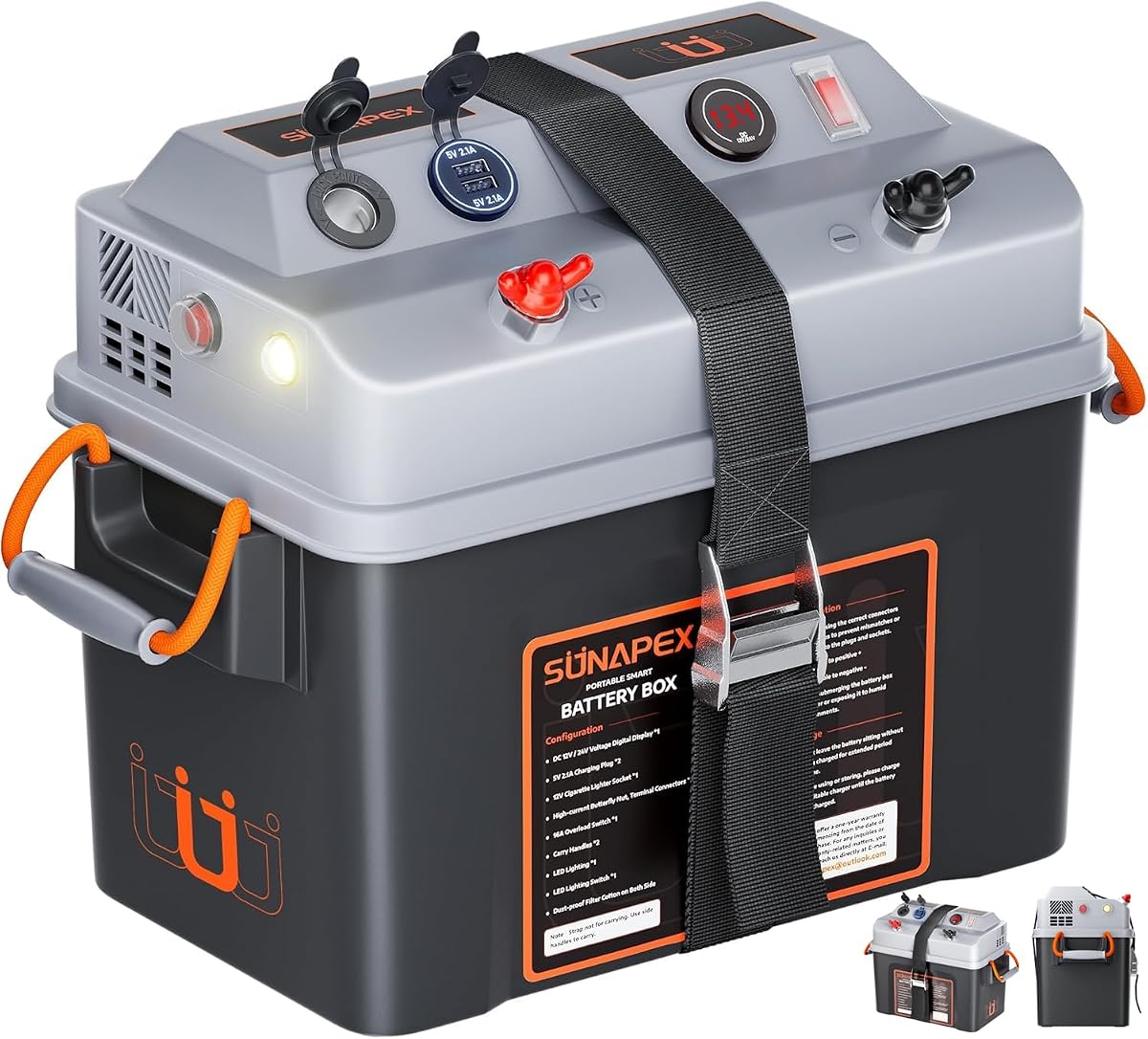
The SUNAPEX Marine Power Center delivers a simpler version of the smart battery-box concept, combining battery storage, protected accessory ports, a digital voltmeter, and illumination. Its 4.5 rating indicates a well-received general-purpose option for kayaks, small boats, and mobile 12V or 24V power needs.
We may earn a commission when you buy through this link, at no additional cost to you.
The interface includes a 16A overload switch, a 12V cigarette-lighter socket, two 5V 2.1A USB-A ports, high-current terminals, a voltmeter, and a side-mounted light. The lighting improves visibility during low-light or nighttime use, while ergonomic side handles make the enclosure easier to move between locations.
A dedicated overload switch helps protect the ports from excessive current and short circuits. Compatibility with Group 24, 27, and 31 AGM or lithium batteries gives owners flexibility when selecting or reusing a power source, and the stated external dimensions allow easier space planning.
This model does not include a battery and offers less high-current connectivity than the PRO version. It is best for owners seeking a straightforward portable power center with USB charging and nighttime illumination rather than extensive Anderson-plug distribution or faster USB-C charging.
The integrated side light illuminates the connection area when visibility is limited. This is a useful safety and convenience feature during early starts, returns after dark, or campsite-based fishing setups.
Side handles support easier transport, while the digital voltmeter keeps basic battery status visible without a phone. Group battery compatibility makes it a flexible enclosure for both AGM and lithium installations.
We may earn a commission when you buy through this link, at no additional cost to you.
The OPTIMA D34M Bluetop is a dual-purpose sealed AGM battery with a 4.3 rating and a long-established specification set. Its 750 CCA, 55Ah C20 capacity, and 120-minute reserve capacity make it suitable for smaller marine electrical systems where starting support and accessory power both matter.
We may earn a commission when you buy through this link, at no additional cost to you.
The battery uses SpiralCell technology with 99.99% pure lead and is designed to deliver more starting power than conventional flat-plate batteries. It can serve both deep-cycle and starting applications while remaining maintenance free, reducing the servicing demands associated with flooded lead-acid batteries.
Vibration resistance is listed at fifteen times that of standard flooded batteries, and expected life is stated at up to three times that of conventional flooded models. The physical specifications include dimensions of 10.06 by 6.88 by 7.94 inches, a weight of 43.5 pounds, and dual SAE and 5/16-inch stainless-steel studs.
Its 55Ah capacity is lower than that of the 100Ah batteries in this guide, and its weight makes it less attractive for portability-focused owners. Nevertheless, it is a sensible dual-purpose option for a compact boat with moderate trolling-motor demand and a need to support engine starting from the same battery.
The dual-purpose design can simplify smaller installations that would otherwise require separate starting and accessory batteries. Buyers should still ensure that the motor, electronics, and charging system remain within the battery's operating limits.
SpiralCell construction is associated with strong starting performance and high vibration resistance. These characteristics suit marine environments where movement, vibration, and repeated accessory loads can challenge conventional battery designs.
We may earn a commission when you buy through this link, at no additional cost to you.
The Smart Marine Battery Box is a portable 12V and 24V power center with a 4.6 rating, making it one of the most highly rated accessories in the guide. It is designed around a 50A Anderson-style quick connector for trolling motors, while adding modern charging ports and battery monitoring for other marine equipment.
We may earn a commission when you buy through this link, at no additional cost to you.
The charging selection includes USB-C PD up to 30W, QC3.0 USB-A up to 18W, a 12V accessory socket, and an LCD voltmeter. A 10A resettable circuit breaker, fuse protection, secure terminals, and a master switch provide multiple layers of protection for the battery system.
Unlike a conventional fixed battery box, this model includes two nano-adhesive pads intended to keep the battery from shifting during transport. The rugged PP housing supports batteries up to 35kg, and the included carrying strap simplifies movement between fishing trips, camping locations, RVs, and emergency setups.
The absence of an included battery is the main limitation. Users must select a suitable deep-cycle battery and verify its weight, dimensions, terminal arrangement, and chemistry. Despite that requirement, the combination of quick motor connections, modern charging, protection, monitoring, and portability makes it particularly useful for mobile setups.
The 50A Anderson-style connector offers a direct, protected connection point for a trolling motor. It reduces the need to route multiple leads through the enclosure while keeping the primary high-current connection organized.
The retaining pads, rugged housing, master switch, and included strap make the box easier to transport safely. Its charging options also support modern phones and other compatible USB devices without requiring a separate wall adapter.
We may earn a commission when you buy through this link, at no additional cost to you.
The right trolling-motor battery depends on motor demand, usable capacity, chemistry, installation space, charging equipment, environmental exposure, and the amount of monitoring required. These factors help separate a simple compact solution from a large expandable marine energy system.
Begin by estimating how much energy the trolling motor and onboard electronics will consume over a typical outing. Higher-capacity batteries provide more usable energy and greater headroom for long runtime, extra electronics, livewell equipment, or repeated motor use. Capacity should not be chosen in isolation: available compartment space, battery weight, charger output, and wiring requirements influence whether a larger installation is practical.
Choose capacity around real operating needs, not just a headline amp-hour figure. A 100Ah model may suit many common setups, while 320Ah options target extended runtime and expandable power systems. Verify actual system requirements and ensure the complete installation can be safely supported.
LiFePO4 batteries provide high energy density, lower weight, long cycle life, and built-in intelligent management in many modern designs. AGM batteries use sealed lead-acid construction and may be a more familiar choice for boaters who prioritize dual-purpose starting ability or want a simpler electrical installation. Chemistry affects handling, charging equipment, expected service life, weight, and monitoring options.
Select the chemistry that fits the rest of the boat rather than assuming lithium is always superior. Use a charger appropriate for the battery chemistry, confirm that the trolling-motor controller is compatible, and maintain adequate ventilation and secure mounting for the chosen design.
Trolling motors operate differently from marine engines. They draw power steadily for long periods, so stable voltage, repeated deep discharge, and recovery are important. A battery described as dual purpose may still be appropriate, but buyers should look for thick-plate construction, deep-cycle specifications, and compatibility with continuous accessory loads.
Do not confuse cranking amps with sustained runtime. High starting ratings help an engine start, while deep-cycle design determines how the battery behaves during hours of low-speed propulsion and continuous electronics use.
A quality battery management system helps protect against overcharging, over-discharge, short circuits, over-current, and overheating. Low-temperature cut-offs can be especially valuable in cold fishing climates because they establish safe operating and charging boundaries. Marine exposure also makes moisture resistance, secure terminals, corrosion resistance, and a suitably enclosed case important.
Compare the listed protection features rather than assuming every battery with the same capacity behaves similarly. Review cold-weather limits, enclosure material, and whether the battery is specifically positioned for outdoor or marine use.
Bluetooth monitoring can provide valuable information about state of charge, voltage, current, temperature, and cycle activity. Smartphone visibility helps anglers detect abnormal conditions and judge remaining power without relying on a simple voltmeter. Remote charge or discharge controls may also be useful in larger RV and off-grid systems.
Connectivity should support the decision-making process rather than become the main reason to purchase. Confirm app availability for your phone, account requirements, Bluetooth range, and the specific readings the application provides before committing to a connected model.
Boats that will later add solar, larger inverters, more batteries, or RV appliances benefit from a platform with documented 4P4S expansion. Expansion does not happen automatically, however: chargers, controllers, cables, fusing, and system voltage must all support the intended configuration. Some large lithium models also list specific solar-panel and charger recharge methods.
Map out the present and future electrical system before ordering. A 12V battery can become part of a larger series-and-parallel network, but every added component must be designed for that architecture and for the load being placed on the system.
Capacity, chemistry, and case format all affect the space and weight a battery requires. Lithium can reduce weight compared with similarly rated lead-acid batteries, but a 320Ah unit still demands substantial support and clearance. Kayak and small-boat owners should measure their compartments carefully, while trailer owners should verify that the loaded battery remains within the boat's capacity limits.
For portable systems, a battery box with handles, retaining pads, or a strap can improve handling. Measure both the internal and external dimensions of the selected enclosure, including room for terminals, cables, ventilation, and access to controls.
Marine power boxes and trolling-motor batteries should use secure, correctly rated connections that suit the current path. Anderson-style quick connectors offer convenient high-current attachment, while fused accessory outputs and overload switches help protect smaller devices. Terminal layout and compatibility with the trolling motor's lead-acid or lithium requirements should be verified before installation.
A power center without a battery is not a complete power solution. Decide whether you need a complete battery, an additional bank, or simply a protected enclosure and distribution hub, then budget for a separate battery if the package does not include one.
Confirm case dimensions, terminal orientation, weight capacity, and ventilation clearance before installation. Secure the battery against movement with straps or a properly rated tray, connect the trolling motor and accessories according to their instructions, and use corrosion-conscious marine-grade wiring and connections. For lithium systems, use a charger designed for LiFePO4 chemistry and observe the manufacturer's charging parameters.
Check the battery's state of charge before departure and use the app or voltmeter to monitor voltage, current, temperature, and cycle information when available. Avoid exposing a battery to excessive heat, standing water, short circuits, or loads beyond its specified capability. For power boxes, inspect fuses, overload switches, terminals, and quick connectors regularly, and never bypass the protective devices.
Recharge according to the product instructions and avoid leaving a deeply discharged battery stored for long periods. Keep terminals clean and dry, check for swelling, corrosion, loose hardware, or heat-related discoloration, and remove the battery for inspection if any of these signs appear. Recycle or return spent batteries through an approved battery-recycling program rather than disposing of them with household waste.
A dedicated deep-cycle battery can be ideal when the boat has enough room for a separate starting battery and the trolling motor is used for long periods. A dual-purpose AGM can work well in smaller installations because it combines starting and cycling capability. The right choice depends on motor load, available space, charging system, and how the battery is used.
Required capacity depends on the motor's rated current, expected runtime, and the additional load from fish finders, livewells, lights, and other electronics. More capacity can provide longer runtime and better headroom, but it also increases size and weight. Compare estimated energy consumption with the battery's usable capacity rather than selecting only by motor horsepower or pounds of thrust.
A LiFePO4 battery can replace a lead-acid installation when the trolling-motor controller, charger, wiring, and system configuration are compatible. Verify the battery's continuous-current capability, terminal arrangement, voltage, and charging requirements. Lithium batteries also benefit from a compatible charger rather than a general-purpose lead-acid charger.
Bluetooth monitoring is not essential for basic operation, but it can make power management more precise by displaying state of charge, voltage, current, temperature, or cycle information. It is especially useful on multi-day trips, large battery banks, and systems supporting multiple electronics. For a small installation with a simple voltmeter, it may be a convenience rather than a necessity.
Battery boxes are useful for organizing the battery, providing protected high-current connections, distributing accessory power, and charging compatible devices. They do not increase the battery's stored energy, however. Models without an included battery require buyers to select a suitable unit and confirm that its dimensions, weight, and terminals fit the enclosure.
Storage conditions should follow the battery manufacturer's guidance, particularly for lithium batteries exposed to extreme cold. A protected, dry location with moderate temperatures is generally preferable to prolonged exposure or deeply depleted storage. Before storage, confirm the state of charge and recharge as directed rather than leaving a depleted battery connected indefinitely.
Multiple batteries can be used when they are arranged in a properly designed series or parallel configuration, with matched batteries and compatible equipment. The expansion limits shown in the product information are system specifications, not automatic permission to combine any batteries. Fusing, cable sizing, charger selection, and trolling-motor controller requirements must all be considered.
LiFePO4 batteries generally require less routine maintenance than flooded lead-acid batteries because they do not need electrolyte servicing. They still need correct charging, secure mounting, periodic terminal inspection, and protection from excessive heat, moisture, and short circuits. Monitoring temperature and battery condition helps identify problems before they interrupt a trip.
The Interstate Marine AGM is the budget-focused choice for owners seeking established sealed AGM construction and dual-purpose support. The Bluetooth 12V 100Ah LiFePO4 is the most balanced overall recommendation because it combines deep-cycle capacity, monitoring, extensive protection, and expansion options. The Smart 12V 320Ah LiFePO4 stands out for buyers who want maximum runtime and a scalable high-capacity platform.
Prioritize motor compatibility, usable deep-cycle capacity, correct charging equipment, physical space, and safe mounting before considering convenience features. Low-capacity installations may need only one carefully sized battery, while multi-day, high-electronics, or solar-assisted setups may benefit from lithium chemistry, Bluetooth monitoring, and a larger expandable system. Battery boxes can improve connection organization and portability, but they are incomplete without a separate suitable battery.
Product specifications and market conditions can change, so check the current listing, battery dimensions, included components, charger compatibility, and protection details before ordering. Current promotions and pricing should also be reviewed at the time of purchase, since they can shift which model offers the strongest overall value.