
Portacapture X8
4.4Editor score
Eight-channel 32-bit float recording
Four locking XLR and TRS inputs
192 kHz recording support
Detachable stereo condenser microphones
Color touchscreen launcher interface
Our Eight Track Tape Recorder guide compares ten multitrack recorders, helping you evaluate tracks, inputs, portability, effects, storage, and recording
An eight track recorder gives musicians a practical way to build ideas layer by layer without relying on a full computer-based studio. Although the term evokes reel-to-reel tape, modern models are usually digital, offering instant playback, editing, effects, and compact storage. The best model depends on whether your priority is portability, input flexibility, built-in tools, or straightforward music production.
We compared all ten products by considering their relevant capabilities, including simultaneous tracks, available inputs, microphones, effects, storage formats, editing functions, portability, and suitability for songwriting or field recording. Some products are genuine eight-track recorders, while others offer related eight-channel recording features or cassette-to-digital functionality. Each entry explains where that distinction matters in practical use.
The first three picks provide the strongest combinations for mobile music creation, compact home recording, and more advanced field work, but every product has a distinct role. The cassette units and rack device included in the comparison are especially useful for playback, archiving, or nostalgia rather than modern eight-track music production. Product specifications and availability can change, so check the current listing before purchasing.
4.4Editor score
4.2Editor score

4.2Editor score
This side-by-side comparison covers digital eight-track recorders, portable multitrack recorders, and cassette-focused alternatives. The table makes clear which models emphasize music production, field recording, compact operation, or tape playback and archiving.




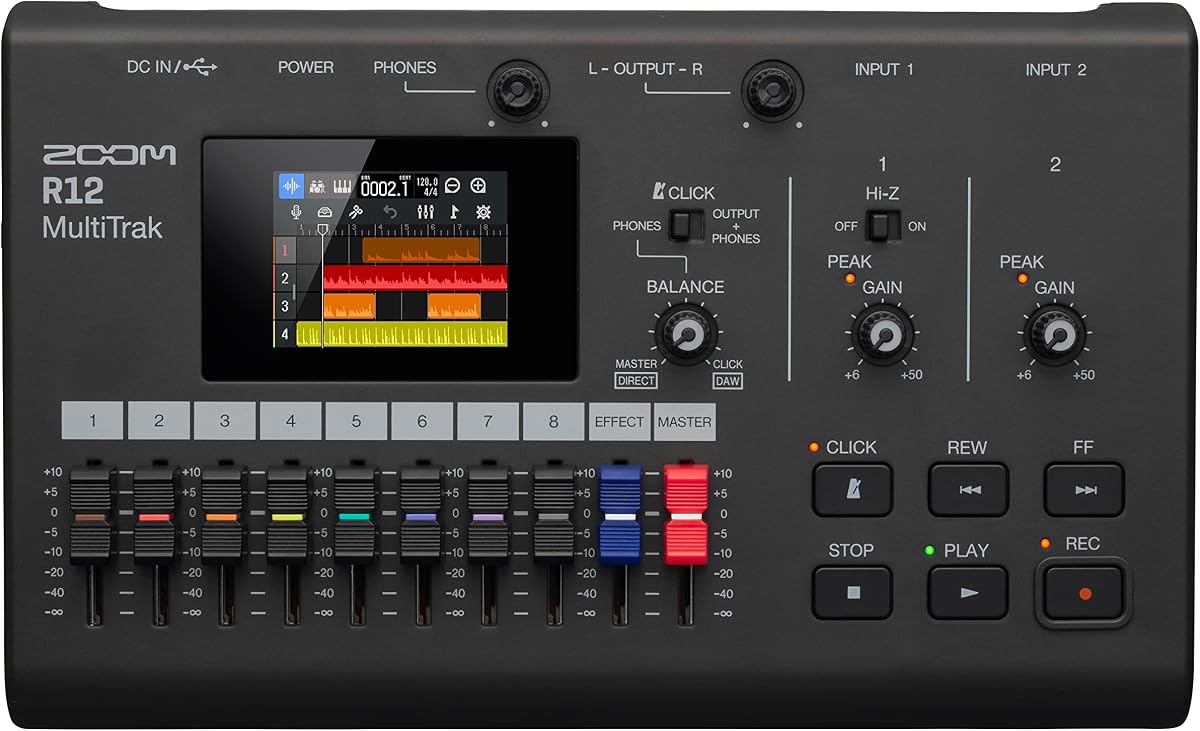
The Zoom R12 is the most complete mobile option in this group, combining eight-track recording, a full-color touchscreen, DAW-style editing, a built-in rhythm section, and USB-C connectivity. Its 4.2 rating reflects a capable and approachable package, particularly for musicians who want to move from an idea to a layered arrangement without assembling a separate computer studio.
We may earn a commission when you buy through this link, at no additional cost to you.
The two XLR and TRS inputs support microphones, instruments, and line sources, while phantom power on both inputs broadens microphone options. Input 1 includes a Hi-Z switch for direct guitar and bass capture. The built-in library contains 150 drum loops across multiple genres and 18 FM synth instruments, and the touchscreen can be used to trigger sounds as well as edit them.
Its strongest advantage is integration. Cutting, copying, looping, and mixing happen on the unit, and the same hardware can operate as a stereo USB-C interface and DAW control surface with transport controls and faders. That reduces dependence on a laptop, although musicians who need several people recorded at once will find two physical inputs limiting.
The four-AA power configuration and stated five-hour runtime also make the R12 compelling for rehearsals, travel, and location recording. It is the best overall choice for a singer-songwriter or small ensemble that values song building over a large input count. Those who mainly need microphone flexibility or high-resolution field capture should consider one of the more specialized alternatives.
Overall, the R12 makes the most convincing case for this list because it combines modern eight-track production, instrument sounds, and computer integration in one portable device. Its menu-based touchscreen may take adjustment, but the breadth of tools makes that effort worthwhile.
Built-in loops and synths make the R12 useful before external sounds are introduced. A musician can establish a groove, add compatible parts, and build a more convincing arrangement directly on the recorder.
USB-C operation transforms the R12 into an audio interface and DAW controller. That makes it easy to move between standalone recording and a more detailed computer-based production workflow.
We may earn a commission when you buy through this link, at no additional cost to you.
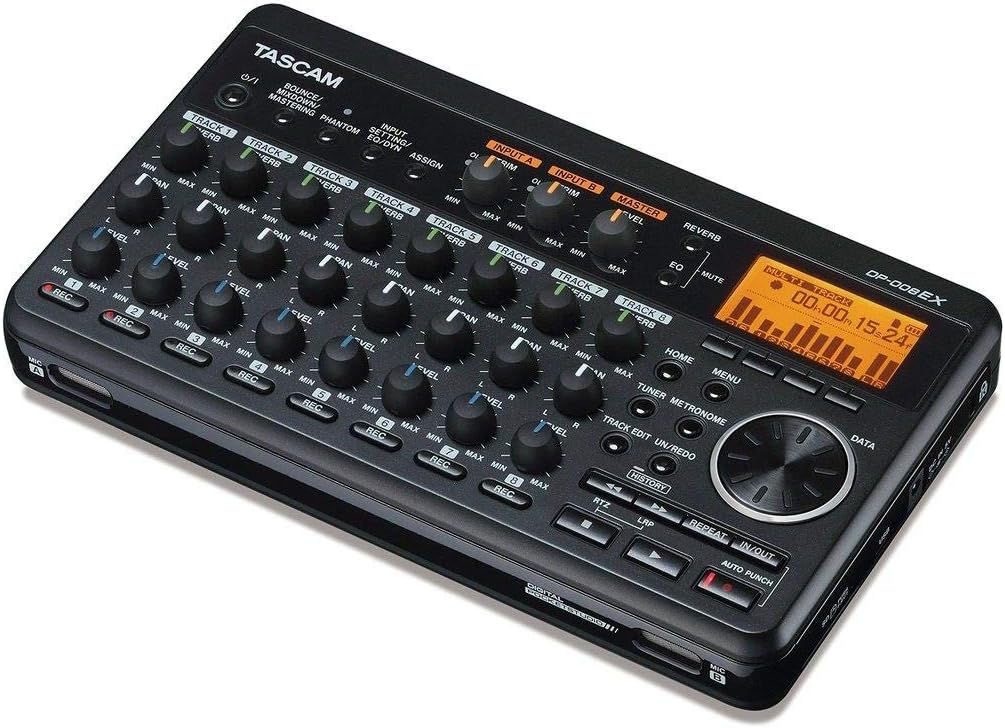
The TASCAM DP-008EX is a compact eight-track Pocketstudio aimed at songwriters who want to capture ideas away from a desk. It carries a 4.6 rating, the highest among the listed products, and its built-in microphones and battery operation remove several common obstacles to spontaneous recording.
We may earn a commission when you buy through this link, at no additional cost to you.
The central benefit is simplicity. A musician can record, organize, and develop multiple tracks without bringing along microphones, cables, and a power outlet. Its pocket-oriented form also makes it easier to keep ideas moving during rehearsals, lessons, travel, or informal writing sessions than a full Portastudio.
The supplied product information is less detailed than for the DP-03SD and DP-24SD, so prospective buyers should verify the current specification sheet and confirm how the microphones, inputs, effects, and storage work for their preferred workflow. A strong customer rating is encouraging, but it does not replace checking connector availability and current recording formats.
This recorder is especially suitable for writers who mainly record vocals, acoustic ideas, and rough arrangements in small spaces. It is less compelling for a band needing several simultaneous external connections or a recording engineer who expects extensive hardware control. For those needs, the larger TASCAM models or Zoom R12 offer more visible flexibility.
The DP-008EX earns its place as the straightforward portable choice in this comparison. Its high rating, integrated microphones, and battery-powered operation make it particularly appealing when convenience and compact size matter more than expandability.
Battery operation and built-in microphones reduce setup time, which is valuable when inspiration arrives before a home studio is ready. The recorder can be picked up and used with fewer decisions between capturing an idea and preserving it.
The eight-track Pocketstudio format emphasizes songwriting rather than elaborate routing. It is a natural fit for melodic ideas, voice memos, acoustic performances, and developing compact arrangements.
We may earn a commission when you buy through this link, at no additional cost to you.
The TASCAM DP-03SD combines an approachable digital Portastudio design with eight-track recording, professional connectivity, and onboard mastering. Its 4.5 rating makes it one of the strongest-rated products here, while the cassette-style operation concept helps retain the directness associated with traditional multitrack recorders.
We may earn a commission when you buy through this link, at no additional cost to you.
Two channels can be recorded simultaneously through an XLR microphone terminal and TRS instrument connections. The XLR side supports condenser microphones, and the two included stereo condenser microphones allow immediate stereo capture. This arrangement is broad enough for a solo performer, duo, or small acoustic session without pretending to offer full multichannel mixing.
Onboard mastering effects and editing functions help the DP-03SD produce a finished result without requiring a separate mastering setup. A dedicated tuner and metronome are useful for pitch accuracy and timing, and both are accessible through their own buttons. The 20 Hz to 20 kHz frequency response is specified for the microphone and line input path through the line output.
This is a strong recommendation for songwriters who want a recorder that is ready to capture and polish music rather than serve as a basic sketchpad. It is less suitable for bands that need more than two performers recorded at the same time. Those users should examine the DP-24SD or a field recorder with more physical inputs.
The DP-03SD delivers a balanced blend of portability, musical tools, and finish. Its mastering-oriented features and high rating make it one of the most complete options for individual or small-scale recording.
Onboard mastering effects reduce the need to move a basic project elsewhere merely for final polish. The result is a more convenient path from rehearsal-room capture to a shareable finished recording.
The simple body and intuitive cassette-style approach prioritize direct recording. For users who want physical controls and musical tools without navigating a complex digital workstation, that simplicity remains valuable.
We may earn a commission when you buy through this link, at no additional cost to you.
The TASCAM DP-24SD is the most expandable conventional recorder in this list, offering 24 tracks and eight XLR microphone inputs. Its 4.6 rating matches the highest figure shown, and the feature set is aimed at musicians who need to record a full ensemble instead of building one arrangement track at a time.
We may earn a commission when you buy through this link, at no additional cost to you.
Eight XLR inputs make it possible to connect a much larger group of microphones, including a drum overhead pair, instruments with microphones, and vocals. A color screen helps present the larger control set, while onboard effects and mastering functions keep common processing tasks within the unit.
Its main trade-off is portability. The listed package dimensions are substantially larger than those of a pocket recorder, and the listed package weight is 15.74 pounds. It is better viewed as a home-studio or rehearsal-room instrument than a device designed to accompany a songwriter everywhere.
This model is the right recommendation for bands, ensembles, podcast-style multi-person sessions, or any project where simultaneous microphones are essential. It also offers more room to alternate takes and preserve separate ideas than an eight-track model. A solo artist who only needs a couple of inputs may find it unnecessarily substantial.
Despite being outside the strict eight-track limit, the DP-24SD deserves inclusion because it shows what an eight-track-focused buyer gains by stepping up in scale. For many home recordists, the jump to 24 tracks and eight XLR connections is the decisive feature.
Eight XLR connections support realistic ensemble recording rather than a limited two-person setup. Separate microphones also make it easier to balance instruments later and reduce the compromises caused by recording through a mixer.
Twenty-four tracks provide room for many alternate takes, overdubs, and supporting parts. That makes the DP-24SD more suitable for evolving a song through multiple stages without constantly consolidating sessions.
We may earn a commission when you buy through this link, at no additional cost to you.
The Boss BR-600 delivers the core elements of a portable digital multitrack recorder at a traditionally value-focused level of equipment. Its 4.2 rating reflects a dependable approach to recording eight tracks at once while offering 64 virtual tracks for organizing and arranging the project.
We may earn a commission when you buy through this link, at no additional cost to you.
The built-in stereo microphone allows immediate recording without additional hardware, and the drum machine provides velocity-sensitive pads for adding a basic rhythmic foundation. A dedicated guitar and effects processor includes vocal effects and a pitch corrector, adding tools that can help an idea sound more developed.
Recording media uses CompactFlash, with a 128 MB card included. That older storage format is one of the model's main limitations for a buyer seeking a long-term system. Cards also have finite capacity, so anyone creating substantial projects should consider a suitable higher-capacity card and confirm compatibility before buying.
The BR-600 is best for guitarists, singer-songwriters, and small groups that want a substantial collection of musical tools without moving to a full computer-based system. It is less attractive for modern high-resolution field recording or projects requiring current connectors and storage formats, but it remains a practical multitrack recorder for portable practice and composition.
Within this comparison, it stands out as the value-focused selection because it includes eight-track playback, virtual tracks, a microphone, drums, and effects in one dedicated unit. Those features make it a strong option when the main goal is making music rather than maintaining a computer-based workflow.
The effects processor, vocal effects, pitch corrector, and velocity-sensitive drum pads help users develop ideas without requiring separate software. These tools are most useful for quickly auditioning arrangements and polishing rough performances.
Sixty-four virtual tracks provide room to organize ideas beneath the eight simultaneous playback tracks. The stereo microphone and battery support make the unit convenient for rehearsals and location practice.
We may earn a commission when you buy through this link, at no additional cost to you.
The Roland BR-80 is a portable recorder designed for more than conventional multitrack capture. Its 4.4 rating reflects a versatile feature set spanning MTR multitrack recording, eBand phrase training, and Live Recorder operation, all within a portable device.
We may earn a commission when you buy through this link, at no additional cost to you.
The eBand function is particularly useful for practicing against backing and rhythm patterns or learning parts. A built-in library of backing tracks and rhythms reduces the need to prepare accompaniment before every session, while the included stereo condenser microphone allows immediate capture. The result is a device that works for rehearsal, practice, and song development.
COSM amplifier and effects models add a familiar guitar-oriented tone shaping layer. The unit can also function as a USB audio interface with built-in effects, although the included SONAR X1 LE software reflects an older generation of computer tools. Buyers who need a modern native software ecosystem may prefer a recorder with more recently documented compatibility.
This model is a strong fit for guitarists, practicing musicians, and anyone who wants to learn, rehearse, and record in one device. It is less focused than the Portacapture X8 on high-resolution field capture and less open-ended than a computer DAW for advanced production.
The BR-80's defining benefit is versatility. MTR, eBand, and Live Recorder modes serve distinct creative tasks, making it a more specialized purchase than a conventional eight-track recorder but a compelling one for practice-oriented musicians.
The eBand mode supports phrase training and play-along work, while the pattern library supplies material for rehearsal. These features can help a musician learn arrangements and develop timing without a separate teaching setup.
COSM amplifier models and onboard effects provide guitar players with familiar sound-shaping options. They are also useful when recording ideas without access to a larger amplifier or production setup.
We may earn a commission when you buy through this link, at no additional cost to you.
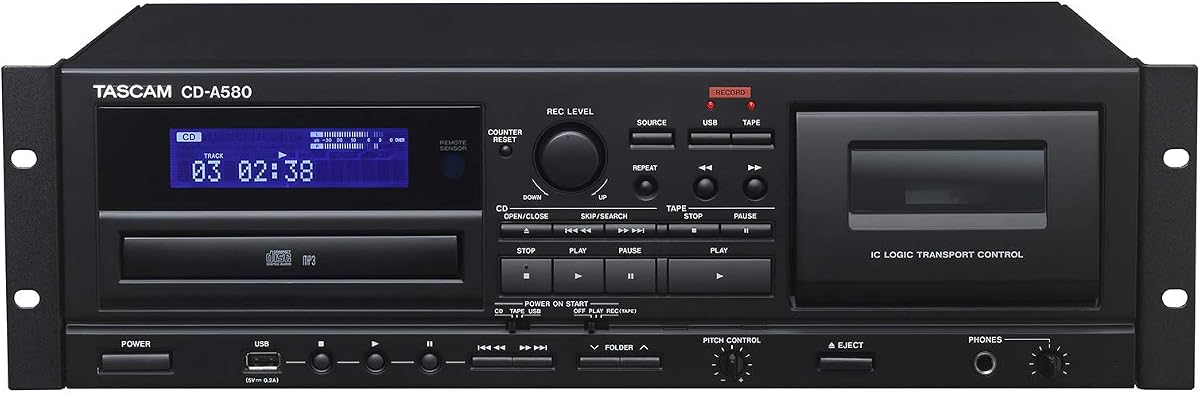
The TASCAM CD-A580 is not an eight-track recorder in the conventional multitrack sense. It is a rackmount media player and recorder built around cassette preservation, CD handling, and USB transfer, making it relevant to the tape theme while serving a very different purpose from the other products.
We may earn a commission when you buy through this link, at no additional cost to you.
Its defining strength is cassette-to-USB recording, which can help digitize a cassette collection for playback, storage, or further use. Audio from CDs and line inputs can be recorded in MP3 format to USB flash media. The deck also supports copying CDs to cassette, creating a practical bridge between physical media and digital workflows.
Several CD formats are supported, including CD-DA, CD-R, CD-RW, and data CDs containing MP3 files. During cassette playback, pitch can be adjusted up to plus or minus 10 percent, which is useful for musicians learning by ear, matching playback speed, or working with material recorded at an unusual tempo.
The single-direction logic-based transport control emphasizes stability and longevity rather than the bidirectional shuttle behavior of some cassette decks. That design is sensible for repeated archiving tasks. The rackmount format, however, makes this a poor fit for a mobile musician and an unnecessary choice for someone seeking eight audio tracks.
Choose the CD-A580 for archiving, media conversion, or preserving the tactile experience of cassette in a fixed installation. For layered music recording, select one of the dedicated multitrack recorders instead.
Cassette-to-USB transfer provides a practical route for creating a digital copy of analog recordings. MP3 recording from CD and line sources extends that function to several other common media.
The single-direction transport control is designed for dependable operation over repeated media movement. Its format also supports CD-to-cassette copying, making it useful for users who still want physical recordings.
We may earn a commission when you buy through this link, at no additional cost to you.
The K8 is a compact cassette player and recorder designed for listening, radio, and capturing short memories rather than producing layered music. Its 4.1 rating indicates a straightforward consumer device, and its built-in speaker makes it easy to enjoy tapes without carrying separate headphones or a portable speaker.
We may earn a commission when you buy through this link, at no additional cost to you.
Cassettes can be played, and the built-in microphone allows direct recording onto tape. An integrated AM and FM radio adds music, talk, and news listening without requiring a separate receiver. A 3.5 mm earphone jack and included earphones support quieter private listening during commuting, travel, or outdoor use.
Power can come from AA batteries for portable operation or an AC-DC adapter for continuous home use. That flexibility makes the K8 useful in several settings, although it remains far removed from the control and storage capabilities expected of a dedicated multitrack recorder.
The obvious audience is someone who values cassette playback, simple recording, and radio in a portable format. It is not appropriate for musicians seeking eight tracks, overdubs, effects, or multi-input recording. Its value lies in accessibility and convenience rather than studio capability.
As a themed product selection, the K8 succeeds by making cassette use uncomplicated. It should be judged as a portable tape and radio device, while musicians focused on recording should look toward the Zoom, TASCAM, Boss, Roland, or Portacapture options.
The built-in speaker and radio reduce the need for several accessories. Users can switch between cassette playback and live radio without carrying a separate portable receiver.
AA batteries support travel and outdoor listening, while the adapter option suits continuous home use. That makes the K8 practical for both mobile and stationary listening.
We may earn a commission when you buy through this link, at no additional cost to you.
The Portacapture X8 is designed for users who need genuinely flexible location recording rather than a simplified songwriting device. It captures up to eight channels in 32-bit float point format at resolutions as high as 192 kHz, and its 4.4 rating reflects a capable, professional-oriented feature set.
We may earn a commission when you buy through this link, at no additional cost to you.
Four XLR and TRS locking combo inputs support microphones and line sources, with individual 24 V or 48 V phantom power for condenser microphones. The in-house HDDA preamps are designed to preserve low-noise capture quality. These specifications make the recorder well suited to podcasting, interviews, music, field recording, voice work, vlogging, and ASMR.
The detachable 14.6 mm large-diaphragm condenser microphones can be positioned in A-B or X-Y configurations. That flexibility helps users move between focused directional capture and stereo recording without buying a separate microphone system. The 3.5-inch color touch panel and launcher-based interface also provide centralized control over a sophisticated feature set.
The main trade-off is complexity. A recorder with this many capture options and high-resolution modes can be more demanding than a straightforward eight-track unit. There is also a specific adapter restriction: only the AK-BT1 adapter is compatible, and the AK-BT2 is not supported.
For location sound specialists, podcasters, and musicians who want pristine flexibility, the X8 is one of the strongest choices here. It is best suited to users who will benefit from professional inputs and float recording rather than those seeking the simplest portable sketching tool.
The 32-bit float format is particularly valuable when levels are unpredictable, because it provides additional headroom for capturing quiet and loud moments without the same clipping concerns associated with fixed integer workflows.
Detachable large-diaphragm condensers support both A-B and X-Y positioning. Creators can adapt the stereo image to the environment rather than accepting one permanently fixed arrangement.
We may earn a commission when you buy through this link, at no additional cost to you.
The QFX RETRO-39BT is a portable cassette deck built around two-way transfer between tape and modern sources. Its 3.8 rating is the lowest in the group, but the product fills a distinct niche by recording digital audio from USB onto cassette and sending cassette, Bluetooth, FM radio, microphone, or line-in audio to USB.
We may earn a commission when you buy through this link, at no additional cost to you.
That flexibility makes it useful for creating physical recordings from digital files or moving analog material into a computer. The push-button workflow favors approachable operation, while USB input, line-in and line-out jacks, and external microphone support provide more connection options than a simple novelty tape player.
Bluetooth playback and the built-in three-inch speaker allow convenient listening without external equipment, and the swivel carrying handle supports portability. The unit can operate with four C batteries or an included AC cord. Those batteries are not included, an important detail for buyers who plan to use it away from an outlet.
This is not a multitrack recorder and should not be purchased to layer separate musical parts. Its strengths relate to media conversion, simple voice recording, radio listening, and the experience of making physical cassettes from digital audio.
The QFX is best for a compact, entertainment-focused tape setup with useful transfer options. For layered songwriting, musicians should choose a recorder with actual track allocation, editing, and effects rather than interpreting cassette recording as equivalent to eight-track production.
USB-to-cassette recording gives users a straightforward way to create physical tapes from digital files. The reverse transfer path also makes old cassettes easier to move into a digital listening or storage setup.
Bluetooth, FM radio, an integrated speaker, and external audio connections make the deck adaptable to listening and simple recording. It is a versatile media accessory rather than a dedicated production tool.
We may earn a commission when you buy through this link, at no additional cost to you.
The right recorder depends on how you intend to make music, how many sources you need to record simultaneously, and whether portability, editing, or physical tape matters most. These factors help separate dedicated multitrack tools from related playback and archiving devices.
Track count refers to how many audio parts can be combined into a finished project. Eight tracks are enough for a lead, several supporting parts, effects, and reference material, but the number of simultaneous inputs is a separate consideration. A recorder may offer eight tracks while allowing only one or two people to record at the same time. Consider both figures before buying.
XLR inputs support microphones and commonly provide phantom power for condenser models. TRS or instrument inputs are useful for guitars, basses, and keyboards, while a Hi-Z switch can improve direct electric-guitar recording. Built-in microphones add convenience for quick ideas but usually offer less control than external microphones.
A recorder used away from home should have a manageable size, clear battery requirements, and controls that remain usable on the move. The Zoom R12 runs on four AA batteries for up to five hours, while several smaller recorders are designed around rechargeable or removable batteries. A larger studio recorder may offer more inputs but require a dedicated setup.
Built-in editing can include cutting, copying, looping, mixing, effects, mastering, tuners, and metronomes. These features reduce the need for immediate computer editing and help a rough performance sound more finished. Recording software or a DAW can provide greater depth, so confirm that a computer-based workflow will complement rather than duplicate the recorder.
Storage affects file compatibility, capacity, and future usability. The Boss BR-600 uses CompactFlash, the Roland BR-80 supports SD and SDHC cards, and the Portacapture X8 supports high-resolution formats up to 192 kHz. The listing does not state storage details for every model, so verify the current specifications before buying or reusing old media.
Built-in microphones make a recorder ready for immediate use, but their placement is fixed. Detachable microphones, as offered with the Portacapture X8, allow A-B or X-Y positioning and better adaptation to the scene. For serious voice or music recording, the recorder should also accept quality external microphones through suitable XLR or TRS connections.
USB audio interface and DAW control functions can turn a portable recorder into the center of a larger production setup. The Zoom R12 includes both transport controls and faders, while the Roland BR-80 can operate as a USB interface with onboard effects. Compare included software, current operating-system support, and the control layout with your existing studio tools.
A cassette player can provide recording and archiving without creating layered tracks. The TASCAM CD-A580, K8, and QFX RETRO-39BT are relevant to the tape theme, but their strengths lie in playback, media conversion, radio, or simple recording. Musicians building arrangements need dedicated multitrack allocation, editing, synchronization, and effects.
Begin by planning the recording rather than pressing record at the first opportunity. Confirm storage, battery charge, input selection, phantom power, and monitoring levels. For a fresh project, create clearly named tracks for the main performance and any supporting parts, and leave room for alternate takes before the available tracks become crowded.
Record a strong reference first, then use the recorder's tuner, metronome, loops, and effects selectively. Keep levels consistent across takes, avoid clipping, and listen back through both headphones and speakers when possible. If the unit supports USB editing or DAW control, back up the project before making substantial changes on a computer.
Care for the unit by keeping connectors clean, storing it in a padded case, and removing batteries during long periods of nonuse. Use compatible memory cards or the specified adapter, and do not force tape into a cassette mechanism. For analog decks, clean the heads and pinch rollers according to the manufacturer's instructions, and store tapes upright in a clean environment away from heat and moisture.
Not necessarily. An eight-track recorder may support eight recorded parts while allowing only one or two simultaneous inputs. An eight-channel field recorder may capture eight channels at once but devote fewer resources to musical effects and track-based editing. Compare both simultaneous input count and total recording workflow before choosing.
Digital models generally provide more editing control, immediate playback, greater track organization, and easier copying than cassette decks. Cassette equipment remains attractive for nostalgia, physical media, simple voice recording, and archiving. The best choice depends on whether your priority is layered music production or tape handling.
You need enough simultaneous microphone inputs for the performers and a way to mix or monitor them. Some eight-track devices record only one or two channels at a time, making overdubbing necessary. A model with more XLR inputs, such as the TASCAM DP-24SD, may be more practical for a full ensemble.
They are useful for songwriting because they provide an immediate rhythmic or melodic foundation. Built-in sounds are not essential for polished production, but they can accelerate idea development and reduce the need for another device. Musicians who already own a strong software instrument collection may value flexible external inputs more.
Many digital models support USB audio, file transfer, or DAW control. The Zoom R12 functions as a stereo USB-C audio interface and DAW control surface, while the Roland BR-80 can also operate as a USB interface. Check the current system requirements and confirm whether the connection transfers files, sends audio, or does both.
Choose a modern format supported by the recorder and your editing software, and confirm that your storage medium has enough capacity. Older CompactFlash-based units and newer SD-based recorders have different compatibility considerations. The listing does not provide complete storage details for every product, so review the manufacturer's current manual before purchasing cards.
Standard cassette decks are generally better suited to playback, simple recording, and archiving than synchronized multitrack production. Dedicated digital recorders offer repeatable tracks, editing, effects, and timing tools. If physical tape is important, you can still use a cassette-focused unit alongside a separate digital multitrack recorder.
The Zoom R12 stands out for portable eight-track recording, built-in drum loops and synths, touchscreen editing, and USB-C connectivity. The TASCAM DP-008EX is a simpler alternative for quick ideas, while the Boss BR-600 offers traditional multitrack features and built-in instruments. The best choice depends on whether you prioritize sounds, editing, simplicity, or storage.
The Zoom R12 is the strongest all-around recommendation because it combines eight-track capture, touchscreen editing, built-in musical tools, USB-C connectivity, and battery-powered portability. The Portacapture X8 is the advanced choice for high-resolution field recording, while the Boss BR-600 provides a more traditional and value-oriented multitrack setup.
Before buying, prioritize simultaneous inputs, storage compatibility, and the type of recording you expect to make. A songwriter may value loops and fast editing, while a band needs XLR connections and enough channels to record everyone at once. Field specialists may prioritize float capture and microphone placement, and tape enthusiasts may primarily want archiving or playback.
Specifications, bundle contents, software compatibility, and availability can change over time. Check the current Amazon listing and manufacturer documentation before ordering, and compare the latest features rather than relying solely on a historic product design. With that final check, the right recorder should support both the way you create music and the places you need to create it.