
BOTSLAB G300H Plus
4.2Editor score
4K front, 1080p rear
Dual STARVIS 2 sensors
Wide-angle night coverage
Voice-controlled operation
Our guide compares the best Dash CAM with Starvis 2 Night Vision options, covering low-light clarity, coverage, storage, parking features, and connectivity.
A dash cam with a STARVIS 2 sensor is designed to collect more usable detail in dim streets, tunnels, garages, and nighttime highways than many conventional dash cams. These sensors work together with wide apertures, HDR, and image processing to balance bright headlights against dark surroundings while reducing noise and preserving license plate detail.
We compared all ten cameras by channel count, sensor configuration, recording resolution, field of view, parking-mode design, wireless connectivity, GPS support, storage options, and practical installation considerations. The list includes two-camera, three-channel, and compact front-only systems, allowing buyers to compare coverage and advanced night performance without paying for unnecessary features.
Each entry explains where the camera stands out, where compromises remain, and which type of driver is most likely to benefit. The top picks highlight the strongest choices for budget-conscious buyers, well-rounded performance, and premium coverage. Product availability and pricing can change, so confirm current details before making a final purchase.
4.2Editor score

4.2Editor score

4.4Editor score
The table below compares all ten models by recording format, STARVIS 2 implementation, night-vision features, and supporting functions. It makes clear which cameras emphasize front-and-rear coverage, which provide full cabin monitoring, and which prioritize a compact or more affordable installation.



The REDTIGER F7N TOUCH combines a 4K front camera, a 1080p rear camera, a STARVIS 2 front sensor, and a 4.3 rating in a particularly approachable dual-channel package. Its standout feature is the combination of a 170-degree front lens and a 140-degree rear lens, providing broad coverage for ordinary road use. WDR, HDR, and an f/1.5-class night-vision approach are intended to preserve detail when ambient light is limited.
We may earn a commission when you buy through this link, at no additional cost to you.
Control options are unusually varied for this category. The included touchscreen can lock emergency footage, activate Wi-Fi, and capture still images, while voice commands reduce the need to interact with the unit while driving. The REDTIGER Cam app supports both Android and iOS devices through 5GHz Wi-Fi, with transfer speeds stated at up to 20MB/s. A built-in GPS module adds route, location, and speed information, making the footage more useful when an event needs context.
The included 128GB card makes the system ready for use, while seamless loop recording manages storage and the G-sensor protects clips associated with sudden movement or impact. Parking monitoring includes time-lapse and collision-oriented modes, although a separate hardwire kit is required for permanent power. That dependency is the main practical limitation, but it applies to many parked-car surveillance features that operate without draining the vehicle battery.
This camera is a strong recommendation for drivers who want a high-resolution front view, rear coverage, GPS, quick wireless transfers, and several ways to control the device without paying for a three-channel system. It is particularly attractive for commuters and rideshare drivers who want front-and-rear evidence but do not need a dedicated cabin camera. The F7N TOUCH delivers the most balanced feature set in this part of the roundup.
The STARVIS 2 front sensor, HDR, WDR, and broad lens work together to balance dark roads against bright headlights. The 170-degree front view is especially useful for capturing adjacent lanes, roadside signs, and vehicles entering the frame.
A touchscreen, voice commands, 5GHz Wi-Fi, and built-in GPS provide several ways to review and share recordings. The included card and emergency locking help make the system convenient from the first drive.
We may earn a commission when you buy through this link, at no additional cost to you.
The ROVE R2-4K Dual earns a 4.5 rating, the highest among the ten products considered, and pairs a Sony STARVIS 2 IMX675 sensor with a wide f/1.5 aperture in the front camera. The rear camera records at 1080p through an f/1.8 aperture. Although the title uses a 4K designation, the supplied details clarify that the front view is recorded at 2.5K and intelligently upscaled to 2160p rather than captured natively at 4K.
We may earn a commission when you buy through this link, at no additional cost to you.
That distinction does not diminish its practical strengths. HDR helps balance headlights and shadowed surroundings, while the STARVIS 2 sensor is designed to improve nighttime clarity, plate recognition, and the visibility of nearby vehicles. The 3-inch IPS display shows live speed and compass direction, and built-in GPS records routes, locations, and speed stamps that can be reviewed with the supplied desktop GPS player.
ROVE includes a 128GB microSD card, dual-band 5.8GHz and 2.4GHz Wi-Fi, and app-based transfer speeds stated at up to 20MB/s. Firmware can also be updated over the air. Parking surveillance is more comprehensive than in many competing systems, offering time-lapse, motion detection, and collision detection, with event files saved in a separate folder. A hardwire kit is still needed for continuous parked-car operation.
The R2-4K Dual is an excellent choice for drivers seeking a refined dual-camera system, strong low-light capability, high app transfer speeds, and built-in navigation data. It is less suitable for buyers who require native 4K front footage or a separate cabin camera, but for most road users, the combination of sensor quality, accessibility, and connectivity is exceptionally well balanced.
The IMX675 sensor and wide front aperture support cleaner low-light recordings than a comparable standard dash cam. HDR helps retain information when headlights illuminate one part of the scene while the surroundings remain dark.
Time-lapse, motion, and collision modes give owners three different approaches to parked-car monitoring. Detected events are stored separately and announced when the vehicle is started again.
We may earn a commission when you buy through this link, at no additional cost to you.
The REDTIGER F17 brings front, rear, and cabin recording into one three-channel system, earning a 4.4 rating along the way. Its front camera uses the STARVIS 2 IMX675 sensor with WDR and HDR, while the interior and rear channels record at 1080p. The listed fields of view are 150 degrees at the front, 160 degrees inside the cabin, and 155 degrees at the rear.
We may earn a commission when you buy through this link, at no additional cost to you.
The key benefit is flexibility. The camera can record 4K at the front and 1080p at the rear, or it can use 2.5K dual-channel recording with the front and rear cameras. When the interior camera is disabled, the system prioritizes front resolution and retained detail. This makes the F17 useful both for drivers who want maximum road detail and those who need a balanced three-camera setup.
Dual-band Wi-Fi includes a faster 5GHz option for transferring video through the REDTIGER app, while built-in GPS records routes and real-time positioning information. Parking modes provide time-lapse and collision detection across the available cameras, although permanent parking surveillance requires an extra hardwire kit. A supercapacitor supports stable operation in extreme temperatures and avoids reliance on a conventional lithium battery.
The F17 is most appropriate for commuters, rideshare operators, and families who want evidence from all three directions. Its included 64GB card is smaller than the bundles offered by some competitors, but the expandable design and flexible channel selection compensate well. It stands out as a practical all-around three-channel system rather than merely adding a cabin camera to a basic dual model.
Drivers can prioritize a sharper 4K front image and 1080p rear view or use the interior channel for fuller coverage. That flexibility makes the F17 adaptable to different driving and passenger-monitoring needs.
STARVIS 2, HDR, and WDR improve the front camera's handling of dim roads and bright headlights. The system also gives the rear and cabin channels useful nighttime context for incidents inside and behind the vehicle.
We may earn a commission when you buy through this link, at no additional cost to you.
The Vantrue N4S is notable for placing a STARVIS 2 sensor in all three recording channels. It captures 2.7K footage through the front camera and 1440p through both the interior and rear cameras, producing a high-detail three-channel system with a 4.3 rating. Its wide lenses cover 158 degrees at the front, 165 degrees in the cabin, and 160 degrees at the rear.
We may earn a commission when you buy through this link, at no additional cost to you.
Night Vision 4.0 and HDR are central to the N4S proposition. The stated plate-processing technology is designed to improve license plate detail by as much as twice the baseline, while triple HDR balances contrasting areas such as headlights and dark pavement. The product is also designed around temperature resilience, with a supercapacitor rated by the manufacturer from -4 to 140 degrees Fahrenheit.
Installation is designed around a magnetic mount, static-cling film, and cable clips that conceal wiring. The rear camera rotates a full 360 degrees, allowing it to monitor following traffic or turn inward to watch cargo, luggage, or pets. Four proprietary parking modes include buffered motion recording, collision locking, and lower-bitrate or frame-rate options. MicroSD cards up to 1TB are supported, although none are included.
The N4S is a strong recommendation for ridershare drivers, delivery operators, and families who want every camera to benefit from improved low-light capture. The need to connect the rear-camera wiring carefully and supply a suitable card are minor inconveniences compared with the benefit of complete three-sensor coverage and a flexible rear-camera position.
Unlike systems that reserve the newest sensor for the road-facing camera, the N4S uses STARVIS 2 across the front, rear, and cabin. This creates more consistent nighttime evidence when an incident involves passengers or vehicles behind you.
The 360-degree rotating rear unit can remain aimed at traffic or rotate toward the cabin. That makes the system useful for monitoring passengers, pets, cargo, and rear-road events without adding another camera.
We may earn a commission when you buy through this link, at no additional cost to you.
The REDTIGER F7NP is a straightforward dual-camera system built around native 4K front recording and 1080p rear footage. It carries a 4.1 rating, the lowest figure in this comparison, but its specifications remain competitive for drivers who prioritize a sharp road-facing image, broad viewing angles, and a mature feature set.
We may earn a commission when you buy through this link, at no additional cost to you.
Its STARVIS 2 sensor, f/1.5 aperture, six-layer optical lens, WDR, and HDR form the core of the night-vision system. The 170-degree front and 140-degree rear lenses cover multiple lanes and much of the vehicle's surroundings. Built-in 5.8GHz Wi-Fi supports app transfers stated at up to 20MB/s, and the GPS module records route, speed, and location information.
Loop recording handles routine storage, while the G-sensor locks important files after sudden movement or impact. Time-lapse and collision-oriented parking modes add a separate layer of protection, but a hardwire kit is necessary for continuous power. The included card allows immediate use, and the supercapacitor is intended to improve heat resistance and long-term reliability in parked vehicles.
The F7NP is best suited to commuters, long-distance drivers, and rideshare operators who need front-and-rear coverage without a cabin camera. Its lower rating does not correspond to missing essential functions; rather, it reflects a less differentiated package than the newest three-channel systems. For buyers seeking proven resolution, broad angles, and straightforward operation, it remains a credible choice.
Native 4K resolution gives the front camera a meaningful detail advantage over upscaled or lower-resolution alternatives. The STARVIS 2 sensor and wide aperture help preserve that resolution when daylight fades.
Seamless loop recording minimizes interruptions, while the G-sensor protects event files from being overwritten. Time-lapse parking mode adds continuous monitoring when the necessary hardwire installation is provided.
We may earn a commission when you buy through this link, at no additional cost to you.
The BOTSLAB G300H Plus combines a 4K front camera, a 1080p rear camera, and a STARVIS 2 sensor while carrying a 4.2 rating. It is the best budget pick in this guide because it delivers the core elements valued in a modern nighttime dash cam without focusing on an elaborate cabin-camera system or premium parking-mode suite.
We may earn a commission when you buy through this link, at no additional cost to you.
Its wide lenses cover 170 degrees at the front and 150 degrees at the rear, giving the system broad situational awareness across nearby lanes. The front camera uses an f/1.5 aperture, while the rear uses f/2.0. These aperture figures, combined with the STARVIS 2 sensor and the stated night-vision processing, are designed to improve color, visibility, and scene detail after dark.
Voice commands can start video or take a photograph, helping drivers avoid handling the device while moving. Installation uses straightforward peel-and-stick wiring and a compact dashboard design. The internal supercapacitor is specified to tolerate temperatures from -20 to 70 degrees Celsius, providing a potentially useful advantage in climates where conventional batteries struggle.
The main trade-off is that the supplied information does not mention built-in GPS, Wi-Fi app control, or a dedicated parking mode. That makes it less complete for drivers who want remote review, route data, or automatic parked-car surveillance. Even so, it is a compelling choice for budget-conscious buyers seeking native 4K front footage, a rear camera, and strong low-light hardware.
The STARVIS 2 sensor and wide front aperture deliver the most important ingredients for nighttime clarity. A native 4K front image can preserve fine details, although actual results still depend on lighting, speed, and motion.
The 170-degree front and 150-degree rear lenses provide excellent spatial coverage with a simple dual-camera layout. Voice control adds convenience without requiring a touchscreen or complicated physical buttons.
We may earn a commission when you buy through this link, at no additional cost to you.
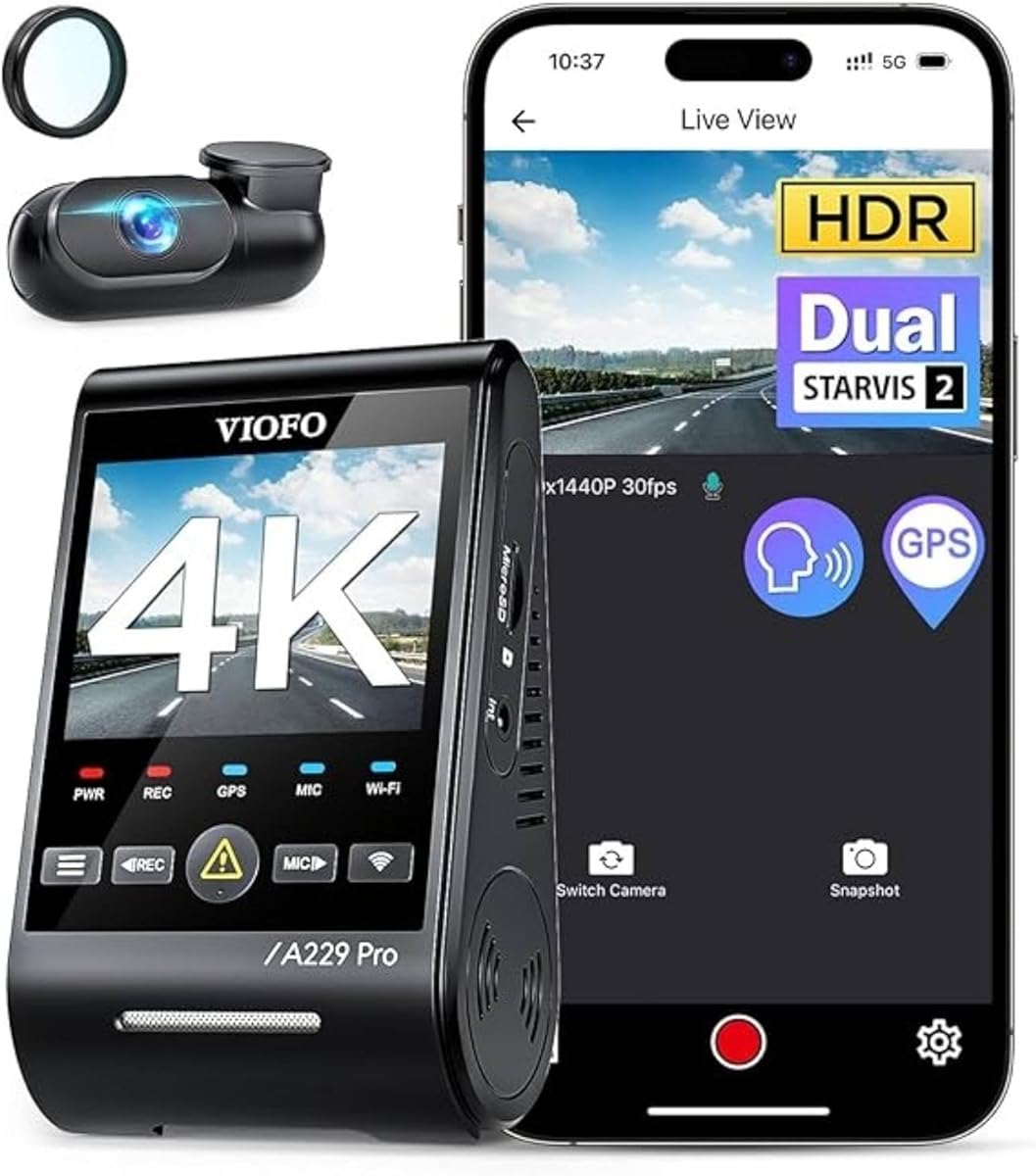
The VIOFO A229 Pro is a front-and-rear system distinguished by using two flagship STARVIS 2 sensors. The front camera pairs a 4K 2160p mode with the IMX678, while the rear records at 2K 1440p through an IMX675. Its 4.2 rating reflects a capable, premium-oriented design that focuses on road detail rather than cabin surveillance.
We may earn a commission when you buy through this link, at no additional cost to you.
HDR is applied to both cameras to retain information in bright and dark areas. The stated Night Vision 2.0 processing is intended to support license plate recognition during high-speed nighttime driving, while the included circular polarizing filter helps reduce reflections from windshields and road surfaces. Voice control includes commands for taking photos, locking video, managing Wi-Fi and audio, and switching between camera views.
The parking system offers buffered event detection, low-bitrate recording, and time-lapse. With buffering enabled, the camera can retain 15 seconds before and 30 seconds after an event, which is valuable when the precise beginning of a collision is unclear. Quad-mode GPS supports GPS, BeiDou, Galileo, and GLONASS, adding route, speed, and timestamp information to recordings.
This is an excellent choice for performance-oriented drivers who want a very detailed front image and a rear camera that surpasses the common 1080p standard. A suitable high-endurance card must be selected separately, and parking use requires an HK4 hardwire kit. Those additions do not undermine the core appeal for buyers who value imaging quality, GPS accuracy, and useful event buffering.
The IMX678 front sensor and IMX675 rear sensor support native high-resolution capture rather than relying on digital upscaling. Dual HDR balances headlights, road signs, and surrounding shadows for clearer incident evidence.
The included CPL filter reduces glare that can obscure plates and vehicles. Buffered parking detection adds pre-event footage, giving owners a more complete account of how a detected event unfolded.
We may earn a commission when you buy through this link, at no additional cost to you.
The REDTIGER F17 Elite is the editor's choice because it combines true 4K front recording, a 2.5K rear channel, 1080p cabin footage, and full-color night performance. Its 8MP IMX678 front sensor and 4MP IMX675 rear sensor are supported by HDR and advanced processing, producing a detailed three-camera package with a 4.2 rating.
We may earn a commission when you buy through this link, at no additional cost to you.
Full-color night vision is the feature that distinguishes it from many cabin-oriented dash cams. Rather than relying on grainy black-and-white output, the front and cabin channels can retain color in low light. This may improve the ability to identify clothing, faces, vehicle colors, and other details during nighttime events. The rear camera adds a higher-resolution view behind the vehicle than the 1080p standard common among competitors.
5.8GHz Wi-Fi 6 supports app transfers stated at up to 30MB/s, while built-in GPS stores route, speed, and location data. Voice commands, a touchscreen, and a customizable cabin-camera toggle make the system easy to manage and more privacy-conscious. The included 128GB card supports loop recording, G-sensor event locking, and expansion to 512GB. A supercapacitor supports operation in extreme temperatures.
The F17 Elite is the strongest recommendation for drivers who want full three-channel coverage and insist on color nighttime video. It suits rideshare operators, families, and anyone who needs evidence from the road, cabin, and rear simultaneously. Parking monitoring requires a hardwire kit, and the rear camera is not 4K, but the overall balance of resolution, color, storage, and connectivity is exceptionally strong.
Full-color output can preserve information that monochrome infrared footage may lose, particularly around clothing, faces, and vehicle paint. HDR further improves the balance between bright headlights and the surrounding darkness.
Wi-Fi 6 and stated transfer speeds of up to 30MB/s make it quicker to move important clips to a phone. GPS overlays and the included 128GB card add useful context without requiring an immediate card-formatting routine.
We may earn a commission when you buy through this link, at no additional cost to you.
The Vantrue N4 Pro S is the premium pick, combining a 4K front camera, 2.5K rear camera, and 1080p interior channel with a STARVIS 2 sensor at each position. It has a 4.4 rating and broad 155-degree, 160-degree, and 165-degree fields of view. The result is one of the most complete imaging configurations in the roundup.
We may earn a commission when you buy through this link, at no additional cost to you.
Night Vision 4.0, PlatePix processing, and triple HDR form the core low-light system. The manufacturer states that this combination improves license plate accuracy in dim conditions and strong backlight, with plate recognition claimed at speeds up to 31mph in the specified night-driving scenario. The 2.5K rear camera can rotate 360 degrees, allowing it to monitor traffic or the trunk and cargo area.
A front-and-rear mode prioritizes road recording and is stated to reduce heat by 30 percent compared with triple recording, improving efficiency during hot weather. Buffered parking detection retains 10 seconds before an event, while all three cameras remain active in parking mode. Storage can reach 1TB, with more than 37 hours of continuous triple-channel 4K recording claimed under supported conditions.
The N4 Pro S is best for buyers who want a premium, versatile system rather than the simplest front-and-rear setup. It is especially relevant to rideshare drivers, families, and road-trip users who value rear-camera flexibility, triple sensors, and large storage capacity. A high-endurance card and hardwire kit must be added separately, but the core hardware is among the most advanced listed.
Each channel uses STARVIS 2, while the front and rear cameras deliver 4K and 2.5K respectively. The result preserves useful detail around the vehicle rather than relying on one high-resolution camera and two basic companions.
The rotating rear camera and selectable front-and-rear mode make it possible to prioritize either traffic monitoring or cabin coverage. The lower-heat dual mode can also improve sustained operation in warm environments.
We may earn a commission when you buy through this link, at no additional cost to you.
The VIOFO A119 Mini 2 is the simplest and most compact choice in the guide. It is a one-channel front camera with a STARVIS 2 IMX675 sensor, a 2K 60fps mode, and a 4.3 rating. Unlike most other products here, it does not support a rear camera, so it should be considered for drivers who specifically want a small, unobtrusive forward-facing unit.
We may earn a commission when you buy through this link, at no additional cost to you.
The camera records at 2560 by 1440 pixels and 60fps, with a maximum 2592 by 1944 mode at 30fps. Its 140-degree lens gives a broad view of the road, while the seven-glass f/1.6 lens and DOL-HDR help manage the transition between bright and dark areas. Enabling HDR reduces the 60fps option to 30fps, an important setting tradeoff for buyers who want the highest frame rate.
The mini enclosure is easy to conceal behind or beside a rear-view mirror. Built-in 5GHz Wi-Fi provides faster app transfers, while GPS synchronizes the time and records route, speed, and timestamp information. Voice controls can lock video, take photos, and manage Wi-Fi, and buffered parking detection can save 15 seconds before and 30 seconds after an event. Parking operation requires the separately sold HK4 hardwire kit.
This is a strong recommendation for drivers who prioritize compact installation, smooth high-frame-rate capture, and a front-facing STARVIS 2 camera. It is not appropriate for anyone requiring rear or cabin evidence. A compatible Class-10 or UHS-I high-endurance card up to 512GB is also needed, but the core camera is well suited to unobtrusive daily recording.
The compact body is easier to conceal than many screen-equipped models. Its 2K 60fps mode can make moving vehicles and road details appear smoother, provided HDR is disabled and lighting is sufficient.
DOL-HDR helps balance the intense brightness of headlights against dark roads. Built-in GPS adds route, speed, and time information, making the simple front-only setup more useful for documenting journeys.
We may earn a commission when you buy through this link, at no additional cost to you.
Choosing the right STARVIS 2 dash cam involves balancing nighttime image quality, camera coverage, parking behavior, storage, power requirements, and installation constraints. The sensor is only one part of the imaging system, so aperture, HDR processing, lens design, and resolution should be evaluated together.
Front-only cameras are compact and reduce installation complexity, while front-and-rear systems provide evidence of vehicles approaching from behind. Three-channel systems add an interior camera for passenger, cabin, and rideshare monitoring. Consider whether you regularly carry passengers, operate a delivery vehicle, or need rear-facing context during a collision rather than selecting the highest channel count available.
Native 4K records four times the pixels of 1080p and can preserve more detail at a distance. An upscaled 4K mode starts with lower-resolution footage and increases its output dimensions digitally, which may look sharper on some displays without creating the same amount of original detail. Check whether each channel is recorded natively and whether HDR or high frame rates reduce the selected resolution.
A STARVIS 2 sensor improves light sensitivity, but aperture, HDR, optical lens quality, and image processing determine how effectively that information becomes readable footage. Look for a wide front aperture, balanced exposure, and dedicated low-light processing. Full-color night footage can help identify clothing, faces, and vehicle colors, while infrared cabin recording is useful mainly for shape and movement.
Dash cams write continuously, making a high-endurance microSD card more useful than a card chosen solely for price. Check the included capacity, maximum supported capacity, and whether the manufacturer recommends a specific endurance card or speed class. Multi-channel systems consume more space, while larger cards can support longer recording windows and less frequent overwriting.
Collision detection, motion activation, time-lapse, and buffered recording serve different purposes. Buffered modes preserve footage before an event, while low-bitrate time-lapse reduces storage use. Most parking modes require a hardwire kit for continuous power, and the kit is usually sold separately. Confirm fuse-box compatibility and installation requirements before choosing a model.
Wi-Fi makes recordings easier to preview, download, configure, and share, while dual-band or Wi-Fi 6 connections can accelerate transfers. GPS adds route, speed, location, and synchronized time information, which is valuable for trip records and incident context. Some compact models include these features while others do not, so verify each specification rather than assuming they are standard.
A dashboard-mounted camera operates in temperatures that can shorten the life of a conventional lithium battery. Supercapacitor-based systems are designed for more stable thermal performance, although operating ranges vary by model. Also consider mounting location, cable length, adhesive quality, windshield obstruction, and whether the rear camera requires careful routing through the vehicle trim.
Daily commuters may prioritize compactness, quick Wi-Fi access, and front-and-rear coverage. Rideshare and delivery drivers often benefit from a cabin camera, privacy controls, voice commands, and buffered parking detection. Families may value full-color nighttime recordings and flexible rear-camera positioning. Comparing the actual use case prevents paying for sophisticated features that will remain unused.
Begin by identifying a clean section of the windshield for the front camera, keeping the lens within the driver's clear view. Mount the rear camera securely, route its cable away from airbags and sharp trim edges, and test the connection before hiding any wiring. Insert a compatible high-endurance microSD card and format it using the camera or app before recording important journeys.
Configure the recording channels, resolution, frame rate, HDR behavior, motion sensitivity, and screen or voice preferences. Set date and time through the app so GPS information remains accurate, then test both live view and file playback. If parking surveillance is required, install the appropriate hardwire kit with the vehicle safely powered down and confirm the parking mode activates as expected.
Review downloaded footage periodically, save important events outside the normal loop cycle, and keep storage available for new recordings. Clean the lenses with a soft lint-free cloth, avoid leaving the camera exposed to severe heat without power disconnected, and check cables and mounts periodically. Software updates through the manufacturer app can improve operation or fix compatibility issues when supported.
No. STARVIS 2 improves light sensitivity and can produce cleaner, more detailed low-light images, but the final result also depends on aperture, lens quality, HDR, sensor size, motion, and illumination. A well-designed camera with STARVIS 2 generally has a stronger foundation for nighttime recording than a comparable system using an older or less capable sensor.
Native 4K captures four times as many pixels as 1080p and generally retains more fine detail when the image is cropped or enlarged. Upscaled 4K can still look useful and may be sharper on a display, but it cannot recreate original detail that was never captured. Consider frame rate and HDR trade-offs as well as resolution.
Three-channel systems add an interior view, which is useful for rideshare drivers, families, and anyone concerned about cabin incidents. A front-and-rear system is usually sufficient for ordinary commuting and road evidence. A front-only camera can be the simplest option when discretion and minimal wiring matter more than comprehensive coverage.
Most models offer time-lapse, motion, or collision-triggered parking modes, but continuous parking operation normally requires a separate hardwire kit. The kit connects the camera to a suitable vehicle power source so it can remain active without draining the battery. Check the manual and kit compatibility before installation.
Dash cams continuously rewrite files, which places a heavier and more repetitive workload on memory cards than ordinary photography does. A high-endurance card is designed to handle sustained sequential writes and helps reduce the risk of recording gaps or corrupted files. Capacity should be chosen according to the number of channels and the desired recording window.
It can. The VIOFO A119 Mini 2, for example, records at 60fps without HDR but falls to 30fps when HDR is enabled. Other models may handle these settings differently, so review the stated operating modes before choosing a resolution and frame-rate combination.
GPS is not essential for basic collision recording, but it adds route, location, speed, and time data to recordings. Those details can help establish where an event occurred and when it happened. It is particularly useful for long trips, rideshare documentation, and drivers who review footage for route or speed context.
Choose a camera with STARVIS 2, a wide aperture, HDR, and native high resolution, then keep the lens clean and correctly aligned. Stable lighting and slower relative movement also help because motion blur and glare cannot be fully recovered by processing. Avoid expecting digital enhancement to produce information that the lens and sensor did not capture.
The REDTIGER F7N TOUCH stands out as a well-rounded dual-channel option, while the ROVE R2-4K Dual pairs strong low-light hardware with polished wireless controls. For buyers seeking the most complete feature set, the REDTIGER F17 Elite delivers true 4K front video, full-color night recording, and fast Wi-Fi 6 transfers, with the Vantrue N4 Pro S representing the premium three-sensor alternative.
Before choosing, prioritize native resolution, sensor placement, aperture, and HDR rather than looking only at marketing labels. Match the camera count to your driving needs, confirm whether parking mode requires a hardwire kit, and select a high-endurance card with enough capacity. Compact single-camera users can still find strong nighttime performance in the VIOFO A119 Mini 2, while budget-focused buyers can consider the BOTSLAB G300H Plus.
Finally, verify the current specifications, included accessories, and product availability before purchasing, because manufacturer bundles and features can change over time. Prices also fluctuate, so compare the complete feature set rather than selecting a model on cost alone. The right STARVIS 2 dash cam is the one that captures the views, detail, and parking behavior you actually need.