
Mroinge MBC022
4.6Editor score
Five-stage smart charging
Supports two battery chemistries
Twelve-foot output cord
Compare 10 LiFePO4 battery trickle charger and maintainer options for LiFePO4 and lead-acid batteries, with charging stages, safety, displays, and compatibility
A LiFePO4 battery wall trickle charger and maintainer is more than a convenience for stored vehicles and equipment. It helps preserve battery charge, supports healthy storage, and provides the controlled charging profile needed by lithium and lead-acid chemistries. The best unit should match your battery voltage, offer useful safeguards, and make status information easy to understand.
We compared ten wall-powered chargers across LiFePO4 and lead-acid compatibility, charging stages, output current, connection options, displays, repair functions, temperature compensation, and safety protections. The list includes compact maintainers for motorcycles and powersports as well as higher-current models intended for cars, trucks, marine equipment, and seasonal machinery.
Each pick highlights a different reason to buy: the Mroinge MBC022 stands out for value and broad compatibility, the Battery Tender Junior prioritizes simple powersport care, and the Antigravity SC-4 provides advanced diagnostics and lithium battery features. Product availability and pricing can change, so confirm the current specifications before purchasing.
4.6Editor score

4.8Editor score

4.7Editor score
The table below compares all ten chargers by supported chemistries, charging capacity, display capabilities, and notable maintenance functions to help you identify the right model for your battery and application.



The Mroinge MBC022 is a versatile 2A wall charger with a 4.6 rating, combining lead-acid and LiFePO4 support in a relatively approachable package. It is intended for motorcycles, cars, marine batteries, ATVs, lawn mowers, RVs, and other equipment using compatible 12V batteries. Its defining feature is a five-stage process that moves from initialization through bulk charging, absorption, and float maintenance rather than applying a constant low current.
We may earn a commission when you buy through this link, at no additional cost to you.
Safety is a major strength of this model. The listed protections cover reverse polarity, short circuits, overcharging, excessive temperature, dust exposure, and sparking during proper connections. It can also identify a bad battery and offers a low-voltage activation function for compatible 12V LiFePO4 batteries. Capacity support extends to batteries up to 85Ah, while the included battery clips and O-ring terminals make it suitable for both temporary and more permanent hookups.
The main inconvenience is operational. The instructions specifically advise disconnecting the battery before changing the charge mode, which adds a step when you own multiple battery types. It also lacks the large data screens and advanced lithium diagnostics found in higher-end models. Nevertheless, the long output cord, five-stage logic, and broad safety coverage make it an economical general-purpose maintainer.
Choose the MBC022 if you want one charger for a mixed garage of compatible 12V lead-acid and lithium batteries without paying for a large diagnostic display. It is particularly well suited to seasonal motorcycles, ATVs, lawn equipment, and stored vehicles. For users who prioritize simplicity over sophisticated monitoring, it offers a strong feature set at a modest tier.
Supporting flooded, AGM, gel, SLA, and LiFePO4 batteries means users can consolidate equipment maintenance around one unit. The selectable chemistry and automatic five-stage process reduce the need for separate chargers.
Reverse-polarity, overcharge, short-circuit, and thermal protections make the charger a practical choice for unattended storage periods. The LED indicators also provide useful charging and diagnostic feedback.
We may earn a commission when you buy through this link, at no additional cost to you.
The Battery Tender Junior carries the highest customer rating in this roundup at 4.8 and is a strong all-around recommendation for powersports. Its 800mA output is intentionally modest, making it better suited to motorcycles, ATVs, UTVs, personal watercraft, and scooters than to large discharged vehicle batteries. The compact housing is also easy to operate in crowded garages or storage areas.
We may earn a commission when you buy through this link, at no additional cost to you.
Its standout feature is uncomplicated battery selection. A push of a button lets the user choose between lead-acid, including AGM, flooded, and gel batteries, and LiFePO4 chemistry. An ISM microcontroller continually adjusts the charge sequence, while the automatic maintenance behavior keeps the battery at an appropriate storage level. Spark-proof lead connection and automatic reverse-polarity detection improve setup safety.
The trade-off is a narrow electrical range. It handles 12V batteries only and its lower current may take longer than a 4A, 5A, 10A, or 15A charger on a deeply depleted battery. The supplied information also does not indicate a built-in voltage display, so users who want continuous amperage and voltage readings should look elsewhere. Even so, its certifications and five-year warranty add confidence.
This is the most sensible pick for someone maintaining several smaller powersport batteries who values reliability, compactness, and simple controls. Choose it for seasonal motorcycles, ATVs, scooters, and watercraft where a low-output maintainer is appropriate. For large trucks, deeply discharged batteries, or users who need 6V support, one of the higher-output or dual-voltage models will serve better.
The 800mA output is well aligned with smaller 12V powersport batteries and offers a gentler maintenance approach. Its lightweight housing makes it easy to carry between a storage area and different machines.
A button-controlled lithium or lead-acid selection avoids complicated menus. Adaptive charging then manages the selected battery type without demanding frequent user intervention.
We may earn a commission when you buy through this link, at no additional cost to you.
The ECO-WORTHY 12V 10A is a higher-current option for users who need more recovery speed than a compact maintainer can provide. Its 4.6 rating reflects a broadly capable charger designed for both 12V lead-acid and LiFePO4 batteries. A 10A output can meaningfully reduce charging time compared with the 2A and 800mA models in this list.
We may earn a commission when you buy through this link, at no additional cost to you.
The charger goes beyond basic trickle charging with intelligent detection of low voltage, vulcanization, and capacity loss. Rather than treating every battery as identical, it can prompt the user to repair and charge a battery or indicates when a battery may have lost value. It is fully automatic, making it suitable for cars, motorcycles, lawn mowers, ATVs, trucks, boats, personal watercraft, and classic cars.
Connection hardware is well considered. The included battery clips, O-ring terminal cable, and fused SAE connector offer several practical options, while plug-and-play connectivity simplifies setup. The absence of a stated LCD means users receive less detailed visual information than with the PZ.P, GOOLOO, or Antigravity. Also, unlike some alternatives, it is limited to 12V operation rather than 6V or 24V.
Choose the ECO-WORTHY 10A when a depleted car, truck, boat, or lawn tractor battery needs faster charging and you still want automatic maintenance. It is less suited to a collection of tiny powersport batteries where a gentler 800mA unit would be more appropriate, or to 6V and 24V systems. For its intended 12V garage, it balances power, diagnostics, and flexible connections well.
A 10A output is better suited to sizable automotive and marine batteries than the low-current maintainers in this roundup. It provides more recovery capacity while preserving automatic float-style maintenance.
Battery clips, ring terminals, and a fused SAE lead support temporary, semi-permanent, and accessible installations. This makes the charger useful across a varied collection of vehicles and equipment.
We may earn a commission when you buy through this link, at no additional cost to you.
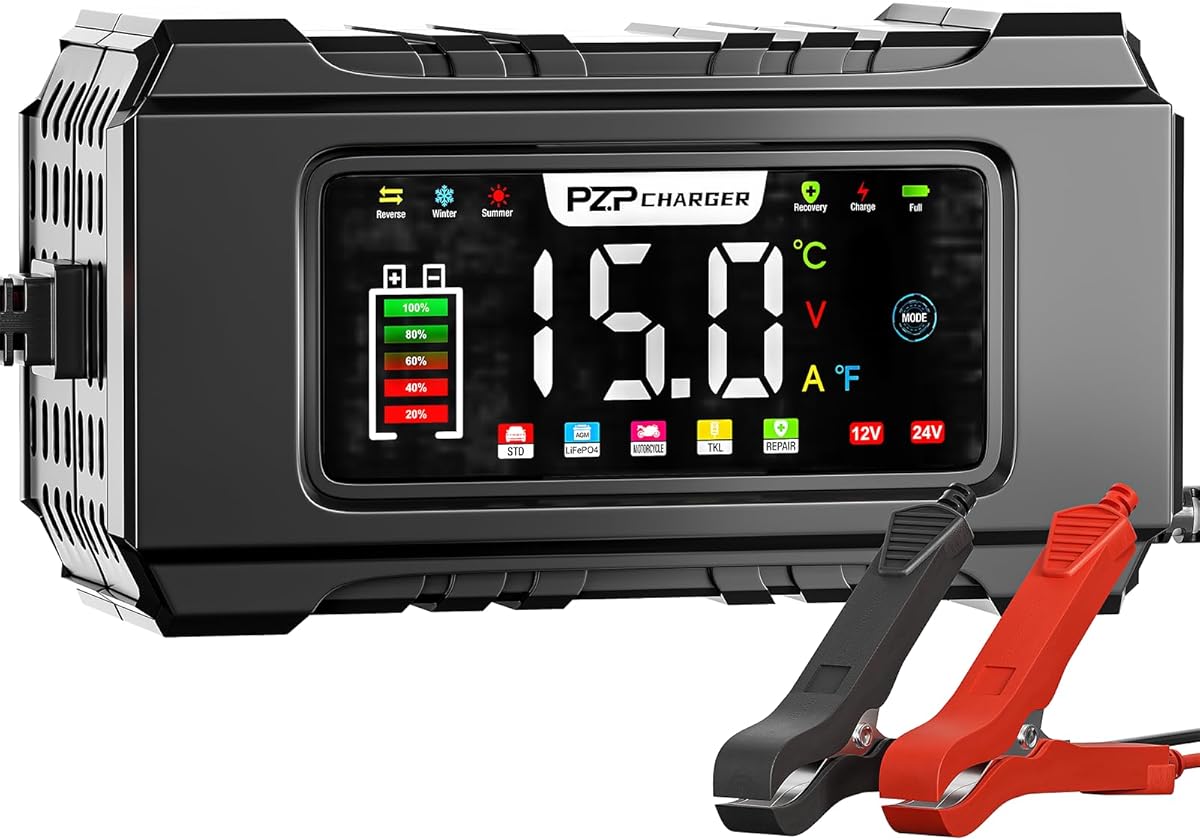
The PZ.P 15-Amp charger stands out for unusual electrical flexibility and a 4.5 rating. It supports 12V and 24V LiFePO4 and lead-acid batteries, including AGM, gel, SLA, and flooded types. At 12V it delivers up to 15A, while the 24V setting provides up to 8A, giving it broader applicability than chargers restricted to one system voltage.
We may earn a commission when you buy through this link, at no additional cost to you.
Its nine-stage process automatically transitions to trickle or float maintenance after bulk charging. A large color screen displays voltage, current, internal temperature, charge percentage, and seasonal modes. The screen remains readable in direct sunlight, and a six-and-a-half-foot charging cable improves access to awkward battery positions. This combination of monitoring and reach is particularly useful for working vehicles and larger equipment.
The charger also includes temperature compensation and protections against reverse polarity, undercharging, overcurrent, overvoltage, short circuits, and overheating. A one-click pulse repair function is advertised for sulfation and acid stratification, although the product explicitly notes that it cannot activate or charge a completely dead battery. It is also a charger rather than a jump starter, an important distinction when emergency starting might be expected.
This model fits buyers who own several battery voltages or want unusually high current in a wall charger. It is a strong option for 12V trucks, SUVs, motorcycles, boats, and lawnmowers, as well as compatible 24V systems. The 24V setting broadens its reach, but the complex display and numerous modes may feel excessive for someone who only needs to maintain one small motorcycle battery.
Supporting 12V and 24V batteries reduces equipment clutter for mixed fleets. Users must still select the correct voltage and chemistry for each application.
The color screen provides substantially more information than basic LED chargers. Voltage, current, temperature, state of charge, and seasonal mode can all be checked at a glance.
We may earn a commission when you buy through this link, at no additional cost to you.
The ECO-WORTHY 12V 5A occupies a practical middle ground between compact trickle chargers and higher-current automotive models. It has a 4.5 rating and supports 12V lead-acid and 12V LiFePO4 batteries. Five amps is sufficient for routine maintenance and more practical than a very low-output unit when a battery has lost a meaningful amount of charge.
We may earn a commission when you buy through this link, at no additional cost to you.
Automatic operation is the core appeal. The charger detects low voltage, vulcanization, and loss of capacity, then alerts the user to repair and charge the battery or notes when it may have diminished value. It also functions as an automatic maintainer rather than simply supplying an unchanging trickle current. Its input range of 100-240V AC is broader than the 100-120V or 100-110V ranges listed for some competitors.
The included battery clips, O-ring terminal cables, and SAE connector with a 10A fuse offer flexible attachment options. Suitable applications include cars, motorcycles, ATVs, lawn tractors, trucks, SUVs, boats, personal watercraft, and classic cars. One limitation is that no detailed screen or amperage readout is specified, so the visual information is less extensive than on the PZ.P or GOOLOO.
Choose this ECO-WORTHY model for users who want more charging capability than a basic maintainer without the complexity of a nine-stage display system. It is also attractive for travel or use in regions with varied mains power because of its wide input range. Buyers needing 6V or 24V support, precise live readings, or a lithium BMS reset should choose a more specialized model.
Five amps gives the charger enough flexibility for larger 12V batteries while remaining less aggressive than the 10A and 15A alternatives. It suits both routine topping up and more deliberate recovery charging.
Automatic detection can direct users toward repair when a battery shows signs of sulfation or lost capacity. Clips, ring terminals, and a fused SAE lead make the same charger useful across temporary and installed setups.
We may earn a commission when you buy through this link, at no additional cost to you.
This 2A maintainer is notable for handling both 6V and 12V batteries, giving it more voltage flexibility than most 12V-focused models. It supports common 6V and 12V lead-acid chemistries, including wet, AGM, gel, SLA, and VRLA, along with compatible 12V LiFePO4 batteries that have a built-in battery management system. A 4.4 rating reflects a capable entry for mixed equipment.
We may earn a commission when you buy through this link, at no additional cost to you.
The charger uses a mode button for voltage and chemistry selection. After charging, its microcontroller automatically enters float maintenance and continues monitoring battery status. A lead-acid pulse repair function may help certain batteries affected by sulfation or acid stratification, but it must never be used with lithium chemistry. It also cannot restore frozen, leaking, swollen, internally shorted, or physically damaged batteries.
Its ten-foot reach consists of an eight-foot AC cord and a two-foot DC lead. Heavy-duty alligator clips support temporary hookups, while fused ring terminals provide a cleaner option for ongoing storage. A built-in thermal sensor adjusts the charging process according to ambient temperature, and protection circuits address reverse polarity, short circuits, overvoltage, overcurrent, and overheating.
Choose this charger if your garage includes 6V lead-acid equipment alongside 12V batteries or if the 12V unit's ten-foot reach is particularly useful. It is best treated as a maintainer and recovery charger for compatible batteries, not a rapid solution for severely depleted high-capacity packs. Confirm the correct mode before connecting lithium, especially if pulse repair is active.
Six-volt support is uncommon among compact maintainers and is valuable for classic cars and other compatible equipment. The mode button keeps the voltage choice visible and manageable.
The thermal sensor allows charging adjustments as ambient conditions change. Pulse repair may help certain lead-acid batteries, but it must remain separate from LiFePO4 operation.
We may earn a commission when you buy through this link, at no additional cost to you.
The Battery Tender 4 AMP is a well-rounded automotive maintainer with a 4.7 rating. It supports 6V and 12V lead-acid batteries, including flooded, AGM, and gel, as well as LiFePO4 chemistry. A four-amp output gives it enough authority for cars, SUVs, and trucks while remaining manageable for batteries that are simply being stored.
We may earn a commission when you buy through this link, at no additional cost to you.
The adaptive ISM system is one of the most important details. After fully charging, the unit switches to float mode to maintain the battery at an appropriate level. If voltage falls too far under load, charging resumes at full output. A solid-state two-color LED indicates charging status without overwhelming the user with a complex display. The compact housing is designed to fit into small storage spaces.
Its combined eleven-foot reach includes a six-foot AC cord and five-foot DC output lead. Ring terminals and alligator clips are included, allowing a semi-permanent connection for storage. Spark-proof connection behavior and automatic reverse-polarity detection improve safety. The charger carries UL, CSA, CE, and BC approvals, along with a five-year warranty and lifetime customer service.
This is a strong choice for owners of a mixed 6V and 12V garage who want automatic maintenance without a large display. It also suits vehicles that see intermittent use and may benefit from resumed charging after a load event. The main limitation is its simple LED feedback, which will not satisfy someone who needs live voltage, current, temperature, or charge percentage readings.
A battery that loses voltage under load can trigger the charger to resume full output. This makes the maintainer more useful for active vehicles than a passive storage-only device.
The unit fits neatly in small workspaces despite its automotive capability. Eleven feet of combined cord and two connection styles provide flexibility around vehicles and stored equipment.
We may earn a commission when you buy through this link, at no additional cost to you.
The Suuwer 2A maintainer is a broad-purpose 12V charger rated 4.5. It works with lead-acid batteries, including flooded, AGM, and gel, as well as LiFePO4 chemistry. Its list of compatible equipment is extensive, covering vehicles, recreational machines, marine equipment, aircraft, golf carts, generators, alarm systems, emergency lighting, standby power supplies, and telecommunications equipment.
We may earn a commission when you buy through this link, at no additional cost to you.
The four-stage program includes initialization, bulk charging, absorption, and float maintenance. This allows the charger to complete a more structured charge before maintaining storage voltage. Temperature compensation adjusts the charging voltage to ambient conditions, while protections cover reverse polarity, short circuits, overcurrent, and overvoltage. Red and green LEDs communicate charging, completion, maintenance, and common connection errors.
Its generous twelve-foot DC cord is particularly useful for reaching batteries in cars, boats, and tightly parked equipment. Large battery clips and O-ring terminals provide two connection approaches. The simplicity is both a strength and a limitation: users get clear state feedback but not a numeric screen showing voltage, current, temperature, or estimated capacity.
Choose the Suuwer when you need a dependable 12V maintainer for a wide assortment of stored equipment and value long reach. It works well for motorcycles, ATVs, boats, lawn tractors, snowmobiles, and backup systems. If you own 6V or 24V batteries, require a built-in voltage tester, or want a lithium BMS wake-up function, a more specialized charger is the better fit.
The four-stage process ends in float maintenance instead of continuing an uncontrolled low-current charge. This is useful for batteries that remain connected during long storage periods.
Compatibility extends to standby power, emergency lighting, generators, golf carts, and communications equipment. This broad range makes the maintainer useful beyond a typical automotive garage.
We may earn a commission when you buy through this link, at no additional cost to you.
The GOOLOO S4 combines a 4A output with a ten-stage intelligent charging program, earning a 4.5 rating. It supports 6V and 12V lead-acid batteries across WET, SLA, GEL, AGM, FLOODED, and VRLA types, plus 12V LiFePO4 batteries. That makes it a flexible choice for classic cars, modern vehicles, motorcycles, lawn equipment, and marine applications.
We may earn a commission when you buy through this link, at no additional cost to you.
Its strongest differentiator is the ability to charge batteries as low as three volts. Pulse-current charging and a desulfation function are included to address lost performance in suitable lead-acid batteries. The charging program adapts to ambient temperature, reducing the likelihood of overcharging in hot conditions and undercharging in cold ones. The LCD displays voltage, mode, and battery level, while a blinking V indicates maintenance mode.
A limitation is that pulse repair is principally relevant to lead-acid chemistry and should not be treated as a universal lithium recovery function. The charger is also limited to 6V and 12V systems, so owners of 24V commercial batteries will need another model. Compared with the PZ.P, it offers less elaborate information because the screen does not list every internal measurement.
Choose the GOOLOO S4 when you want a capable maintainer with a ten-stage recovery process, an LCD, and support for both 6V and 12V batteries. It is particularly appealing for owners of older lead-acid equipment that may benefit from pulse charging. For a 24V system or more extensive lithium diagnostics, look to the PZ.P or Antigravity.
Three-volt charging capability gives the S4 an advantage when a compatible battery has been deeply discharged. Actual results still depend on battery condition, and the product is not a jump starter.
The ten-stage program responds to different battery conditions and ambient temperatures. The LCD gives users enough feedback to identify the active mode and maintenance status.
We may earn a commission when you buy through this link, at no additional cost to you.
The Antigravity SC-4 is the most feature-oriented premium pick in the roundup, combining a 4.7 rating with 4A charging, an LCD, a built-in voltage tester, and lithium-specific battery management system functions. It supports 6V and 12V LiFePO4 batteries and 12V lead-acid types including AGM, flooded, gel, SLA, and VRLA. The model is designed for controlled garage or workshop charging rather than emergency jump starting.
We may earn a commission when you buy through this link, at no additional cost to you.
The large digital display provides real-time voltage, charging current, state of charge, and active mode. Because it includes a voltage tester, users can check battery condition without carrying a separate multimeter. A particularly notable lithium feature is BMS Wake-Up/Reset, which can help compatible batteries that have entered protection mode. Automatic winter mode and advanced lead-acid reconditioning add further season-specific and recovery functions.
Operation remains approachable through two buttons, but the range of features may be unnecessary for a simple storage task. Six-volt support is specified only for lithium, while lead-acid applications remain at 12V. The supplied connection options include clamps, an SAE pigtail, and a cigarette-lighter adapter for Power Supply mode, making the charger more versatile than a basic hardwired maintainer.
Choose the SC-4 when your priority is detailed battery intelligence, particularly if you own LiFePO4 systems that may need BMS recovery. It is also well suited to workshops where real-time readings and diagnostics are valuable. Buyers seeking simple on/off maintainers for one lead-acid motorcycle battery can find the same core job completed with less complexity by a less advanced model.
BMS wake-up and reset can address compatible lithium batteries that have gone into protection mode. This focused feature gives the SC-4 an advantage for owners of modern LiFePO4 installations.
The integrated voltage tester and detailed LCD reduce the need for independent measuring equipment. Seeing voltage, current, state of charge, and active mode helps make maintenance decisions more informed.
We may earn a commission when you buy through this link, at no additional cost to you.
The right wall charger depends on battery chemistry, voltage, capacity, and how often the equipment is used. Use the following factors to narrow the options before making a final selection.
Confirm that the charger explicitly supports the chemistry installed in your battery. Most products in this guide handle both LiFePO4 and common lead-acid types, but a lead-acid-only repair mode must never be applied to lithium. AGM, gel, flooded, and sealed batteries can have different charge requirements, so verify that the model covers the exact type you own rather than relying on a generic lead-acid label.
Voltage is a non-negotiable compatibility factor. Most powersport and automotive batteries are 12V, but some classic vehicles and equipment use 6V, while commercial applications may require 24V. The PZ.P supports both 12V and 24V, the Battery Tender Junior focuses on 12V, and the Antigravity supports 6V and 12V lithium plus 12V lead-acid. Match the setting to the battery before attaching power.
Charging current determines how quickly a depleted battery can recover and how appropriate the charger is for its size. An 800mA maintainer is gentle and convenient for small powersport batteries, while 2A models suit routine maintenance. Four- and five-amp chargers offer more flexibility for mid-size batteries, and 10A or 15A models are better for larger automotive and marine applications. Higher output is not automatically better if the battery or wiring is not designed for it.
A true smart charger uses multiple stages to move from initialization through bulk charging, absorption, and float maintenance. This is generally preferable to a constant trickle because it responds to the battery's state and reduces the risk of prolonged overcharging. Pulse repair and reconditioning modes can help certain sulfated lead-acid batteries, but they do not restore physically damaged or badly depleted lithium packs.
Cold temperatures can make a battery accept charge less efficiently, while heat can make overcharging more likely. Temperature compensation adjusts charging behavior according to ambient conditions, and dedicated winter modes can further tailor the profile. This is especially valuable for batteries stored outdoors or maintained through seasonal temperature swings. Verify whether compensation is based on ambient temperature, an internal sensor, or a selectable operating mode.
Look for reverse-polarity detection, spark-resistant hookups, overcharge protection, short-circuit protection, and thermal safeguards. These features reduce the consequences of an incorrect connection or an electrical fault. Ring terminals are convenient for semi-permanent installations, while alligator clips are convenient for occasional charging. Fused leads and SAE connectors add protection and make setup faster, particularly in crowded engine compartments.
Basic LED indicators can show charging, completion, maintenance, and connection errors without overwhelming the user. An LCD adds voltage, current, state of charge, temperature, and operating mode, which is useful for diagnosing battery health or confirming winter settings. The GOOLOO, PZ.P, and Antigravity provide screens, while the Mroinge, Suuwer, Battery Tender models, and ECO-WORTHY chargers emphasize simpler status feedback.
LiFePO4 batteries with internal battery management systems may need wake-up or reset support after entering protection mode. The Antigravity SC-4 is the clearest example in this list, offering BMS Wake-Up/Reset along with 6V and 12V lithium support. These functions are not universal, so check that your exact battery is compatible. No charger can compensate for internal damage, deep cell imbalance, or an unsafe battery.
Begin by identifying the battery voltage, chemistry, and terminal polarity. Consult the charger and battery instructions, then select the matching mode before attaching the leads. For a temporary connection, attach the positive clip first and the negative clip second. When removing the charger, reverse that order. Some models require the battery to be disconnected when changing chemistry or charge modes, so follow the product-specific directions.
Place the charger in a dry, ventilated location away from combustible materials, excessive heat, and standing water. The AC outlet and battery leads should be arranged so they cannot be pinched, cut, or exposed to moving parts. For a semi-permanent installation, use the supplied ring terminals and ensure the connection remains clean and secure. Recheck polarity before switching the charger on.
Allow the charger to complete its charging stages and move into float or maintenance mode. Inspect the connection and status indicators periodically, especially during long storage periods. Disconnect the charger before servicing the vehicle or battery, and never use a charger on a swollen, leaking, frozen, internally shorted, or physically damaged battery. Clean corrosion from terminals with appropriate tools, store the charger dry, and use only the original compatible power supply and connection leads.
Yes, but it must have separate, clearly identified modes for the two chemistries. LiFePO4 and lead-acid batteries use different charge characteristics, so never assume a generic lead-acid setting is appropriate for lithium. Select the chemistry manually, follow the instructions, and confirm the voltage and terminal polarity before connecting.
A constant trickle can be inappropriate because it may continue pushing current without responding to the battery's actual state. A smart charger is preferable because it monitors the battery, completes controlled charge stages, and then reduces or stops current. Use the lithium-specific mode and avoid a dedicated lead-acid pulse repair function on LiFePO4.
A maintainer can remain connected during long-term storage when the charger is designed for that application and the battery is healthy. Check the model for any time limit, especially in extreme temperatures. Periodic visual inspections of the connections, cables, indicators, and battery condition are still advisable.
It depends on the charger and vehicle. Some smart chargers can connect directly to a battery, while others recommend disconnection or removal of the vehicle's negative terminal. Follow both instructions carefully, particularly before changing voltage or chemistry modes. If the manufacturer requires disconnection, do so before switching settings.
A healthy battery that has merely lost charge may recover, especially with a higher-current model. However, no charger can restore a battery that is frozen, leaking, swollen, internally shorted, or physically damaged. The PZ.P explicitly notes that its pulse repair cannot activate or charge a totally dead battery, a limitation worth considering for any similar product.
Choose a current appropriate for the battery's size and the charger's specifications. Low-output maintainers are convenient for small powersport packs, while higher-current models recover larger automotive batteries more quickly. The battery manufacturer may specify a maximum charging current, which should take precedence over a general rule of thumb.
A basic trickle charger supplies a small, relatively constant current. A smart maintainer measures the battery and follows programmed stages, usually adding bulk charging, absorption, and float maintenance. The latter is generally better suited to LiFePO4 because it adjusts output as the battery's state changes.
Only if the charger explicitly supports 6V and the battery is a compatible 6V chemistry. The Antigravity SC-4 supports 6V and 12V LiFePO4 batteries, while the 2A smart charger and GOOLOO S4 support compatible 6V lead-acid batteries. Verify every specification because not every model in this guide handles 6V or 24V systems.
The Mroinge MBC022 is the strongest budget-oriented all-rounder, combining 2A output, five-stage charging, broad lead-acid and LiFePO4 support, and extensive safety protections. The Battery Tender Junior is the most refined choice for small powersports because of its high rating, compact design, straightforward chemistry selection, and five-year warranty. The Antigravity SC-4 is the premium selection for users who value detailed LCD information, a built-in voltage tester, winter charging, and lithium BMS wake-up or reset.
Prioritize exact voltage and chemistry compatibility before comparing output or features. After that, choose enough current for the battery's size, look for a complete multi-stage program, and ensure the safety protections cover reverse polarity, overcharging, short circuits, and heat. A display is helpful for deeper diagnostics, but a well-designed LED system can be more practical when the primary goal is uncomplicated seasonal maintenance.
Finally, verify the current specifications, included accessories, warranty terms, and battery manufacturer requirements before buying. Product designs and availability can change, and prices fluctuate as well. The right charger should match your battery today while providing safe, automatic maintenance for the equipment you plan to store or use.