
WD-40 Specialist Contact Cleaner Spray
4.8Editor score
Removes flux and condensation
Quick-drying residue-free formula
Precise PCB application
Compare 10 leading Circuit Board Cleaner options for residue, drying speed, material compatibility, precision application, and safe electronics maintenance.
Circuit board cleaners are specialized contact cleaners used to remove flux, grease, dust, oxidation, and other contaminants from PCBs, connectors, switches, and sensitive electronic components. A worthwhile formula dries quickly, leaves no residue, reaches confined areas, and remains compatible with the materials it may contact.
The products in this guide were compared using their stated formulas, intended applications, drying behavior, residue claims, material limitations, packaging, and customer ratings. The list covers aerosol, brush-assisted, and multi-can options for electronics repair, computer maintenance, industrial controls, and other electrical equipment.
Each review highlights the cleaner that suits a particular need, from budget aerosol maintenance to precision PCB cleaning and broader contact protection. Ratings and availability can change, and current prices should be checked before purchase because retailers frequently adjust product listings and promotions.
4.8Editor score

4.8Editor score

4.6Editor score
The table below compares all ten cleaners by formulation, delivery method, intended surfaces, residue behavior, and stated material compatibility. It is designed to make it easier to match a cleaner to a PCB repair, routine maintenance task, or delicate electronic assembly.




CRC 05103 QD Electronic Cleaner is an 11 wt oz aerosol cleaner made from petroleum distillate and alcohol. Its 4.8 rating reflects a strong customer reception, while its quick-evaporating, residue-free formula makes it particularly appropriate for cleaning sensitive contacts without leaving a conductive film behind.
We may earn a commission when you buy through this link, at no additional cost to you.
The product is impressively versatile. CRC identifies applications that include computer components, circuit breakers, circuits, coin mechanisms, contacts, sockets, plugs, relay switches, lighting equipment, plastics, nylon, and PVC. It is also presented as useful for flux removal, allowing it to address more than simple dust and dirt on electronic assemblies.
Its plastic-safe claim broadens the potential applications, although testing remains sensible whenever a cleaner will encounter an unfamiliar housing, adhesive, coating, or printed marking. Because it is an aerosol, precise placement can be more difficult than with a brush-assisted liquid, and overspray should be controlled around sensitive components.
This is a strong all-around recommendation for home electronics repair, general bench maintenance, and cleaning mixed electrical equipment. Buyers seeking a proven, widely applicable contact cleaner can place it near the top of their list, particularly if its listed uses align with the equipment they need to service.
The residue-free, fast-evaporating formula is its most important feature for PCB work. It is designed to clean contacts and remove flux without leaving a persistent film that could interfere with electrical performance.
The extensive application list makes this a practical shelf staple. From relay switches and sockets to computer components and circuit breakers, it can cover several maintenance tasks without requiring a different specialty chemical for each job.
We may earn a commission when you buy through this link, at no additional cost to you.
WD-40 Specialist Contact Cleaner Spray combines a 4.8 rating with a focused 11 oz aerosol format. It is engineered to remove oil, dirt, flux residue, and condensation from sensitive electrical equipment, making it a practical choice for routine PCB and contact maintenance.
We may earn a commission when you buy through this link, at no additional cost to you.
The quick-drying, residue-free formula is especially useful when cleaning switches, controls, precision instruments, electric panels, and printed circuit boards. Its stated compatibility with most plastics, rubbers, and metals gives users more flexibility than a cleaner restricted to metal components alone.
There are important exclusions. The manufacturer advises testing on plastic first and avoiding adhesives, device screens, and keyboards. Those limitations make careful surface assessment important, particularly on assembled devices where the spray could reach materials outside the intended cleaning area.
For consumers seeking an effective, familiar contact-cleaner option for electronics repair, this product offers a strong balance of contaminant removal, quick drying, and ease of use. It is especially suitable for PCB maintenance when users can control overspray and avoid the specifically listed sensitive surfaces.
Cleaning electronics often means dealing with more than one kind of contamination. This formula is listed for removing oil, dirt, flux residue, and condensation, covering several common causes of poor electrical contact.
Its fast-drying and residue-free behavior is valuable when equipment must return to service quickly. The formula is designed to clean sensitive electronics without leaving a lingering film after application.
We may earn a commission when you buy through this link, at no additional cost to you.
This 250ML Electronic Contact Cleaner offers a more hands-on cleaning approach through its included brush. The brush can agitate oily areas on computer motherboards, mobile phone assemblies, and industrial control boards, giving the user more control than a conventional aerosol alone.
We may earn a commission when you buy through this link, at no additional cost to you.
Its formula evaporates quickly and is described as leaving no residue after drying. That behavior is beneficial for contact cleaning because the objective is not merely to dissolve contaminants, but also to leave the surface ready for continued electrical function without a secondary film.
Material compatibility is the main concern. The product information specifically says it is not suitable for ABS resin, PS, PC, and other listed plastics. Since those materials can appear in electronic housings, a user should identify the substrate before applying the cleaner broadly.
This option is best for repairers who prefer a liquid and brush application and who know which plastics are present in the device. It is less convenient for quick maintenance than an aerosol, but its directed application can make it valuable on stubborn or localized contamination.
The matching brush lets users apply cleaner directly to an oily region and wipe the area repeatedly. This targeted method can be useful on dense boards where broad spraying would be difficult to control.
A quick-drying, residue-free result keeps the cleaning process moving. The surface can be left to dry after the contaminant has been loosened and wiped away.
We may earn a commission when you buy through this link, at no additional cost to you.
BW-100 stands out for two clearly defined features: a non-flammable formulation and an attached extension straw for precise delivery. Its 4.6 rating and zero-residue claim make it a credible option for cleaning dust and contaminants from PCBs, computers, Joycons, and other sensitive electrical equipment.
We may earn a commission when you buy through this link, at no additional cost to you.
The extension straw is particularly useful around tightly grouped contacts, recessed connectors, and hard-to-reach areas where a standard spray pattern may be too broad. The formula quickly evaporates, which supports maintenance of equipment that needs to remain relatively free of lingering liquid.
The product is described as safe for rubber, metal, and most plastics, but a small-area compatibility test is recommended. Users should avoid spraying keyboards, screens, and adhesives, just as they should with many aerosol electronics cleaners. Its non-flammable status does not mean it should be applied indiscriminately to every material.
This cleaner is worth considering for precision work on crowded assemblies, game-controller contacts, and computer hardware. The delivery straw gives it a practical edge over standard aerosol cans, while the stated non-flammable formula and rapid evaporation make it an appealing premium maintenance option.
The attached straw directs cleaner into confined spaces and reduces the need to flood an entire assembly. That precision is useful when dust or contamination is concentrated around a single connector or switch.
Quick evaporation helps minimize the time a liquid remains on the work area. The non-flammable formulation also distinguishes this option from many conventional aerosol maintenance products.
We may earn a commission when you buy through this link, at no additional cost to you.
This 250ML Electronic Contact Cleaner is designed around rapid evaporation and direct application to oily areas. Its 4.0 rating places it below the category leaders, but its stated PCB focus may still appeal to users seeking a straightforward liquid cleaner.
We may earn a commission when you buy through this link, at no additional cost to you.
The product claims a rapid drying technology that prevents liquid residue from building up on components such as circuit boards and connectors. It is listed for computer motherboards, mobile phone repairs, and industrial control boards, covering both hobbyist and service environments.
Users are instructed to apply the cleaner directly to the contaminated area, wipe it repeatedly, and allow it to dry. That method is simple, although the absence of a listed brush in the supplied information makes application details less clear than with a brush-included product.
The trade-off is a more limited evidence base compared with higher-rated options. Its 4.0 rating, relatively short specification list, and absence of detailed material guidance mean that compatibility should be evaluated carefully. It remains a relevant choice for direct PCB cleaning when rapid drying is the priority.
The formula is designed to evaporate within seconds, limiting the amount of time cleaner remains on a board. This helps support the goal of removing contamination without creating liquid residue around connectors.
Computer motherboards, mobile phone assemblies, and industrial control boards provide a broad range of intended applications. The liquid format can also be more approachable for users who prefer direct application over aerosol spraying.
We may earn a commission when you buy through this link, at no additional cost to you.
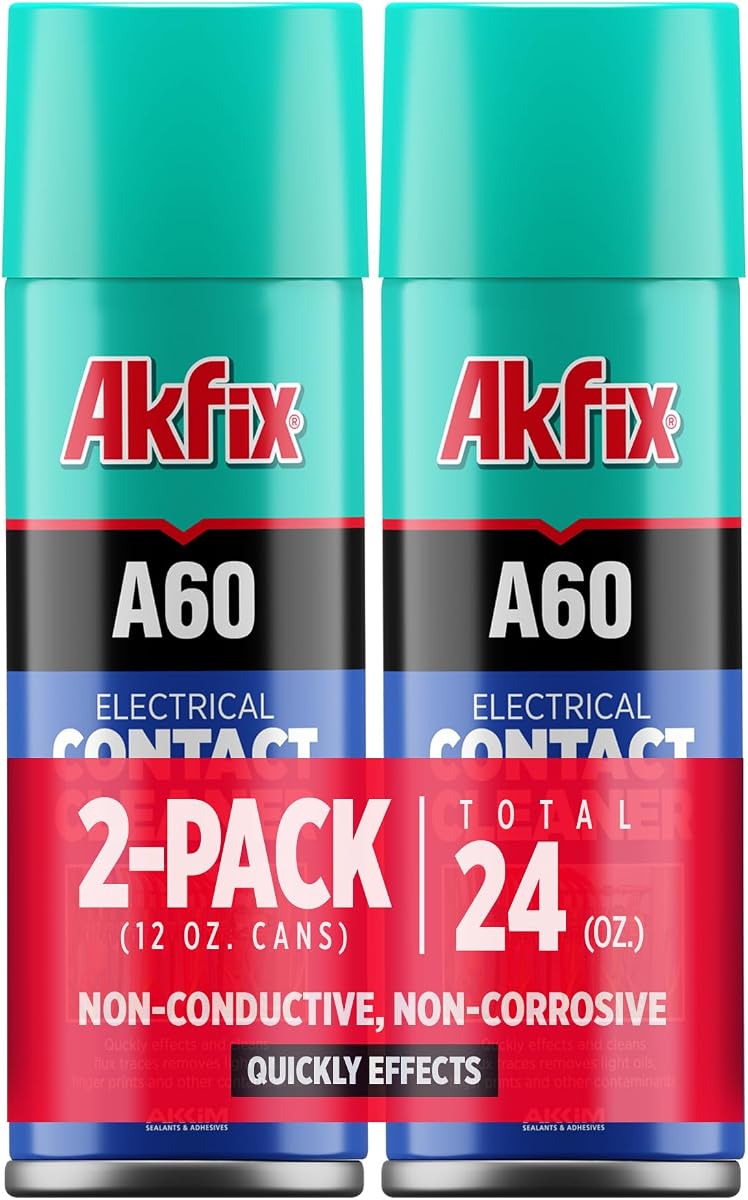
Akfix A60 is supplied as a two-can package of 12 oz aerosols and carries a 4.5 rating. Its defining feature is a fast-evaporating contact cleaner designed to remove dirt, light oil, grease, flux, and dust from electrical and electronic equipment.
We may earn a commission when you buy through this link, at no additional cost to you.
The non-corrosive formula is intended to support efficient connector and contact operation. A60 is listed for computer, battery, keyboard, and digital equipment, along with circuit boards and general metal connectors, giving it relevance across several repair and maintenance environments.
The manufacturer recommends testing on sensitive plastics, adhesive-mounted parts, and stressed parts before full application. This caution is appropriate because even a contact cleaner can create problems if it reaches a material not designed to tolerate it or penetrates beneath an adhesive.
A60 is a good option for users who want multiple cans available, whether for a busy workbench, a maintenance team, or separate storage locations. Its contaminant coverage and non-corrosive claim are solid, while careful material testing remains necessary for sensitive assemblies.
The cleaner is listed for dirt, light oil, grease, flux, and dust. This mix makes it useful when contamination comes from multiple sources rather than a single known substance.
The two-can package provides useful redundancy for frequent maintenance or professional work. Separate cans can also be assigned to different benches or equipment categories, reducing repeated transfers between work areas.
We may earn a commission when you buy through this link, at no additional cost to you.
CRC QD Electronic Cleaner 05101 is the compact 4.5 wt oz version of the QD electronics cleaner. Its 4.7 rating, plastic-safe formulation, fast evaporation, and residue-free performance make it well suited to sensitive electronic components and smaller maintenance inventories.
We may earn a commission when you buy through this link, at no additional cost to you.
The petroleum-distillate-and-alcohol formula is intended to remove flux and clean a wide variety of surfaces, including computer components, circuit breakers, circuits, coin mechanisms, contacts, sockets, lighting, plastics, nylon, plugs, relay switches, and PVC. This broad list reduces the need to switch products for mixed repairs.
The smaller aerosol size is both its main limitation and a practical advantage. It contains less cleaner than the 11 wt oz version in the number-one position, but it may be easier to store in a compact tool kit and sufficient for occasional contact maintenance.
This product is a compelling choice for repairers who value CRC's stated electronics focus and want a portable, plastic-safe aerosol. Those needing larger quantities for frequent service can select the larger version, while occasional users may find this format more convenient.
The stated plastic-safe formula makes the cleaner suitable for many electronic assemblies that contain more than bare metal. Users should still avoid applying it to unsuitable coatings or adhesives.
At 4.5 wt oz, this can is easier to carry and store than a larger aerosol. It offers a practical balance for technicians who perform occasional cleaning rather than continuous production maintenance.
We may earn a commission when you buy through this link, at no additional cost to you.
The WD-40 Specialist Contact Cleaner Twin Pack combines two 11 oz cans with the Smart Straw delivery system. Its 4.7 rating places it among the stronger products in the guide, while the duplicated supply is attractive for frequent maintenance or use in separate workspaces.
We may earn a commission when you buy through this link, at no additional cost to you.
The cleaner is formulated for oil, dirt, flux residue, and condensation on sensitive electrical equipment. Printed circuit boards, controls, switches, precision instruments, and electric panels are specifically identified as suitable applications. The quick-drying, residue-free formula supports fast turnaround after cleaning.
The Smart Straw helps direct the spray with greater control than an undirected aerosol pattern. As with the single-can WD-40 Specialist option, however, plastics should be tested first, and the product should avoid adhesives, device screens, and keyboards.
This twin pack is a strong choice for maintenance professionals or serious electronics hobbyists. It provides the same stated core cleaning performance as the single can, with added convenience from having two containers and more controlled delivery.
The built-in straw directs cleaner toward selected contacts and reduces broad overspray. This is particularly helpful when working around switches, connectors, or densely populated circuit boards.
The twin-pack format offers more continuity than a single aerosol. It suits technicians, repair businesses, or users who want one can in a workshop and another in a general maintenance kit.
We may earn a commission when you buy through this link, at no additional cost to you.
Electronic Contact Cleaner 8.5 Oz has a 5.0 rating, the highest numerical rating among the listed products. It combines deep cleaning, quick drying, and a stated protective lubricating film, while the included soft brush adds a way to agitate stubborn contaminants gently.
We may earn a commission when you buy through this link, at no additional cost to you.
The cleaner is described as dissolving dust, grease, flux, and rosin from delicate electronic surfaces. Its fast-evaporating formula leaves no residue, streaks, or moisture and is intended to eliminate the risk of short circuits or secondary contamination after cleaning.
A notable distinction is the thin, long-lasting lubricating film deposited on metal surfaces and electronic components. That film is claimed to reduce friction, protect against future oxidation, and extend equipment life. Users should still verify whether a lubricating deposit is desirable for the exact repair, especially in high-precision or manufacturer-controlled assemblies.
This product offers the most ambitious feature set in the group and should appeal to maintenance users seeking cleaning and protection in one product. Its rating is compelling, but the limited manufacturer detail means compatibility and application testing are especially important before treating sensitive components broadly.
Most contact cleaners focus primarily on removal, while this formula also claims to deposit a thin lubricating film. That combination may reduce friction and help shield cleaned metal surfaces against later oxidation.
The included brush can gently work dust, grease, flux, and rosin from surfaces that are difficult to clean with spray alone. It gives users a controlled way to loosen residue while directing the liquid.
We may earn a commission when you buy through this link, at no additional cost to you.
CAIG DeoxIT Contact Cleaner D5S-6 is a 5 oz product with a 5% spray formulation and a 4.7 rating. Its compact size and established contact-cleaning format make it suitable for users who want a dedicated product for routine electrical maintenance rather than a general-purpose solvent.
We may earn a commission when you buy through this link, at no additional cost to you.
The supplied product information is concise, identifying the product as a DeoxIT contact cleaner and confirming its spray percentage and size. That leaves fewer technical details than some competing listings, but the focused format and strong rating make it a credible choice for maintaining electrical contacts.
Because the data does not state a detailed residue profile, drying rate, or material list, buyers should review the manufacturer's current instructions before applying it to unfamiliar plastics, coatings, switches, or assembled equipment. Good contact-cleaning practice calls for testing in a hidden area and allowing the device to be fully dry before energizing it.
This cleaner is a sensible option for technicians already familiar with DeoxIT products or seeking a compact contact-maintenance solution. It may be less informative for first-time buyers than products with extensive application guidance, but its dedicated purpose and customer rating remain favorable.
The product is specifically presented as a contact cleaner rather than an all-purpose household aerosol. That focused positioning makes it relevant for routine maintenance of compatible electrical contacts and connections.
The five-ounce container is smaller than most aerosol options in the guide. It can suit occasional servicing, portable tool kits, and users who prefer to keep only a limited amount of specialized chemistry on hand.
We may earn a commission when you buy through this link, at no additional cost to you.
Choosing a circuit board cleaner requires balancing contaminant removal, drying speed, residue behavior, delivery precision, and compatibility with the device being serviced. The right product should clean effectively without introducing new material problems or leaving a film that interferes with electrical contact.
A residue-free formula is one of the most important characteristics in a contact cleaner. Residue can attract new dust, interfere with conductivity, create a sticky surface, or conceal incomplete cleaning. Several products in this guide specifically state that they leave no residue, while others claim a protective lubricating film that may be useful for some contacts but should be evaluated separately.
Choose a product that explicitly describes its residue behavior. Quick evaporation is also useful because it reduces the amount of time a liquid can remain around heat-sensitive or powered components.
Fast drying matters when a repaired board must be reassembled or returned to service. Products advertised as drying within seconds or evaporating quickly can simplify bench work and reduce the chance of trapped liquid causing a short circuit. Drying claims should be treated as relative guidance rather than a guarantee for every environment, humidity level, or amount of application.
A cleaner that leaves no streaks or moisture after evaporation is especially attractive for delicate surfaces. Users should also allow proper ventilation and follow the product's complete handling instructions.
PCB cleaning can involve plastic housings, rubber grips, printed markings, adhesives, metals, and specialized coatings. Some formulas are described as plastic safe or safe on most plastics, while the 250ML brush-assisted product specifically excludes ABS resin, PS, and PC. These differences make compatibility information more important than a broad electronics claim.
Test an unfamiliar cleaner on a small hidden area and confirm that it is suitable for the device's materials before treating the full assembly. Do not assume that a cleaner safe for a metal contact is automatically safe for every surrounding component.
Different contaminants call for different cleaning strengths. Flux residue, condensation, light oil, grease, dust, rosin, and oxidation are all mentioned across the listed products. A cleaner advertised for several of these contaminants can simplify maintenance, but it should still be applied according to the manufacturer’s instructions.
For recently soldered components, flux removal is the central requirement. For older or exposed equipment, dust, oxidation, and grease may be equally important. Match the product to the contamination rather than assuming one cleaner handles every situation equally well.
Aerosols are fast and convenient for larger electrical equipment, but broad spray patterns can be awkward around crowded PCBs. Extension straws and Smart Straw systems provide more targeted delivery, while a liquid cleaner with a matching brush allows direct application and controlled wiping. The best choice depends on the user's comfort, workspace, and repair volume.
For dense or recessed assemblies, precision accessories can make a meaningful difference. For routine maintenance of larger panels and equipment, an aerosol's straightforward delivery may be more efficient.
Can size affects portability, maintenance frequency, and convenience. Compact products such as the 4.5 wt oz CRC and 5 oz DeoxIT options may be easier to store in small tool kits, while 8 oz, 11 oz, and 12 oz cans provide more product for repeated use. Twin packs and multi-can packages are especially relevant to technicians working across multiple benches.
Choose a quantity that matches realistic usage. A large supply can be efficient for professional maintenance, while occasional users may prefer the smallest practical package that still covers their usual tasks.
A product expressly formulated for electronics and electrical contacts is generally more relevant than a general aerosol solvent. Look for stated applications involving printed circuit boards, switches, sockets, relays, connectors, controls, or precision instruments. These details indicate that the formulator considered the needs of sensitive equipment.
Pay attention to exclusions as closely as inclusions. Instructions to avoid screens, keyboards, adhesives, or certain plastics can prevent accidental damage and are a sign that the product should be used selectively rather than sprayed indiscriminately.
Some cleaners only remove contamination, while others claim to leave a lubricating and protective film. A lubricating layer can be advantageous for switches, connectors, and sliding contacts, but it may not be desired on every PCB surface or precision mechanism. Users should identify the functional goal before choosing between a purely evaporating cleaner and one with a stated protective deposit.
If the goal is simple restoration of electrical contact, prioritize residue-free cleaning and compatible materials. If protection is part of the maintenance plan, review the deposited-film claim and ensure it suits the equipment being treated.
Begin with the safest possible maintenance approach: identify the contaminants, disconnect or de-energize the equipment, and consult the cleaner’s instructions and the device manufacturer’s service guidance. Where possible, use compressed air or a soft brush to remove loose dust before applying liquid, reducing the amount of chemical needed for the remaining residue.
Test the cleaner on a small hidden or noncritical area, especially on unfamiliar plastics, coatings, adhesives, printed markings, or flexible components. Apply only enough cleaner to address the contaminated area. Aerosols should be directed with a straw where available, while liquid cleaners can be placed on the supplied brush and dabbed onto the affected contact before being wiped away.
Keep the assembly powered off while the cleaner evaporates, allow adequate ventilation, and wait until the surface is completely dry before testing or reassembly. Follow the product label for any required drying interval, avoid screens, keyboards, adhesives, and incompatible plastics, and never combine cleaning products unless the instructions explicitly permit it.
Yes, when the cleaner is designed for electronics and the materials present are compatible with its instructions. Apply it carefully to dirty contacts or connectors, avoid spraying indiscriminately across the board, and keep the equipment de-energized during cleaning. Test unfamiliar plastics or coatings in a hidden area first.
Useful cleaners commonly target flux residue, dust, light oil, grease, condensation, rosin, and oxidation. The exact contaminants should determine which product you choose because a cleaner intended for routine dust removal may not be optimized for stubborn solder flux. Always follow the application instructions on the specific product.
Yes. Residue can leave a film on contacts, attract additional dust, or interfere with reliable electrical contact. A formula that evaporates quickly and leaves no residue is generally easier to use on sensitive electronics. Some products intentionally leave a protective film, so users should determine whether that type of deposit is appropriate for the repair.
Only if the manufacturer states that the cleaner is compatible with the specific plastic. Several options in this guide are described as plastic safe, while one explicitly excludes materials such as ABS resin, PS, and PC. Test a small area and avoid adhesives, screens, and other sensitive surfaces unless they are expressly approved.
No. Disconnect power before applying cleaner and keep the equipment de-energized until the surface is fully dry. Even a fast-drying formula can conduct electricity while liquid remains, and spraying near powered components creates unnecessary risk. Follow the equipment manufacturer’s service instructions as well as the cleaner’s label.
Contact cleaner is formulated to remove contamination and restore electrical contact, while an ordinary lubricant may reduce friction without being designed to dissolve flux, grease, or oxidation. Some contact cleaners also leave a protective film, so reading the stated purpose and residue behavior helps distinguish the products.
The listed WD-40 and BW-40 products are not recommended for keyboards or screens, and the BW-100 product likewise advises avoiding keyboards, screens, and adhesives. Other cleaners should be checked individually for those restrictions. Liquid can infiltrate seams, damage membranes, cause display marks, or leave optical surfaces streaked.
Clean when dust, flux, grease, corrosion, or unreliable contact is present rather than following a rigid schedule. Preventive cleaning may be useful in dusty, humid, industrial, or frequently serviced environments. Repeated unnecessary cleaning can expose components to liquid, so use the smallest effective amount and avoid aggressive spraying.
CRC 05103 stands out for its broad applications, plastic-safe claim, residue-free evaporation, and strong customer rating. WD-40 Specialist Contact Cleaner is a practical budget-oriented choice for removing flux, oil, dirt, and condensation, while BW-100 earns the premium distinction through its non-flammable formula and precision extension straw.
The most important selection criteria are residue behavior, drying speed, contaminant coverage, material compatibility, and application control. Users who need maximum precision may favor a straw-equipped aerosol or brush-assisted liquid, while frequent technicians may appreciate twin packs. Any product used around unfamiliar plastics should be tested carefully before broader application.
Ratings, formulations, and retailer listings can change, and current prices should be checked before buying. Comparing the present listing with the manufacturer's instructions is also important, especially for devices that contain sensitive coatings, adhesives, displays, or mixed materials.