
SPARK Golf Cart Restore
3.9Editor score
Treats six battery packs
Flooded batteries from 6–12V
Made in the USA
Explore the best battery desulfator solutions for golf carts, cars, RVs, solar systems, and fleets, compared by chemistry, capacity, and use.
Battery desulfator solutions can help rejuvenate lead-acid batteries that have lost capacity because of sulfate buildup, heat, prolonged storage, or repeated shallow cycling. The right product depends on battery chemistry, voltage, condition, and whether you want a liquid treatment or a connected pulse device.
We compared all ten options by battery compatibility, treatment coverage, expected use cycle, construction, safety features, and suitability for individual vehicles or battery banks. The list includes liquid additives for serviceable flooded batteries and electronic desulfators designed for broader lead-acid applications.
Each review explains what stands out, where limitations matter, and who is most likely to benefit. Ratings reflect the supplied customer feedback, while technical details come from the listed product information. Product pricing and availability can change, so confirm the current listing before purchasing.
3.9Editor score

4.1Editor score

4.1Editor score
This side-by-side overview compares treatment type, supported battery systems, application needs, and key restrictions across ten liquid and electronic desulfator solutions.




This 64-ounce liquid restorer is designed for lead-acid batteries found in golf carts, recreational vehicles, motorcycles, ATVs, cars, boats, tractors, and other machinery. Its supplied rating is 3.8, which reflects mixed feedback, but its main attraction is flexibility: one product can address several lead-acid applications without a complex electronic setup.
We may earn a commission when you buy through this link, at no additional cost to you.
The formula is positioned to remove harmful sulfation buildup, improve the battery's chemical balance, and increase charge capacity. Its battery-acid-refill and additive framing may appeal to owners of serviceable flooded batteries, while the large container is useful for a complete golf cart pack or several smaller batteries. The manufacturer describes the treatment as a gentle restoration process designed to protect internal battery components.
The main drawback is that the listing's compatibility language is broad without a detailed cell-by-cell application table. Buyers should verify whether their batteries are serviceable flooded lead-acid units, confirm the required quantity per cell, and follow the label before adding liquid. A moderate customer rating also suggests that users should judge results by the condition of the battery rather than expecting every weak or damaged battery to be recovered.
This is a practical choice for a homeowner or small operator who wants one liquid product covering cars, carts, and outdoor equipment. It is best for batteries that still accept a charge but show reduced capacity, not for visibly damaged, frozen, dry, or end-of-life cells. Confirm chemistry and application rates before treating multiple batteries.
The wide equipment list makes this solution useful for mixed households. Instead of maintaining separate products for a cart, motorcycle, and mower, owners can potentially use the same liquid when each battery is a compatible flooded lead-acid model.
Its central benefit is attacking sulfation that can reduce charging efficiency. The formula is intended to improve the chemical condition of the plates and help weak batteries accept and retain more charge.
We may earn a commission when you buy through this link, at no additional cost to you.
Battery Restore is a one-gallon liquid solution created for operators who need to service more than one lead-acid battery. It is listed for golf carts, motorcycles, cars, trucks, boats, ATVs, RVs, snowmobiles, forklifts, tractors, and solar storage systems. The 3.8 supplied rating indicates mixed experiences, while the fleet-oriented container size gives it a practical purpose.
We may earn a commission when you buy through this link, at no additional cost to you.
The listing states that one gallon can treat three to six batteries, depending on the number of cells. It specifies 2 ounces per cell for 6-volt batteries and 3 ounces per cell for 8-volt and 12-volt batteries, enough to service a six-battery golf cart bank with solution to spare. That clarity makes it easier to plan treatment across carts, marine equipment, or business fleets.
The important limitation is chemistry. This product is not designed for gel, AGM, maintenance-free, completely dry, or frozen batteries. It is also not a repair for a dead cell or a physically damaged battery. The description says measurable improvement may take seven to ten days of regular charging, so buyers need to be patient and follow a proper charging routine rather than judging the result immediately.
This gallon is best for a golf course, marina, solar installer, farm operator, collector, or household with several serviceable flooded batteries. The non-toxic formula and direct cell-addition method simplify routine maintenance, but the user must identify the battery type and use the correct dosage. It is a fleet convenience product, not a universal restoration shortcut.
A key advantage is the potential to treat several batteries from one container. This reduces container clutter and makes scheduled maintenance across a fleet or a six-pack cart more convenient.
The stated seven-to-ten-day charging period provides a useful expectation for owners. It distinguishes a gradual chemical treatment from an immediate jump in starting power and encourages consistent charger use.
We may earn a commission when you buy through this link, at no additional cost to you.
SPARK's 64-ounce solution is especially easy to understand for golf cart owners. The supplied rating is 3.9, and the product is formulated for flooded lead-acid batteries at 6, 8, or 12 volts. One bottle is advertised as enough to condition all six batteries in a typical golf cart pack, with solution remaining.
We may earn a commission when you buy through this link, at no additional cost to you.
The application rates are clearly stated: 2 ounces per cell for 6-volt batteries, 1.5 ounces per cell for 8-volt batteries, and 1 ounce per cell for 12-volt batteries. Beyond carts, the listing also names cars, trucks, motorcycles, boats, RVs, tractors, ATVs, marine batteries, forklifts, and solar power systems. It can serve as periodic maintenance or a response to reduced runtime and charging efficiency.
This product is limited to batteries that still accept a charge. It is not compatible with AGM, gel, frozen, or completely dry batteries, and the description says best results are typically found on batteries around one to five years old. The recommended maintenance schedule is once per year, with no more than three treatments over a battery's life. Those boundaries make it more of a controlled maintenance product than a universal recovery treatment.
The SPARK solution is a strong pick for the owner of one or several standard golf carts who wants enough liquid to treat an entire pack. It is also suitable for owners of other flooded lead-acid equipment. The key is to verify the battery type, follow the per-cell quantities, and avoid expecting restoration from a dead or damaged battery.
The application rates and remaining-volume claim are particularly helpful for cart owners. They reduce guesswork when treating several batteries of different voltages and make preventive care easier to plan.
Rather than waiting for a battery to fail completely, owners can use the solution on a schedule. A controlled annual maintenance approach may help limit the performance effects of accumulated sulfation.
We may earn a commission when you buy through this link, at no additional cost to you.
This electronic desulfator is the most versatile product in the list by battery chemistry and voltage. It has a supplied rating of 4.1 and supports 12-, 24-, 36-, 48-, 60-, and 72-volt lead-acid systems. Compatibility includes AGM, gel, VRLA, SLA, and flooded batteries, covering a wider range of equipment than the liquid products.
We may earn a commission when you buy through this link, at no additional cost to you.
Rather than adding electrolyte, the device sends high-frequency, low-current pulses intended to prevent and dissolve lead sulfate buildup. The listing says users may notice improvement in roughly two to four weeks and that the unit can run up to 30 intelligent desulfation cycles. It is explicitly not a charger, although pairing it with a normal charging cycle is recommended for optimal results.
Safety and construction features add to its appeal. The unit includes low-voltage cutoffs, internal fuses, reverse-polarity protection, and an aluminum shell for heat dissipation. Those protections make it more suitable for long-term maintenance than a bare pulse attachment, though users must still follow polarity instructions and use appropriate battery and charger settings.
This is the leading choice for owners of mixed battery inventories, especially RV, solar, marine, backup-power, and large cart systems that may include sealed or flooded batteries. Its capability to serve 12-to-72-volt configurations separates it from smaller pulse devices. The tradeoff is a gradual process and the need to connect the device consistently over several weeks.
The ability to work with AGM, gel, VRLA, SLA, and flooded batteries is the key advantage. That flexibility makes it suitable for equipment collections where different battery types would be awkward to treat with a single liquid additive.
Low-voltage cutoff, internal fuses, and reverse-polarity protection provide useful safeguards. The aluminum housing also supports heat management during repeated pulse cycles.
We may earn a commission when you buy through this link, at no additional cost to you.
Battery Renew is a one-gallon treatment aimed at serviceable lead-acid batteries that still charge but no longer hold capacity as well as they once did. Its supplied rating is 4.1, placing it among the stronger customer-feedback results in this roundup. Its size and dosing scope make it especially relevant to professionals and owners of multiple batteries.
We may earn a commission when you buy through this link, at no additional cost to you.
One gallon can treat three to six batteries depending on voltage and cell count. The suggested process is to add the correct quantity per cell, charge normally, and allow the formula to work between cycles, with full effect sometimes taking up to ten days. Applications include golf carts, riding mowers, marine deep-cycle batteries, RV house batteries, forklifts, floor scrubbers, and solar storage banks.
Its limitations are firm. Gel, AGM, completely dry, and frozen batteries are outside the stated compatibility range, and dead, damaged, or end-of-life batteries are not candidates for recovery. The product is a maintenance solution for serviceable flooded lead-acid batteries, not a substitute for battery replacement when internal damage has already occurred.
This gallon is best for golf courses, marinas, solar installations, fleet managers, and households with several carts. Its large volume and clear charge-based routine make professional maintenance easier to standardize. Choose it when the batteries accept charge but exhibit reduced runtime, and avoid it when physical damage or end-of-life symptoms are present.
The three-to-six battery coverage makes this a practical choice for operators servicing multiple carts or pieces of equipment. A single container can support a consistent maintenance program across several units.
The product can be used before golf season, ahead of winter storage, or whenever a battery appears to retain less charge. Regular charging remains central to allowing the chemical treatment to work.
We may earn a commission when you buy through this link, at no additional cost to you.
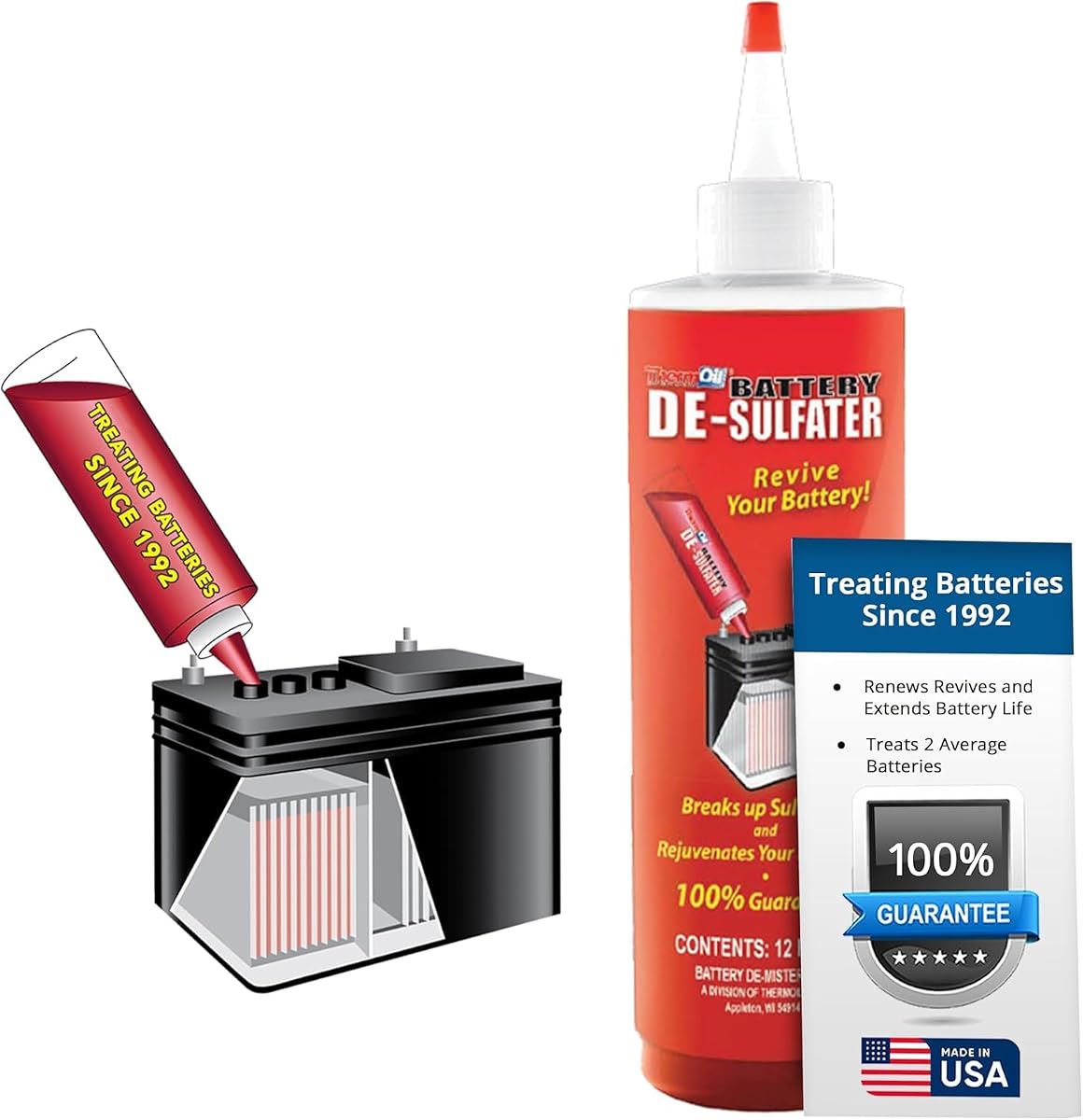
Thermoil's 12-ounce DeSulfater is a compact electrolyte additive for lead-acid battery maintenance. It has a supplied rating of 3.8, and the brand emphasizes that its formula contains no Epsom salts. The manufacturer also states that the product has been used since 1992 and is backed by a guarantee for mechanically sound, sulfated lead-acid batteries.
We may earn a commission when you buy through this link, at no additional cost to you.
The intended action is to break down sulfation corrosion on battery plates and insulators. The product description claims this can reduce internal heating, improve power efficiency, and eliminate resistance by as much as 50 percent. It is positioned for preserving both new and used batteries and is said to suit batteries regardless of make, age, or size.
The small container is both its main convenience and its main limitation. It is easier to store and handle than a gallon jug, but it covers fewer batteries or cells per purchase. The product must be added as an electrolyte additive, so users should follow the label and identify the battery construction before opening a cell. The guarantee applies to the manufacturer's stated use conditions and does not turn a physically failed battery into a serviceable one.
This solution fits a car owner, collector, or technician who wants a compact treatment for a small number of batteries. It may be less convenient for a full six-cart pack than the 64-ounce or gallon options. Its established product identity and straightforward application make it a credible maintenance option for compatible, mechanically sound lead-acid batteries.
The 12-ounce format is convenient for owners maintaining one or two batteries. It takes less storage space and makes it easier to limit the quantity used on a selected vehicle.
The brand's stated history since 1992 and no-Epsom-salt formulation distinguish it from listings that offer little detail. The focus is a controlled additive for existing sulfation rather than a general-purpose charger.
We may earn a commission when you buy through this link, at no additional cost to you.
The 64-ounce Thermoil De-Sulfator is the larger counterpart to the brand's 12-ounce solution. It retains the supplied rating of 3.8 and the same no-Epsom-salt positioning, but it is better suited to households or operators maintaining several lead-acid batteries at once.
We may earn a commission when you buy through this link, at no additional cost to you.
Its proposed mechanism is to break down sulfate corrosion on plates and insulators, thereby improving battery performance. The manufacturer describes reductions in internal heating and resistance, along with improved power efficiency and a longer useful life for mechanically sound batteries. The formula is labeled non-hazardous and intended for all lead-acid batteries when applied according to its instructions.
Compared with the 12-ounce version, the primary advantage is simply coverage. It can support a golf cart pack, several vehicles, or a group of batteries around the garage without repeated purchases. The trade-off is that owners must measure the correct quantity for each cell and avoid over-application. A larger container also needs secure storage away from children, pets, and unintended access.
This product is a good middle ground for a multi-battery household that prefers a liquid additive rather than a permanently connected electronic unit. It combines broad chemistry positioning with enough volume for repeated maintenance. As with the smaller version, the product is intended for serviceable batteries that still function, not cells that are already physically damaged or beyond useful life.
The 64-ounce size is substantial enough for a golf cart pack and multiple smaller batteries. It offers greater flexibility than the compact version while remaining less bulky than a one-gallon container.
Owners who like the Thermoil approach can use one formula across different lead-acid equipment. The same additive process may simplify routine maintenance compared with keeping multiple chemistry-specific products.
We may earn a commission when you buy through this link, at no additional cost to you.
This auto-setting desulfator offers a relatively simple way to maintain a lead-acid battery with recurring pulses. It has a supplied rating of 4.0 and supports systems from 12 to 48 volts, with a maximum capacity of 400AH. That makes it more limited in voltage than the top electronic choice but still appropriate for many cars, carts, and other standard lead-acid installations.
We may earn a commission when you buy through this link, at no additional cost to you.
The device uses high-frequency peak pulses to prevent sulfate crystals from adhering to electrodes and to gradually decompose existing buildup. The description says users may feel a performance improvement after two to three weeks, although heavier crystal accumulation takes longer. It can be used together with a charger, making it more of a maintenance companion than a complete charging system.
An important operating step is testing battery voltage first. If the reading is below 11.5 volts, the instructions say to charge the battery before using the device. If the voltage is above 11.5 volts, the desulfator can be connected. Voltage is recognized automatically, reducing the need for manual settings, but the user must still observe the stated threshold and connect red to positive and black to negative.
This device is best for technically minded owners who want a straightforward connected unit without a complex control panel. It is suitable for compatible 12-to-48-volt lead-acid systems up to the stated capacity. Buyers should understand that it is not an instant repair and should not expect it to recover a battery with severely damaged internal cells or one that cannot first be brought to an appropriate voltage.
Automatic voltage recognition removes the need to select a setting for each connected system. The initial voltage check remains important, but the unit is otherwise designed for a straightforward terminal connection.
Support for batteries up to 400AH expands its usefulness beyond a single compact starting battery. The upper limit still requires buyers to match the device to the battery bank they intend to service.
We may earn a commission when you buy through this link, at no additional cost to you.
This SPARK 64-ounce solution shares a cart-focused application and dosing structure with another listing in the roundup, but it has a notably lower supplied rating of 2.6. It is intended for flooded lead-acid batteries at 6, 8, or 12 volts and is advertised as sufficient for a complete six-battery golf cart pack.
We may earn a commission when you buy through this link, at no additional cost to you.
The application guidance calls for 2 ounces per cell for 6-volt batteries, 1.5 ounces per cell for 8-volt batteries, and 1 ounce per cell for 12-volt batteries. Its broader compatibility list includes cars, trucks, motorcycles, boats, RVs, tractors, ATVs, marine batteries, forklifts, and solar power systems. The formula is presented as dissolving sulfate deposits so batteries can better accept and retain a charge.
The low customer rating is the most significant reason for caution. It does not prove that the formula cannot work, but it does suggest that expectations should be managed carefully. The product excludes AGM, gel, frozen, and completely dry batteries, and the stated best range is one-to-five-year-old flooded batteries that still accept a charge. Owners should also allow seven to ten days of normal charging after treatment.
This option may still be relevant for a cart owner who values a full-pack quantity and a clear dosing schedule. However, the stronger-rated SPARK product reviewed elsewhere is the more conservative selection when the two listings offer similar stated functions. Consider this only after checking the label, identifying the battery chemistry, and understanding that a liquid treatment cannot fix a dead or physically damaged battery.
The advertised volume and per-cell rates provide an easy way to estimate whether one bottle can cover a typical cart. This convenience is the primary reason to consider it despite the lower customer rating.
The product is intended for gradual improvement in charge acceptance and retention. It cannot overcome compatibility issues, and a seven-to-ten-day charging period is part of the expected process.
We may earn a commission when you buy through this link, at no additional cost to you.
The PL04C-400AH is an automatic pulse-based lead-acid battery reconditioner with a supplied rating of 3.9. Its defining feature is a simple approach: connect the unit to the battery terminals and allow controlled pulse technology to support maintenance and gradual sulfate removal.
We may earn a commission when you buy through this link, at no additional cost to you.
The product is positioned for a wide range of lead-acid applications, including car, marine, RV, and deep-cycle batteries. Its pulse process is intended to dissolve sulfate crystal buildup on the plates, restore capacity, and extend service life. The automatic operation and straightforward terminal connection make it approachable for owners who want a connected maintenance device without complicated controls.
Compared with the more detailed electronic desulfators, this listing provides less information about cycle count, voltage range, cutoff behavior, and expected time to improvement. That limited detail means buyers should review the current instructions and verify the device's specifications before use. It should not be assumed to offer the same sealed-battery compatibility or high-voltage range as products that explicitly specify those capabilities.
This reconditioner is best for a car, RV, marine battery, or deep-cycle system that can remain connected for maintenance. It appeals to users who prefer a set-and-maintain approach over adding liquid to individual cells. The key buying consideration is verifying compatibility from the manufacturer's current documentation and using appropriate charging and electrical practices throughout the treatment period.
Automatic pulse operation reduces day-to-day involvement. Once correctly connected, the device is designed to work as part of a longer maintenance routine rather than requiring repeated manual adjustments.
The stated support for car, marine, RV, and deep-cycle batteries gives it broad household appeal. Those applications benefit from a device that can remain connected without the cell-access and dosing required by liquid additives.
We may earn a commission when you buy through this link, at no additional cost to you.
The right desulfator depends first on battery chemistry and condition, then on voltage, treatment style, coverage, and the amount of maintenance you are willing to perform. A product that fits the battery correctly is more important than one with the broadest claims.
Lead-acid batteries include flooded, AGM, gel, VRLA, and SLA designs, and they do not all accept the same treatment. Most liquid options in this guide are restricted to serviceable flooded batteries, while the top electronic desulfator explicitly supports several sealed chemistries. Gel, AGM, maintenance-free, dry, and frozen batteries are expressly excluded by multiple liquid product descriptions. Read the battery label and manual before buying, because adding liquid to the wrong battery type may cause damage or waste the treatment.
Desulfation is best suited to batteries that still accept a charge but no longer hold it, start as quickly, or run for as long as they once did. It is not a cure for dead cells, cracked cases, severe physical damage, or end-of-life batteries. Several products in this guide target batteries roughly one to five years old, while others work on any mechanically sound unit. Before treatment, use a suitable tester to distinguish reversible sulfation from damage, and plan to replace a battery if its load test or cell condition shows an unrecoverable fault.
Electronic desulfators must match the voltage and capacity of the connected battery or bank. The options here range from 12-to-48-volt systems with support up to 400AH to a more flexible unit covering 12 through 72 volts. Liquid treatments are less dependent on system voltage but still require a specific quantity for each cell. For carts, note that individual batteries may be 6, 8, or 12 volts even when several are connected in a larger pack. Confirm both the battery arrangement and the product's stated limits before use.
Liquid solutions are added directly to compatible battery cells and then allowed to work through normal charging cycles. They are especially convenient for routine service of a known fleet of flooded batteries. Electronic pulse devices remain connected and gradually work on sulfate through controlled pulses. They are often more convenient when the battery type varies, when cell access is undesirable, or when a broader set of lead-acid chemistries must be supported. Whichever format you choose, follow the complete application and charging instructions.
Container size alone does not reveal how many batteries a liquid can service. Application rates per cell, voltage, and cell count determine actual coverage. A 64-ounce bottle may treat a complete six-battery golf cart pack in certain configurations, while a gallon may cover three to six batteries depending on their construction. A 12-ounce container is more appropriate for a small maintenance kit. Compare the per-cell directions with the number of cells in your battery before purchasing, and avoid estimating based only on vehicle count.
For a liquid additive, the most important safety step is correct identification of a serviceable flooded battery. Read the label, use the stated dose, wear appropriate protective equipment, and store the container securely. Electronic units should have low-voltage cutoff, fuse protection, and clear polarity guidance. The leading electronic choice lists all three, including reverse-polarity protection. Also confirm whether the product can be used alongside a charger and which charger settings are appropriate for the connected battery.
Neither chemical nor electronic desulfation should be expected to work instantly. Liquid products in this guide may require approximately seven to ten days of regular charging, while the electronic options commonly describe improvement over two to four weeks or longer for severe sulfation. A maintenance approach may be used annually on compatible batteries, while pulse devices can remain connected over longer periods. Choose a process you can follow consistently, because repeated charging cycles are central to achieving a meaningful result.
Customer ratings can provide a useful signal about consistency, clarity, and real-world experiences, although they do not prove that a product will work on every battery. This roundup includes ratings from 2.6 to 4.1, so the feedback varies substantially. Treat highly rated products as more established options, but pay close attention to negative comments about compatibility, dosing, or expectations. Also review the complete description, because a favorable rating cannot overcome a fundamental mismatch with a dead, dry, AGM, or otherwise incompatible battery.
Start by identifying every battery's chemistry, voltage, cell count, and physical condition. Clean the terminals, inspect for swelling, cracks, corrosion, or leakage, and test the voltage or load before treatment. A desulfator is intended for a battery that still functions, so replace any damaged unit and do not use a liquid additive on AGM, gel, maintenance-free, dry, frozen, or otherwise excluded batteries.
For a liquid product, follow the label's per-cell dosage exactly. Add the solution only through the appropriate cell openings, reinstall the caps, and use a charger compatible with the battery's chemistry and voltage. Allow the stated treatment period—often seven to ten days for liquids—while cycling the battery normally. Do not combine different additives unless the manufacturer explicitly permits it, and keep the container sealed and safely stored after use.
For an electronic unit, confirm voltage, polarity, and battery chemistry compatibility before connection. Test the initial voltage and follow any precharging instruction, then connect red to positive and black to negative. Use a compatible charger when required, maintain ventilation, and leave the device under observation for the first session. Evaluate improvement only after several weeks of consistent use, and stop if the battery becomes excessively hot, leaks, swells, or shows other signs of damage.
A desulfator is designed to reduce sulfate buildup on lead-acid battery plates, which can restrict charging and reduce usable capacity. Liquid products aim to dissolve the buildup chemically inside compatible flooded cells, while electronic devices use controlled pulses to discourage and gradually reduce crystal formation. Neither method can repair physically damaged cells or restore a battery that has reached the end of its service life.
Usually not. The liquid products in this guide are designed for batteries that still accept a charge but do not hold it well, and they exclude completely dry, frozen, dead, or end-of-life batteries. A dead battery should be tested for cause before replacement, but a desulfator should not be viewed as a guaranteed way to reverse a complete failure.
It depends on the product. Most of the liquid additives listed are intended only for serviceable flooded lead-acid batteries and specifically exclude AGM and gel designs. The top electronic desulfator explicitly supports AGM, gel, VRLA, SLA, and flooded batteries, making it the more broadly compatible choice for sealed batteries within its stated voltage range.
Results generally develop gradually rather than appearing immediately. The liquid products in this guide commonly state that seven to ten days of regular charging are needed, while electronic units may require two to four weeks or longer. The timeline depends on the battery's age, the severity of sulfation, charging consistency, and whether the battery has other defects.
Yes, unless a specific product's instructions state otherwise. The liquid treatments rely on regular charge cycles to support the chemical process, and the electronic desulfators are generally maintenance devices rather than full chargers. Use a charger appropriate for the battery's chemistry, voltage, and capacity, and do not assume a pulse device can replace proper charging.
Follow the product label and count the actual cells in each battery. The SPARK products in this guide specify 2 ounces per cell for 6-volt batteries, 1.5 ounces per cell for 8-volt batteries, and 1 ounce per cell for 12-volt batteries. Other products use different rates, so never transfer a dosage from one formula to another without checking its instructions.
Yes, some products are intended for periodic maintenance rather than only reactive recovery. The SPARK solution recommends use once per year and no more than three treatments over a battery's life, while liquid gallon options are suitable for seasonal preparation and fleet care. Preventive use still requires compatible flooded batteries and should not substitute for inspecting, charging, and testing the battery.
Record a baseline before treatment using a consistent voltage, load, or capacity test, then repeat the same measurement after the stated treatment period. A useful battery should charge normally and show better charge retention, runtime, or cranking performance. If results do not improve, test for a damaged cell, poor charger performance, excessive load, or a battery that is simply at the end of its useful life.
The Pulse Repair Desulfator is the most versatile selection because it supports 12-to-72-volt systems and several lead-acid chemistries, including AGM, gel, VRLA, SLA, and flooded batteries. SPARK Golf Cart Solution is a practical liquid choice for owners seeking enough treatment for a complete cart pack, while Battery Renew Gallon is well suited to professional or multi-battery maintenance.
Prioritize battery compatibility and condition over the broadest restoration promise. Liquid solutions are most appropriate for serviceable flooded batteries that still accept a charge, while an electronic pulse device offers greater flexibility when multiple chemistries are present. For any product, follow the dosing instructions, use compatible charging equipment, and allow the full stated treatment period before deciding whether performance has improved.
Check the current product listing, package directions, and availability before buying because formulations, configurations, and pricing can change. Also verify that your charger supports the battery's voltage and chemistry. A well-matched desulfator can be a useful maintenance tool, but it cannot replace a battery that is dead, cracked, swollen, frozen, or beyond its intended service life.


