
Gebildet 12V 4-Pin Relay Harness
4.7Editor score
Two harnesses included
Built-in diode protection
12AWG power wiring
Discover the best easy to use automotive relay switch options, comparing wiring, pin types, current handling, protection, and installation convenience in 2026
Automotive relay switches give vehicle electrical upgrades a dependable way to control higher-current accessories from a low-current trigger circuit. The easiest systems pair a correctly rated relay with a prewired socket, clearly identified leads, and a configuration that fits the intended circuit. Pin count, contact design, wire gauge, environmental protection, and safe installation matter as much as headline amperage.
This guide compares ten automotive relay switch and relay-harness options for 12-volt vehicles, with particular attention to straightforward wiring and useful protective features. We evaluated the published specifications for each product, including contact configuration, coil voltage, wire sizes, current capacity, pin arrangement, and resistance to moisture and dust. The list includes both standard SPST relays and diagnostic relay-bypass switches.
Each review explains where the product is strongest, where setup demands more care, and which type of installer or vehicle project it best serves. The first three entries receive the Best Budget, Editor's Choice, and Best Premium distinctions, while the remaining products receive no award badge. Product ratings and availability can change, as can pricing, so verify current listings and vehicle-specific compatibility before buying.
4.7Editor score
4.7Editor score

4.7Editor score
The comparison below highlights each relay's core configuration, wiring, electrical capacity, and practical role. These differences determine whether a product is best for a simple accessory circuit, a higher-current installation, or diagnostic relay testing.




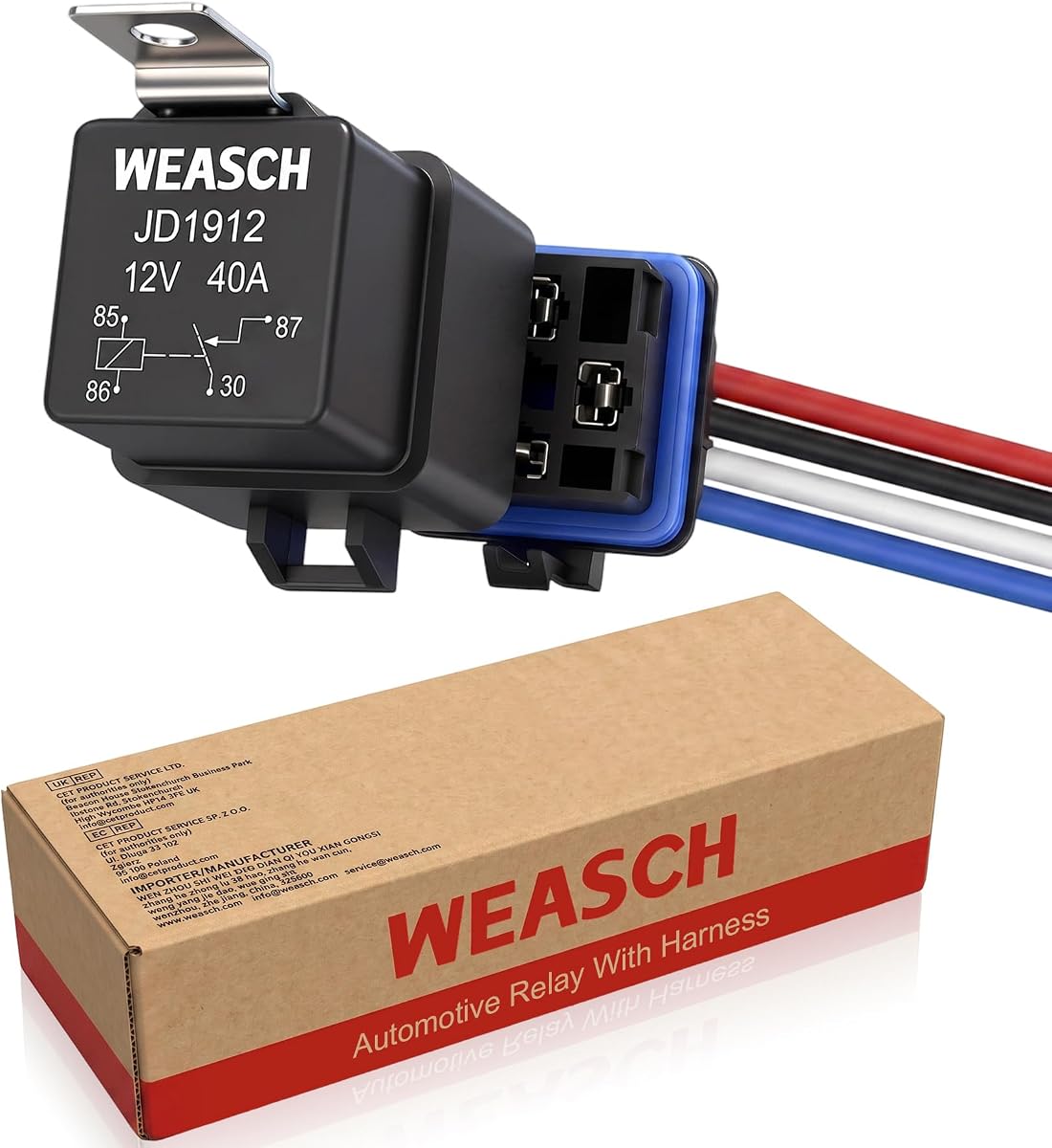
This Gebildet relay-harness set offers an approachable way to add a 12-volt accessory circuit, combining a four-pin SPST relay, socket, wiring, and a built-in diode in each package. Its 4.7 rating reflects a strong combination of straightforward integration and useful electrical protection. The pair provides enough hardware for two separate projects or extra flexibility during a larger installation.
We may earn a commission when you buy through this link, at no additional cost to you.
The most helpful feature is the integrated diode, which suppresses induced voltage when the relay switches. That protection can reduce electrical stress on connected components without requiring the installer to add a separate flyback diode. The relay uses 12AWG harness wiring, while its compact four-pin format remains familiar to technicians working with common automotive relay applications.
There are limits to consider. The SPST contact arrangement provides a straightforward on-off switching path but does not offer the alternate normally closed output found in a five-pin SPDT relay. The specifications also advise keeping operation within the published limits, with continuous loading conservatively below the headline rating. Those constraints are normal for responsible relay selection rather than shortcomings unique to this set.
This is a strong choice for a DIY installer adding lights, a horn, a pump, or another relatively simple 12V accessory. It is particularly attractive when the built-in diode is desired and a four-pin relay fits the planned circuit. The two-pack, 4.7 rating, protected design, and straightforward harness format make it our Best Budget selection.
Each relay comes paired with a socket and harness, reducing the need to source several separate parts. The two included sets can serve independent circuits, and the prewired format creates a more consistent starting point than assembling loose relays, sockets, and mismatched leads.
The integrated diode helps suppress voltage spikes created while the inductive coil switches. That feature can make the package more attractive for relays controlling components whose manufacturers recommend flyback protection.
We may earn a commission when you buy through this link, at no additional cost to you.
This five-pin relay is a premium-oriented choice for installers who want a conventional 12V automotive relay with heavy wire and environmental resistance. Its 4.7 rating indicates strong user satisfaction, while the SPDT contact format gives an installer both normally open and normally closed outputs. That flexibility is useful in circuits that require a default state rather than a simple on-off path.
We may earn a commission when you buy through this link, at no additional cost to you.
The primary leads use 12AWG tinned copper wire, while the coil leads use 16AWG. Tinned copper is well suited to vehicle environments because it is less prone to oxidation than bare copper. The stated coil specifications are also unusually complete: nominal 12V DC operation, 1.8W coil power, 80-ohm coil resistance, a 6–8V must-operate range, and a 0.6–3.6V must-release range.
Its environmental claims need careful interpretation. The housing offers water-repellent and dustproof ability, but the instructions explicitly say not to use it in water. Heavy-duty construction and good sealing make it appropriate for damp or dusty locations, yet it is not a submersible component. The manufacturer also warns that forcing the relay into its socket can bend female connectors, so a proper fit should be confirmed before installation.
Choose this relay for a robust 12V accessory circuit, particularly one that benefits from an SPDT output or uses tinned heavy-gauge wiring. It is less suitable for a user seeking a minimal four-pin plug-and-play package. With its complete electrical specification, strong wiring, and flexible contact arrangement, it earns the Best Premium distinction.
The five-pin arrangement can route current through either the normally open or normally closed contact. That makes it more adaptable than an SPST relay when the accessory needs an inactive default position.
The 12AWG tinned-copper primary leads combine useful current capacity with improved resistance to corrosion. The smaller coil wires are appropriate for the lower-current control side of the relay.
We may earn a commission when you buy through this link, at no additional cost to you.
This four-pin relay combines a familiar layout with heavy-duty wiring, earning a 4.7 rating and a place among the strongest choices for 12V accessory upgrades. It is aimed at installers who want more substantial wire than a basic bare relay without moving to a five-pin SPDT configuration.
We may earn a commission when you buy through this link, at no additional cost to you.
The relay uses 12AWG tinned copper for its primary leads and 16AWG for the coil leads, with seven inches of wire provided. The 40/30A rating describes the contact capability, but the product guidance recommends staying 10–15% below the rated value. The enclosure provides water-repellent and dustproof protection, making it more suitable for exposed vehicle areas than an unsealed relay.
The major practical consideration is size. The listed dimensions are 1.4 by 1.4 by 10 inches, so installers should verify the available space before purchasing. A long inline relay body can be awkward in a tightly packed engine bay, and forcing it into a socket can damage the female connectors. The product guidance also highlights tight load-wire connections as essential when replacing relays that have burned.
This is a good match for an installer who values heavy wire, four-pin simplicity, and environmental resistance. It works especially well for straightforward auxiliary circuits where an alternate SPDT output is unnecessary. Check clearance carefully, keep the load within the recommended margin, and use secure connections; those precautions preserve the otherwise convenient installation experience.
The four-pin design limits wiring choices compared with an SPDT relay, but the 12AWG tinned-copper leads provide a useful foundation for conventional high-current accessory paths.
Its extended inline body is the most important installation constraint. Measure the intended mounting area and make sure the socket, wire routing, and nearby components can accommodate the full relay length.
We may earn a commission when you buy through this link, at no additional cost to you.
The True MODS kit is a recognizable Bosch-style five-pin relay package for 12V systems. Its 4.6 rating reflects a dependable feature set, including waterproof construction, heavy-duty 12AWG contact wire, and a 30/40A high-switching capability. The relay uses SPDT logic, allowing access to both normally closed and normally open outputs.
We may earn a commission when you buy through this link, at no additional cost to you.
One of the easiest features to use is its clear wire coding. Black identifies ground on pin 85, red identifies VDC on pin 30, white identifies trigger on pin 86, yellow identifies normally closed output on pin 87a, and blue identifies normally open output on pin 87. This labeling reduces guesswork, although installers should still test the complete circuit and follow a proper vehicle wiring diagram.
The operating limit is 12V DC with a stated maximum of 14V. That makes the relay appropriate for conventional 12V installations, not higher-voltage systems. It also arrives as one relay rather than a multi-pack, which may require separate purchases for several circuits. The waterproof construction is useful in exposed areas, but responsible installation still requires secure wiring and appropriate circuit protection.
This kit is a strong choice for a technician restoring a Bosch-style five-pin relay circuit or adding a 12V accessory with a selectable output state. Its user-friendly color coding and substantial contact wiring help minimize wiring errors. It stands out as a focused single-relay solution rather than a broad multi-circuit kit.
The five leads correspond to standard relay functions, making the harness easier to trace. The colors are particularly helpful when adding a relay to an existing circuit or working in a crowded installation space.
The five-pin format is useful for circuits designed around a common Bosch-style relay footprint. Confirm the socket arrangement, lead functions, and voltage limits against the vehicle before installation.
We may earn a commission when you buy through this link, at no additional cost to you.
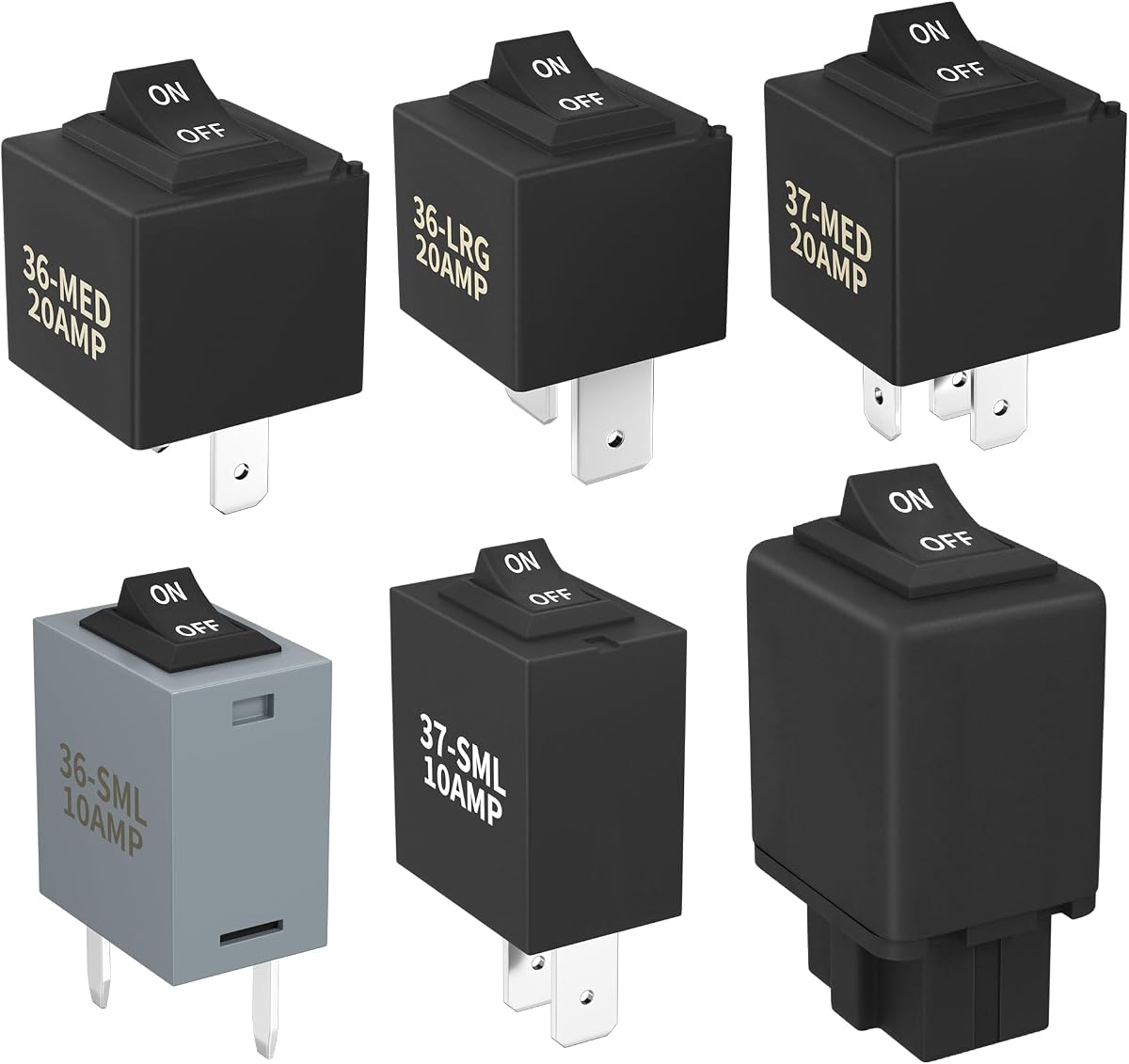
This RVMARINEPAT set is designed for a different purpose from the standard relay harnesses: it is a diagnostic relay tester and bypass kit. Its 4.6 rating and six included units make it a practical choice for technicians or owners diagnosing fuel pump and other relay-controlled circuits across several vehicle applications.
We may earn a commission when you buy through this link, at no additional cost to you.
The kit covers 9038-type use and is also described as replacing 9036 and 9037 relay models. It includes large, medium, and small 9036 and 9037 configurations, with listed continuous capacities of either 20A or 10A depending on the unit. The 20A continuous and 30A surge specification applies at 12V. A tester plugged into the fuel-pump relay position can provide direct control for faster diagnosis.
These are not general-purpose switched accessory relays, and their intended use should be understood before purchase. The tester must match the OEM relay position and application, and users should consult the pictured compatibility information before operating a circuit. As with any diagnostic tool, temporary testing does not replace a final diagnosis of wiring, fusing, control modules, or the component being tested.
Choose this kit when the primary goal is to bypass or control a relay during diagnosis rather than build a permanent accessory circuit. It is especially useful for mechanics working with domestic GM, BMW, Audi, Chrysler, Volkswagen, and other supported vehicles. The range of included sizes and straightforward relay-position approach make it a handy addition to a diagnostic toolkit.
Plugging the tester into a compatible relay position allows the operator to energize or interrupt the associated circuit directly. That can help separate relay and wiring issues from faults in the controlled component.
The package includes large, medium, and small variants for the listed 9036 and 9037 relay types, plus 9038-compatible use. This range helps technicians handle different sockets and circuit requirements.
We may earn a commission when you buy through this link, at no additional cost to you.
This 12V 40A four-pin relay kit stands out for a combination of straightforward installation and more deliberate component construction. It carries a 4.7 rating, uses silver-tin oxide contacts, and comes with a prewired relay and socket. It is one of the most attractive options for common auxiliary-light, horn, pump, and air-horn projects when space permits.
We may earn a commission when you buy through this link, at no additional cost to you.
Its 14AWG tinned copper power leads are thicker than many standard four-wire relay kits, while 16AWG leads handle the control side. The AgSnO2 contact material is intended to resist arc erosion and contact welding, a meaningful advantage in circuits that switch loads repeatedly. The listed 40A figure is a peak switching capacity, so the guidance to keep continuous loads 10–15% below the rating is important.
The relay body measures 2.44 by 1.77 by 1.38 inches before considering the attached wires. That footprint may be too large for a tightly enclosed area, so dimensional checking is essential. The housing resists moisture, dust, and debris and is intended for under-hood or outdoor use, but it is splash-proof rather than submersible.
This is the most balanced pick for an easy-to-install relay system that does not require SPDT flexibility. It provides good wire sizing, durable contacts, environmental resistance, and a simple four-pin format. For a common 12V accessory circuit, those qualities make it our Editor's Choice, provided the installer observes load limits and confirms clearance.
Silver-tin oxide contacts are specified for resistance to arc erosion and welding. That makes the relay well suited to accessories switched intermittently under a properly sized load.
The relay, socket, and labeled power leads arrive as a coordinated assembly. This reduces parts handling and gives a beginner fewer separate components to identify before beginning an installation.
We may earn a commission when you buy through this link, at no additional cost to you.
The Nilight 50003R package is a five-pack of 12V SPDT relays, each paired with an interlocking socket and five-wire harness. Its 4.6 rating and coordinated package make it a practical choice for installers planning several accessory circuits at once, including LED lighting and other vehicle upgrades.
We may earn a commission when you buy through this link, at no additional cost to you.
The male-female socket design is central to the easy-to-use claim. It helps the relay seat in the intended orientation and supports clean connections. Color-coded wires separate load and accessory connections, reducing the chance of confusing control and power paths. The relay supports 40A on the normally open contact and 30A on the normally closed contact at up to 14V DC.
A five-pack is not automatically the right choice for a single circuit. It adds unnecessary parts and takes more space to store, although it can be useful for a multi-light build, a van, or a workshop that regularly installs relays. The universal-fit description still requires verification against the original socket and wiring arrangement, especially when replacing an integrated factory relay module.
This set is best for users who want several complete, consistently wired relay circuits without sourcing sockets and harnesses individually. Its color coding and keyed socket design simplify the work, while the two normally controlled outputs provide useful flexibility. For multi-circuit projects, it offers one of the strongest combinations of convenience and readiness in this roundup.
The interlocking male-female socket design helps establish a proper relay orientation. That can be especially valuable when routing multiple harnesses through a crowded engine bay or accessory panel.
Five complete relay-and-socket sets support a larger installation without requiring five separate sourcing exercises. The uniform wiring format also makes the resulting circuits easier to maintain.
We may earn a commission when you buy through this link, at no additional cost to you.
This six-pack of 9038 relay bypass switches is built for quick circuit testing rather than a permanent auxiliary-output installation. Its 4.6 rating reflects a straightforward diagnostic tool that can replace 9036, 9037, and 9038 relay positions in many domestic, Japanese, Korean, and German vehicles.
We may earn a commission when you buy through this link, at no additional cost to you.
Installation is typically as simple as plugging the tester into the fuel-pump relay position. The unit can be oriented vertically or horizontally, which adds flexibility in cramped spaces. Once connected, the tester allows direct control of the circuit so an operator can determine whether the relay, its socket, or the downstream component is responsible for a symptom.
Compatibility remains the central caution. The instruction to check the OEM part number is not a formality: an incorrect match can prevent the tester from seating properly or make it unsuitable for the intended circuit. The listed operating capacity is 20A continuous and 30A surge at 12V, so the tester should be used only where those values and its 9036, 9037, or 9038 designation are appropriate.
Choose this kit for owners or technicians who need compact, direct control during diagnosis. It is less relevant for someone building a permanent light, pump, or horn circuit, where a wired relay and socket would be preferable. Six testers and flexible orientation make it a capable diagnostic addition at a modest component count.
A bypass tester lets the operator determine whether energizing the circuit at the relay socket restores the controlled device. That narrows the diagnostic process without requiring a complete harness replacement.
Vertical or horizontal placement gives the tester more freedom under a dashboard or near a relay box. Orientation flexibility can make temporary testing faster and less intrusive.
We may earn a commission when you buy through this link, at no additional cost to you.
This two-pack of five-pin waterproof relay kits is built for users who want sealed construction and flexible SPDT control in 12V systems. Its 4.6 rating and two complete sets make it a flexible choice for automotive, marine, off-road, and general circuit work.
We may earn a commission when you buy through this link, at no additional cost to you.
The enclosure uses durable insulating material, sealed terminals, caps, and a rubber ring to improve resistance to water and dust. The 12AWG leads handle pins 87, 30, and 87a, while 16AWG leads handle coil pins 85 and 86. Tinned copper improves conductivity and corrosion resistance, supporting reliable connections in demanding environments.
The kit supports positive or negative activation, which broadens its usefulness when replacing an existing circuit. It is specified for 12V operation with a 14V maximum and 40A/30A switching capability. As with the other relays in this guide, continuous loads should remain roughly 10–15% below the stated rate. The seller also recommends professional technicians for installation.
This kit is a good fit for horns, starters, radiator motor fans, speakers, wipers, and similar 12V accessories where sealed construction matters. It is especially useful for a boat or off-road vehicle because of the environmental sealing and two-pack format. Verify the wiring diagram, protect the circuit appropriately, and avoid forcing the relay into its socket.
Sealed terminals and a rubber ring help protect the connection from moisture and dust. The housing is a meaningful advantage in under-hood, marine, and off-road environments compared with an open relay.
Support for positive or negative activation lets the relay fit more control arrangements. It can simplify replacement work when the original circuit does not use a standard ground-trigger arrangement.
We may earn a commission when you buy through this link, at no additional cost to you.
This four-pin relay is distinctive because it includes a built-in fuse socket and a 30A blade fuse. Its 4.6 rating and compact 2.03 by 1.40-inch body make it an appealing choice for a simple 12V accessory circuit where overcurrent protection should be close to the relay.
We may earn a commission when you buy through this link, at no additional cost to you.
The relay is a normally open SPST unit operating at 12V. Red handles VDC at pin 30, black provides ground at pin 85, white supplies the trigger at pin 86, and blue delivers the normally open output at pin 87. The main power leads use 14AWG copper, while the control leads use 16AWG, providing a more substantial path than many compact four-pin kits.
The integrated fuse is convenient, but it remains the user's responsibility to confirm that the supplied fuse is appropriate for the load and wiring strategy. A higher-capacity accessory may need a separately selected fuse, and overcurrent protection must be correctly positioned. The relay's maximum rated switching current is 30A, with maximum switching voltage of 27VDC.
This is a practical choice for security systems, door-lock or actuator controls, small motors, and other 12V accessories that need a straightforward normally open relay. Its compact body and integrated fuse simplify the parts list, while the four-wire harness keeps the circuit understandable. It is best for projects that do not need SPDT flexibility or a multi-relay wiring architecture.
The included fuse holder and blade fuse reduce the need to find a separate holder for the relay output. This is particularly useful for a clean, compact installation where a loose inline holder would be inconvenient.
The normally open arrangement gives installers a familiar on-off path without the extra terminal of an SPDT relay. Color-coded 14AWG and 16AWG leads also make the control and power functions easier to distinguish.
We may earn a commission when you buy through this link, at no additional cost to you.
Choose an automotive relay switch by matching the relay's contact design, voltage, current rating, wire sizes, environmental sealing, and intended job to your vehicle circuit. Ease of installation depends as much on clear harnesses and correct fit as on the relay itself.
A four-pin SPST relay provides one normally open output and is usually the simplest choice for an on-off accessory circuit. A five-pin SPDT relay adds a normally closed output, allowing the installer to select which state powers the accessory. The extra contact can also provide a default-off or default-on arrangement, but it requires a more complex wiring path. Choose SPST when a single switched output is all the circuit needs; choose SPDT when the equipment must have a defined inactive state or when replacing a five-pin automotive relay arrangement.
Most products in this guide operate on a nominal 12V DC coil, with several listing 14V as the maximum operating voltage. That range suits cars, vans, trucks, motorcycles, and boats using conventional 12V electrical systems. Verify the relay's maximum applied voltage before connecting it to a charging system, trailer circuit, or modified electrical setup. A relay can have an adequate contact rating yet still be damaged by voltage outside its coil or housing specification.
Headline amperage figures often describe maximum switching capability rather than the ideal sustained load. Several manufacturers recommend keeping continuous loads approximately 10–15% below the rated value. In practice, wire length, temperature, terminal quality, duty cycle, and the connected device all influence safe operation. Motors, pumps, and other inductive or startup-heavy loads deserve additional care because their inrush current can be higher than their running current.
A thicker power lead can reduce voltage drop and improve current handling. Products in this roundup use 12AWG, 14AWG, or 16AWG power wiring, with smaller 16AWG conductors generally assigned to the coil. Tinned copper is especially useful in vehicle environments because the tin layer helps resist corrosion. Match wire gauge to the load, keep control and power wiring separate where practical, and use secure, well-made connections rather than relying on loose crimps.
An under-hood relay is exposed to heat, vibration, dust, and intermittent moisture. Waterproof or water-resistant language indicates improved sealing, but most products here are not intended for complete submersion. Look for sealed terminals, protected housings, and a durable socket design. If the relay will be mounted in an exposed area, also consider the wire insulation, strain relief, corrosion resistance, and whether the enclosure can drain or resist standing water.
A relay is not truly plug-and-play unless its body, pins, socket, and mounting space align correctly. Check the listed dimensions before buying, especially for products with long inline housings. Make sure the socket can be inserted without forcing it, as bent female contacts can cause unreliable operation. Also verify that nearby hoses, brackets, body panels, and heat sources will not interfere with the relay or its wiring.
A built-in diode can suppress inductive voltage spikes, while a built-in fuse provides convenient overcurrent protection near the relay. Relay bypass testers serve another purpose: temporarily controlling a circuit to diagnose a fuel pump, window motor, or other relay-fed device. These features are not interchangeable. Choose a diode-equipped harness for permanent control, a fused relay for a protected accessory circuit, or a bypass tester only when the vehicle's relay position and diagnostic plan match.
Universal-fit descriptions generally refer to broad 12V relay formats, not every vehicle, model year, or factory system. Confirm pin functions, wire colors, socket geometry, operating voltage, and current requirements against the original component. Modern vehicles may use relay modules, solid-state controllers, or body-control modules rather than a conventional replaceable relay. A standard four-pin relay can be inappropriate when the vehicle expects a five-pin arrangement or an electronically controlled output.
Begin by disconnecting the vehicle battery according to the manufacturer's service instructions and identify the intended load, trigger source, ground point, and proper fuse location. Compare the relay's pin labels and wire colors with the circuit diagram before connecting anything. Clean the ground point, protect bare conductors from abrasion, and route the harness away from sharp edges, moving suspension parts, exhaust heat, and sharp-edged brackets.
Mount the socket where the relay can be inserted fully without force. Connect the battery and coil inputs according to the relay's diagram, then confirm the contact state with a multimeter before attaching a high-current accessory. The trigger line should be able to energize the coil reliably while the vehicle system is operating. For diagnostic bypass tools, follow the relay-position procedure and remove the tester after testing.
For long service life, keep the load within the relay and fuse limits, use tight and corrosion-free terminals, and inspect the socket for heat discoloration or melting. Water resistance does not eliminate the need to prevent water from pooling around the connector. Replace a relay or socket that has burned, warped, or discolored, and revisit the circuit rather than simply fitting a larger relay if faults recur.
A four-pin SPST relay normally has power, ground, trigger, and one output. A five-pin SPDT relay adds a second output contact, allowing a normally open and normally closed connection. The extra pin provides more control options but also requires more careful wiring. Choose the four-pin layout for a straightforward on-off accessory circuit and the five-pin layout when a default state or alternate output is required.
A correctly rated 12V relay can control many horns, auxiliary pumps, lighting circuits, and similar accessories. The relay's contact rating, wire size, fuse, and trigger circuit must all match the load. Also consider motor startup current, especially for pumps, because the brief inrush can exceed the normal running draw. Stay within the manufacturer's recommended continuous-load margin and follow the circuit diagram.
Usually not. Waterproof and water-resistant automotive relay listings generally describe improved resistance to moisture, dust, and weather exposure, not permission for underwater operation. Most of the products in this guide specifically caution against submersion. Use a truly submersible-rated enclosure if the component will be underwater, and ensure the socket and wire connections are protected as well as the relay body.
The built-in diode suppresses induced voltage when the relay coil switches. It is especially helpful when controlling an inductive load because it reduces voltage spikes that could stress connected electronics. A diode-equipped harness can therefore simplify protection compared with adding a separate flyback diode. Follow the specified wire and polarity arrangement because the protection depends on correct installation.
It is generally better to use a bypass tester only for temporary diagnosis. These tools are designed to plug into compatible relay positions and control circuits while a fault is being investigated. For a lasting installation, use a relay with a suitable socket, correctly rated wiring, and appropriate fuse. Confirm the OEM relay number and vehicle compatibility before using any tester.
Overload, loose terminals, poor crimps, excessive voltage, or a load with unusually high startup current can all create heat and damage. Inspect the load wiring and socket connections, verify the fuse, and ensure the circuit operates within the relay's stated current range. If a relay repeatedly burns, diagnose the circuit rather than repeatedly replacing the same component.
Tinned copper is generally well suited to vehicle wiring because the tin surface resists corrosion while retaining copper's conductivity. The benefit is most noticeable in damp, exposed, or poorly protected installations. Terminal quality and connection tightness still matter; a good conductor cannot compensate for loose or damaged contacts. Match the wire gauge to the load and use proper crimping or soldering methods.
Start with the behavior the circuit requires. SPST is sufficient when the relay simply connects and disconnects one output and defaults to off. SPDT is useful when the circuit needs either a normally closed or normally open output, or when replacing a five-pin socket. Check the original wiring, load requirements, and available space before choosing, because the extra output adds a wire and connection.
The Gebildet two-pack is the Best Budget choice because it combines prewired four-pin harnesses with 12AWG wiring and a useful built-in diode. The 12V 4-Pin Waterproof Relay Kit earns Editor's Choice for its balanced combination of AgSnO2 contacts, 14AWG tinned-copper leads, environmental resistance, and straightforward setup. The five-pin 40/30A relay is the Best Premium option for heavy wiring, detailed coil specifications, and SPDT flexibility.
For most permanent accessory installations, prioritize correct pin configuration, adequate wire gauge, a sound socket, suitable fuse protection, and a load margin below the stated maximum. Diagnostic users should choose a bypass tester only when the OEM relay number, socket, and intended circuit match. A simple four-pin relay is usually easier to install, while a five-pin SPDT unit provides more switching options when the circuit requires them.
Finally, check the current listing for dimensions, included parts, compatibility, and updated technical details before making a purchase. Product ratings, designs, availability, and prices can change, and current costs may differ from earlier snapshots. Comparing the relay's published specifications against the vehicle circuit is more reliable than relying on a headline rating alone.