
Midland GXT1000VP4
4.4Editor score
50 GMRS channels
142 privacy codes
NOAA weather alerts
Dual-power battery support
Our guide compares the best long range two way radios for rural areas, covering range, cellular coverage, battery life, durability, and features.
Long range two way radios for rural areas are especially valuable when cell coverage fades, roads become inaccessible, or family members work across large properties. A capable radio should provide dependable communication across fields, trails, barns, and work sites while remaining easy to carry and operate. The right choice depends heavily on terrain, distance, and whether cellular service is dependable nearby.
We compared the supplied product specifications, focusing on radio technology, advertised coverage, battery life, water and dust resistance, emergency features, noise cancellation, charging options, and ease of use. The list includes traditional FRS and GMRS radios as well as 4G LTE push-to-talk-over-cellular models that can connect users across much greater distances when compatible coverage is available.
Each review explains the most useful features, practical trade-offs, and the type of rural user most likely to appreciate the product. The recommendations range from basic two-unit sets to cellular systems with location tracking, group calling, weather alerts, and rugged construction. Product specifications and availability can change, so readers should verify current details and prices before purchasing.
4.4Editor score

4.5Editor score

4.6Editor score
The table below compares the ten featured radios by connection type, maximum advertised reach, battery capability, and outdoor durability. Traditional radios offer direct local transmission, while cellular models depend on compatible 4G LTE coverage and network availability.


The Midland GXT1000VP4 is a conventional GMRS two-pack aimed at families, campers, and outdoor users who want dependable local communication without relying on cellular infrastructure. It carries a 4.4 rating and includes two radios, rechargeable battery packs, a desktop charger, and headset accessories. Its strongest rural-oriented feature is the built-in NOAA weather scan, which can alert users to severe conditions while they are away from home.
We may earn a commission when you buy through this link, at no additional cost to you.
Communication is organized around 50 channels and 142 privacy codes, allowing separate family or work groups to share a channel without hearing unrelated conversations. Whisper-clear EVOX supports hands-free voice activation, while ten call tones, a keypad lock, vibration, silent operation, and an SOS siren add several practical ways to get a user's attention. Dual-power operation also means users can switch to AA batteries when a rechargeable pack is unavailable or depleted.
Its main limitation is that this is a direct radio rather than a cellular product. A mountain, dense woodland, large building, or substantial hill can reduce the range significantly, and the supplied information does not promise a specific maximum distance. It also lacks GPS location tracking and the large private groups available on LTE systems. Those limitations are reasonable for a budget-oriented traditional radio, especially when it is paired with the included desktop charger and spare power options.
This is a strong choice for households that need a straightforward way to stay in touch around a farm, campsite, or large property. It is particularly attractive to buyers who want a complete two-radio package, weather alerts, and the freedom to operate where cellular service is weak or absent. For ordinary neighborhood or local trail use, it provides an unusually useful feature set without requiring an ongoing cellular service.
The NOAA scan function adds value where changing weather can develop quickly. It is not a substitute for official forecasts, but it gives outdoor users an immediate alert when supported weather channels transmit warnings.
Rechargeable packs are convenient for regular use, while dual-power capability provides a useful backup during extended trips. AA cells can keep the radios operating when charging access is limited.
We may earn a commission when you buy through this link, at no additional cost to you.
The Rapid G09 is a cellular push-to-talk system for rural users who need to communicate across large distances rather than merely across a farm or nearby trail. It has a 4.5 rating and uses 4G LTE PoC technology to provide nationwide communication, subject to network availability. Unlike a conventional radio, it can connect users separated by cities, counties, or states when both endpoints have compatible service.
We may earn a commission when you buy through this link, at no additional cost to you.
Real-time GPS tracking is the defining feature. A parent can see where a child is, a manager can monitor a dispersed work team, and an outdoor group can maintain location awareness without exchanging phone numbers. The product description also highlights AI noise cancellation that filters up to 95% of background noise, making it useful around engines, wind, crowds, and active work environments.
The supplied information states that the included SIM offers lifetime-free data without contracts, monthly fees, or renewal fees, while also identifying a pre-installed SIM and lifetime-free service. Because claims about cellular service can change, buyers should carefully review current coverage, activation terms, and network support before relying on the radio in a remote area. IP65 resistance handles dust and light rain, but it is not described as fully submersible.
Battery life is listed at 18 hours of continuous talk time and 72 hours of standby, with USB-C fast charging. A 256-bit AES encryption function supports private communications, while group and device management can be configured using each radio's IMEI. This is an excellent choice for families, farms, contractors, and safety teams that want distance plus location tracking, provided cellular coverage is dependable at both ends.
GPS monitoring can reduce the need for repeated check-ins when workers, children, or travelers are spread across a large area. It is particularly helpful when team members travel on roads where direct radio line-of-sight is impossible.
The advertised noise filtering is designed to improve intelligibility around heavy equipment, traffic, and outdoor wind. Users should still follow local rules regarding private business and avoid relying on any single communication system in an emergency.
We may earn a commission when you buy through this link, at no additional cost to you.
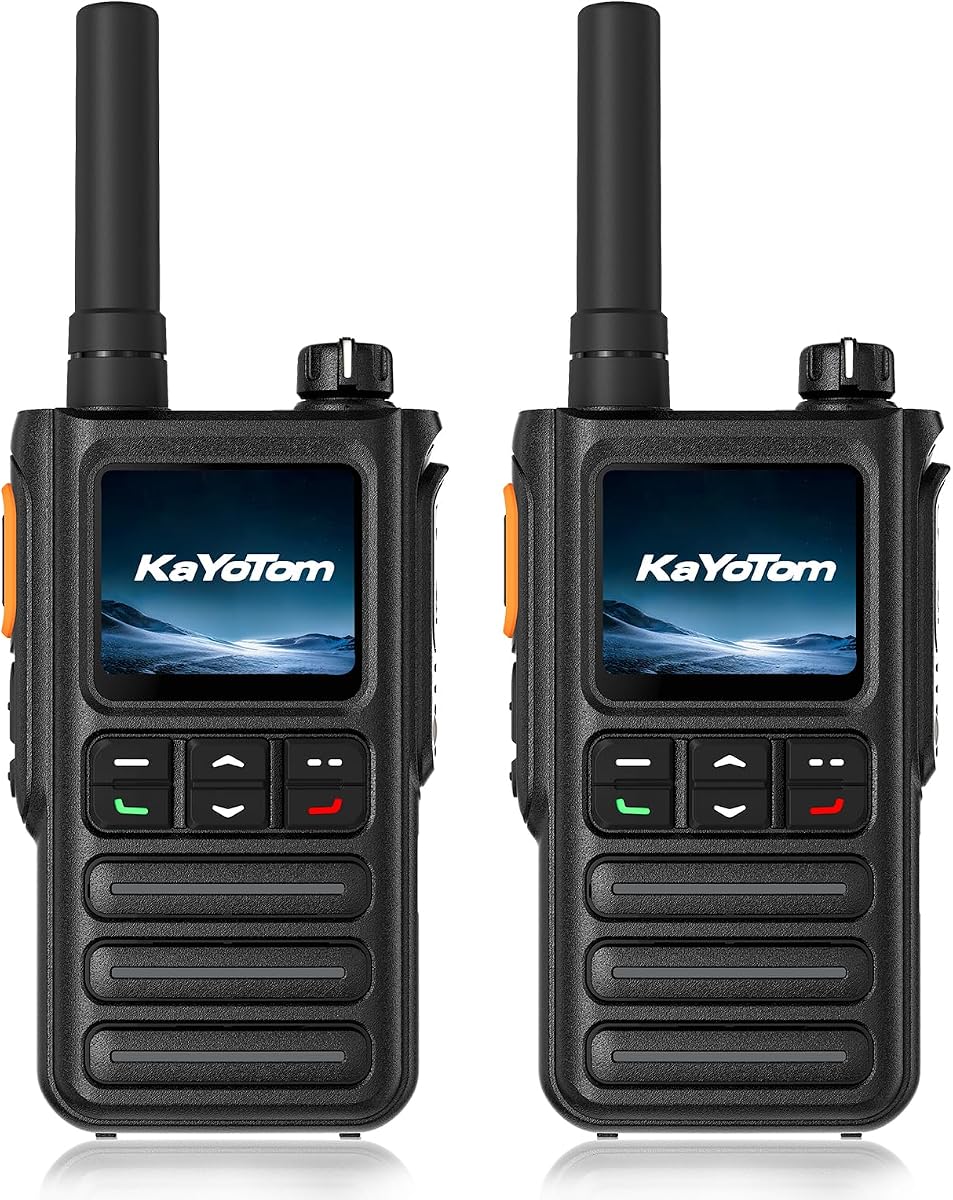
The Kayotom G5 is a three-radio cellular PTT set built for families, construction teams, and fleets that want one button-to-talk device across widely separated locations. Its 4.4 rating reflects a broad feature set, but the defining attraction is the combination of 4G LTE communication, a 3000mAh battery, and a rugged, dust-resistant design. The package includes a SIM and three radios, making group deployment more convenient than buying singles separately.
We may earn a commission when you buy through this link, at no additional cost to you.
The product description advertises communication across 5000-plus miles from California to New York and other locations, using preinstalled 4G LTE service. This is a distance claim made possible by cellular infrastructure rather than a 5000-mile radio transmission. Actual service depends on compatible coverage, signal availability, and the provider's network. A highly sensitive microphone and 95% environmental noise reduction are also claimed for better clarity.
Durability is a major focus. The listing describes resistance to dense dust, two-meter drops, heat, and cold, while also mentioning a belt clip, headphone jack, and emergency light. Its 3000mAh battery is listed at more than 80 hours and 15 days of standby, and the USB-C port is said to restore 50% power in 20 minutes. These are meaningful features for job sites and outdoor trips, although the precise test conditions and real-world runtime can vary.
This set is well suited to a three-person family group, a contractor, or a small fleet that wants PTT-style communication without managing a conventional radio network. It may also work for school trips or convoy travel where members move between cellular areas. Buyers seeking truly unlimited physical range should understand that the radio cannot create coverage where the cellular network is unavailable.
Three units make it easier to equip a complete family, work crew, or travel group. Custom group configuration can keep conversations organized, while the preinstalled SIM is intended to simplify initial setup.
The large rechargeable battery and fast charging are well aligned with extended construction shifts and multi-day outings. Standby estimates are most useful when the radios are not used for continuous transmission.
We may earn a commission when you buy through this link, at no additional cost to you.
The Retevis RB48 is a rugged FRS radio intended for people who need dependable communication in harsh outdoor or industrial settings. It holds a 4.5 rating and is designed around direct radio transmission rather than a cellular network. The bright yellow housing also improves visibility around machinery, trails, and work areas, where a black radio can be difficult to locate.
We may earn a commission when you buy through this link, at no additional cost to you.
MIL-STD-810H testing and IP67 sealing form the core of its durability story. The supplied data specifies protection against 0.1-micron dense dust, two-meter drops, vibration, heat, cold, and other environmental stresses. It also states that the radio passed 1,000 two-meter drops without breaking. These claims make it a convincing option for farm work, hiking, camping, and outdoor events.
The advertised range reaches up to 300,000 square feet or approximately 25 floors, depending on the environment. That describes a potential operating envelope rather than a guaranteed radius across farms or valleys. The 2000mAh battery is listed at up to 20 hours of use, and charging is handled through USB-C and a charging station. A roger beep confirms when a transmission ends, while optional vibration helps users notice a call without immediately hearing it.
The RB48 is a good match for buyers who prefer a self-contained radio network and need a device that can tolerate rain, dust, and drops. It is less suitable for communicating between distant regions where terrain blocks the signal or where a cellular PTT system would provide a clearer advantage. For local farms, large properties, and outdoor teams, however, it offers a strong balance of range, endurance, and physical resilience.
Sealed controls and a rugged shell make the RB48 suitable for barns, job sites, and wet weather. Its testing record is especially relevant for buyers who expect radios to withstand frequent handling rather than careful indoor use.
The large front push-to-talk button can be operated with gloves, and vibration alerts provide a quiet way to notice incoming traffic. These details reduce interruption during jobs that require attention to the task at hand.
We may earn a commission when you buy through this link, at no additional cost to you.
This Retevis RB48 listing places particular emphasis on long-term durability, making it well suited to farms, construction teams, and rural households that use radios in demanding conditions. It carries a 4.5 rating and highlights 19 tests covering temperature shock, rain, salt fog, humidity, sand and dust, vibration, shock, and immersion. The claim is reinforced by an industrial-grade component and reinforced internal structure rather than only a rugged outer shell.
We may earn a commission when you buy through this link, at no additional cost to you.
Its practical feature set remains strong. A large front PTT button supports operation while wearing gloves, vibration alerts notify users of a call, and NOAA weather alerts keep teams informed about changing conditions. The 2000mAh battery is stated to deliver up to 20 hours of use, while the radio can cover up to 300,000 square feet or 25 floors. These specifications align well with large properties, warehouses, and multistory rural facilities.
The key trade-off is that this is still a traditional FRS radio, so its practical reach depends on line-of-sight, terrain, building construction, and other radio conditions. It does not provide cellular roaming, GPS coordinates, or the ability to communicate across state lines merely because the radios are powered on. A buyer expecting a phone-like network should select a cellular PTT model instead.
The five-year warranty and 30-day return period strengthen the case for buyers who want a radio intended for extended use. This RB48 is a compelling recommendation for anyone who values a rugged, local communication system more than nationwide connectivity. It is particularly appropriate for ranch crews, maintenance teams, outdoor guides, and homeowners who need a radio that can handle rain, dust, vibration, and frequent drops.
The listing highlights reinforced internals and industrial-grade components as protection for critical parts. That distinction matters for radios repeatedly exposed to vibration, temperature changes, and impacts in vehicles or work areas.
NOAA alerts add situational awareness, while vibration provides a discreet signal on a noisy job. Together, these features help a user remain aware without watching the radio continuously.
We may earn a commission when you buy through this link, at no additional cost to you.
The Rapid Radios G1 is a nationwide cellular PTT set for organizations that need to coordinate people over a broad geographic area. It includes two radios, chargers, belt clips, and batteries, and provides one year of service per radio according to the supplied information. Additional years can be added for a fee, so buyers should evaluate the ongoing service structure alongside the hardware.
We may earn a commission when you buy through this link, at no additional cost to you.
The radio supports one-to-one private conversations and group talks for as many as 200 people per talk group. That scale is useful for construction projects, farms with multiple crews, event teams, and families traveling in separate vehicles. Advanced noise cancellation is designed to improve clarity in noisy settings, and 256-bit AES encryption is included for private communication across the cellular network.
Battery life is advertised at five days, and the package uses the provided charger. The manufacturer explicitly warns against substituting a third-party charger and states that battery problems, overheating, or injuries arising from that use are its responsibility. Following the supplied charging equipment is therefore important. The radio is also described as rugged and suitable for all-weather use, although a specific ingress rating is not provided in the supplied data.
This set is ideal for users who want a radio-like push-to-talk experience across cities, counties, and states. It is less appropriate for remote stretches without cellular coverage, where a traditional radio can still work because it does not require a network. Subject to service availability, the G1 is especially attractive for work fleets, event coordinators, and multi-state family groups that value large groups and encrypted nationwide communication.
Talk groups of up to 200 people simplify communication for large crews and events. Users can move between private conversations and broader group traffic without relying on a phone application for each call.
The advertised 256-bit AES encryption is intended to prevent unauthorized access to communications. Security features are useful for private business, but they should complement—not replace—an established emergency communication plan.
We may earn a commission when you buy through this link, at no additional cost to you.
The Rocky Talkie Mountain Radio is purpose-built for hikers, climbers, hunters, and backcountry travelers who need a simple radio that remains dependable in difficult terrain. It is the highest-rated product in the group at 4.6 and includes two radios in the set. The product is designed for direct FRS communication and does not depend on cellular service, making it a compelling option for isolated areas.
We may earn a commission when you buy through this link, at no additional cost to you.
The radio transmits at the maximum legal power for unlicensed use, which is two watts. Its maximum range is advertised as over 35 miles, but the supplied information responsibly notes that one to five miles is more typical in backcountry terrain. This distinction is important: broad valleys and unobstructed ridgelines can produce substantial reach, while dense forests, ravines, and curved terrain restrict it.
A specialized rechargeable lithium-ion battery is claimed to provide more than four days of operation, even in cold conditions. The Mountain Radio also has a shatterproof LED screen, thermoplastic protective covering, an ultra-light climbing-rated carabiner, and a metal-reinforced backup leash. It is IP56 rated for splashes and snow. Unlike fragile clip-based designs, its attachment system is intended to stay secure on a backpack or harness.
The radio is ready to use from the box and has only five easy-to-understand buttons. That simplicity makes it attractive during cold, wet, or stressful outdoor conditions when a feature-dense radio may be distracting. It is best suited to experienced backcountry users who understand line-of-sight limitations and want a durable, long-endurance device. Among this group, it stands out for cold-weather battery performance and thoughtful mounting hardware.
The advertised maximum is best viewed as an exceptional condition rather than a typical promise. Rural buyers should consider terrain, antenna height, weather, and whether the other user is on a ridge or deep in a valley.
The carabiner and reinforced leash reduce the chance of dropping the radio during movement. A secure attachment is especially valuable when the user's hands are needed for climbing, hiking, or handling equipment.
We may earn a commission when you buy through this link, at no additional cost to you.
The Intercom Global POC is a two-radio cellular PTT set designed for families, logistics teams, and businesses that want to communicate across a wide area without managing conventional channels. It has a 4.3 rating, uses 4G LTE PoC technology, and includes a SIM card. The supplied information advertises zero-latency calls between locations such as California and New York.
We may earn a commission when you buy through this link, at no additional cost to you.
Its 5000mAh battery is the largest capacity listed in this roundup, supporting a claimed full day of talk time and seven days of standby. That balance favors users who mostly receive short calls and keep the radio on standby between them. A highly sensitive microphone and environmental noise reduction of up to 95% are intended to improve voice clarity around factories, traffic, construction sites, and crowded areas.
The service description emphasizes lifetime-free hyperspeed data, no monthly bills, no activation charges, and no renewal costs after the first year. It also states that customers share their SIM ID with support when the data cycle ends. Since detailed service conditions are not fully presented in the product data, buyers should verify the current terms directly before making a long-term purchase decision.
Group setup is handled through Amazon Messages by sharing each device's IMEI, allowing multiple radios to be linked or placed into custom groups. This is a convenient option for a company, delivery operation, or extended family. The main limitation is that cellular coverage, rather than radio transmission power, determines the useful distance. It is best for populated corridors and areas with dependable 4G service.
The large battery is particularly useful for teams that keep one group listening throughout the day. Heavy transmission still consumes more power, so users should manage talk time and maintain access to charging during extended operations.
IMEI-based setup through customer support allows radios to be organized into shared or custom groups. This avoids the need for every user to configure a complex set of contacts independently.
We may earn a commission when you buy through this link, at no additional cost to you.
The Retevis RB48 Extreme combines a 4.6 rating with extensive durability claims and broad local coverage. It is a traditional FRS radio, which makes it an attractive option for rural buyers who want instant group communication without cellular service. The product is aimed at users who need a dependable radio for demanding work, recreation, or property management.
We may earn a commission when you buy through this link, at no additional cost to you.
The listing says the radio passed 19 tests involving temperature shock, rain, salt fog, humidity, sand and dust, vibration, shock, and immersion. A reinforced internal structure protects critical components beyond the outer shell, while the stated coverage reaches up to 300,000 square feet or 25 floors. A large front PTT button, vibration alerts, and NOAA weather alerts make it practical for crews and outdoor households.
Its 2000mAh battery is listed at up to 20 hours of use. That figure will vary with transmit time, volume, weather alerts, and battery age, but it remains suitable for full workdays when the radios are recharged regularly. The five-year warranty and 30-day return period add confidence for buyers planning to use the same set across multiple family members or employees.
This RB48 is a strong recommendation for people who want one radio to handle local communications, weather warnings, and physically demanding conditions. It is not the right solution for reaching a relative in another state, but that is not its intended role. For a farm, hunting area, large estate, or rural job site, its combination of range, durability, alerts, and warranty support is especially convincing.
The combination of weather alerts, vibration notifications, and glove-friendly controls works for both work crews and recreational users. A single rugged platform reduces the need to carry different devices for routine communication and warnings.
The extended warranty supports the product's positioning as a durable, long-term radio. Buyers should still follow charging guidance, keep ports protected, and store the set dry when it is not in use.
We may earn a commission when you buy through this link, at no additional cost to you.
The Retevis RT86 is a four-pack of high-power traditional radios with shoulder microphones, making it a strong choice for a rural business, farm operation, security team, or property-management group. It has a 4.3 rating and emphasizes strong penetration, extended range, and practical operation in demanding professional environments. The supplied data describes coverage of up to 700,000 square feet and communication through as many as 50 floors.
We may earn a commission when you buy through this link, at no additional cost to you.
High-gain antennas and long wavelengths are intended to produce a clear, robust signal across large properties and through substantial structures. The radios use an ABS body, a more durable hidden screen, and large orange push-to-talk buttons that remain easy to identify with gloves. Shoulder microphones have rotating clips and 3.5-millimeter audio connections, allowing flexible positioning and headset use.
The 2600mAh lithium battery is listed at 130 hours of standby and more than 16 hours of continuous use, making the set suitable for long shifts. However, the product specifically warns that fast-charging or high-power USB-C PD adapters are not supported. Users should rely on the supplied charging base and compatible USB interface to avoid battery issues or other risks mentioned by the manufacturer.
Emergency alarms can be activated after enabling CHIRP settings, and VOX supports hands-free operation. The set is also backed by five years of professional support, including free replacement of small components such as antennas, belt clips, screws, and microphone clips. With four complete radios, the RT86 is a convenient all-in-one package for teams that need immediate local communication across large rural or industrial properties.
The high-gain antennas and 2600mAh batteries are designed for dependable communication across expansive properties. The stated floor and square-foot figures depend heavily on building materials, antenna placement, and terrain.
The oversized orange PTT button, vibration-capable design, and optional headset connection support busy work environments. Shoulder microphones also reduce the need to hold the radio while communicating.
We may earn a commission when you buy through this link, at no additional cost to you.
The best rural radio depends on distance, terrain, coverage, battery needs, and the people who need to communicate. Comparing these factors before purchasing helps avoid a set that looks powerful on paper but performs poorly in the places where it will actually be used.
Traditional FRS and GMRS radios transmit directly between users, so they can work in areas without cellular coverage. Their range is strongly affected by hills, trees, buildings, antenna height, and whether users have clear line of sight. Cellular push-to-talk-over-cellular radios instead use 4G LTE networks, allowing users to communicate across cities and states when compatible coverage is available. These devices offer greater geographic reach but introduce a network dependency that direct radios do not have.
In short, choose a traditional radio for isolated land and predictable local group use. Choose cellular PTT when separation, highway travel, or large geographic areas make direct transmission unrealistic.
Maximum range figures generally describe ideal conditions rather than guaranteed performance. A radio advertising 35 miles may perform at a small fraction of that distance in dense forest, steep terrain, or low positions. Rural buyers should look for line-of-sight potential, useful high-gain antennas, and specifications relevant to their terrain. It is also important to distinguish a cellular distance claim from a direct radio transmission claim: cellular PTT distance is mainly a function of network coverage.
Match the radio to the environment, not just the largest headline number. A wide-open ranch may provide excellent direct range, while a wooded valley may benefit more from cellular coverage.
Rural workdays, hunting trips, and emergencies can last longer than a conventional shift. Compare talk time, standby time, and battery capacity, but recognize that heavy transmission, low temperatures, volume, and alerts can shorten real-world performance. Rechargeable lithium-ion cells are convenient for frequent use, while dual-power radios offer valuable flexibility with disposable batteries. For cellular models, confirm whether a charger is included and follow the manufacturer's power-adapter requirements.
Prioritize sufficient endurance for the longest realistic outing, and carry a backup power plan. Avoid assuming a standby estimate equals continuous talk time.
Rural radios are exposed to rain, mud, dust, vibration, temperature changes, and accidental drops. An IP67 rating indicates protection against dust ingress and temporary water immersion, while IP56 is designed to withstand dust and splashes or snow. MIL-STD-810H references indicate testing across environmental and mechanical stresses, but the specific test details matter. Rubberized controls, reinforced internals, secure belt attachments, and shatter-resistant screens add practical protection.
For frequent outdoor use, IP67 or similarly robust construction is a sensible target. For occasional use in fair weather, a lighter radio may be sufficient.
Cellular radios can provide exceptional distance, but a rural property may contain terrain or vegetation that weakens 4G reception. Traditional radios can also develop dead zones behind hills or inside dense structures. Buyers should evaluate the cellular carrier's map for all regularly used locations and keep a direct radio or charged phone as a backup when dependable communication is safety-critical. GPS tracking and nationwide claims are helpful, but neither guarantees a usable signal in every place.
Test coverage where you live and travel, not only in the city. The best system is the one that maintains service across your actual operating area.
Range is only useful when users can hear one another. Noise cancellation, sensitive microphones, high-quality speakers, and adjustable volume are important around machinery, wind, livestock, and crowded workspaces. Some cellular products support very large talk groups, which is helpful for events and dispersed teams. Traditional radios commonly use channels and privacy codes to separate smaller groups. The controls should also be understandable for occasional users, especially during an emergency.
Choose clear audio and manageable group controls over unnecessary complexity. A radio that everyone can use correctly is usually more valuable than one with a long feature list.
NOAA weather scanning, severe-weather alerts, emergency alarms, SOS sirens, and emergency lights can improve awareness in remote areas. These features should supplement official forecasts and emergency instructions, not serve as the sole source of safety information. VOX and hands-free operation may also be useful for workers driving, riding, or managing equipment, although users should understand their local rules and avoid distracting operation.
Look for at least one reliable alert function if the radio will support travel or outdoor work. Also plan how the group will respond when a call cannot be delivered.
Large push-to-talk buttons, vibration alerts, readable screens, simple menus, and accessible controls improve usability in cold, wet, noisy, or gloved conditions. Headset or shoulder-microphone support lets users keep their hands free. The number of included radios should match the size of the intended group, while belt clips, charging stations, spare batteries, and USB-C charging determine day-to-day convenience. Warranty coverage and replacement support are also useful for equipment that stays in the field.
Favor a kit that includes the accessories you will actually use. A complete matching set, proper charging equipment, and a straightforward control layout usually matter more than minor extras.
Before operating the radios, read the included instructions, charge each battery fully, and confirm that every user understands the push-to-talk button. Agree on a primary channel, backup channel, and emergency procedure. For cellular models, verify the account, service coverage, group membership, and device identifiers. For traditional radios, program identical channels and privacy codes across the group, then test the setup in the areas where it will be used.
Keep the radios accessible but protected. Use belt clips or secure attachment points, operate the push-to-talk button briefly rather than holding it continuously, and allow adequate airflow around the microphone and speaker. Raise the antenna when possible and move toward higher ground to improve direct communication. Avoid placing a radio in direct sunlight or a hot vehicle for extended periods, especially when the battery is charging. Use only the specified charger and compatible batteries.
After outdoor use, inspect the housing, antenna, buttons, charging contacts, and connectors for dirt or damage. Remove grit with a soft brush, and allow the radio to dry before charging or storing it. Keep contacts clean and avoid exposing the device to salt, chemicals, or severe impact. When the battery is no longer performing well, replace it with an approved battery and dispose of the old cell according to local requirements. A regular charging and inspection routine helps prevent avoidable failures.
The best type depends on coverage and distance. Traditional FRS and GMRS radios are dependable where direct line of sight is possible and cellular service is absent. Cellular PTT radios are better for users separated by many miles who can obtain dependable 4G LTE coverage. A combination of both styles can provide useful redundancy.
Traditional FRS and GMRS radios communicate directly and do not require cell towers or mobile data. Cellular PTT radios depend on compatible cellular coverage, so they will not function in every remote location. Checking coverage maps and testing the intended service area is essential before relying on a cellular model.
Actual range varies with terrain, vegetation, buildings, antenna height, and radio power. Some products advertise maximum distances under ideal conditions, but shorter distances are often more realistic in backcountry terrain. For cellular models, the important limit is generally network coverage rather than line-of-sight transmission.
IP67 indicates that the radio is protected against dust ingress and temporary water immersion under defined test conditions. It does not mean the device can be deliberately submerged for any length of time. Seals can also be damaged by drops, worn buttons, or improper charging, so reasonable protection and routine inspection remain important.
No. NOAA scanning can notify a group when certain weather alerts are broadcast, making it valuable in remote areas. However, users should also monitor official forecasts and follow instructions from local emergency authorities. Radio alerts may be missed if reception is weak or a specific warning is not transmitted.
The set should include one radio for every person who needs direct access, plus at least one spare for a group operating over several days. Two-radio sets suit couples or very small crews, while three- and four-radio bundles are more practical for families, farms, and work teams. Each user should carry a charged radio even when a phone is also available.
FRS is common for consumer outdoor and family use, GMRS offers additional channels and privacy-code options, and cellular PTT provides broad geographic reach through a network. Check the radio's supported modes, local operating rules, intended users, and available coverage. A traditional model is usually the safer choice for isolated areas without reliable service.
Keep the radios in belt pouches or secure mounts, clean dirt from controls after muddy work, and inspect seals and charging contacts regularly. Use the manufacturer-approved charger, avoid extreme heat, and store the devices dry when they are not needed. A charging schedule and spare battery or radio are especially useful for extended rural trips.
The Midland GXT1000VP4 is a practical overall pick for families and local groups that value straightforward communication, NOAA scanning, and dual-power flexibility. The Retevis RB48 stands out for rugged construction, extensive environmental testing, weather alerts, and strong local coverage. For outdoor expeditions, the Rocky Talkie Mountain Radio offers the most specialized design, with exceptional cold-weather battery life and secure backpack attachment.
Rural buyers should prioritize the environment in which the radio will operate. Choose a conventional FRS or GMRS model for direct communication away from cellular coverage, or a 4G LTE PTT system for people traveling across counties and states. Battery life, IP ratings, charging requirements, group size, and useful emergency features should then be weighed against the size and complexity of the device.
Before ordering, verify current specifications, service terms, coverage, included accessories, and prices on the product page. Regulatory rules and wireless support can also change over time, so rural users should review the relevant FCC requirements and ensure that everyone in the group knows how to use the radio, charge it correctly, and respond to an emergency.