
Cell Phone Booster for Home & Multi-Room
4.8Editor score
Up to 7000 square feet
Two indoor antennas
Automatic gain control
Signal Booster for Basement Cell Reception guide compares ten top models for coverage, carrier compatibility, gain, installation ease, and reliable indoor
A cellular signal booster can make a dramatic difference in a basement where concrete, masonry, below-grade placement, and competing indoor equipment weaken reception. The right model must combine usable outdoor signal, appropriate carrier and frequency support, enough gain, and carefully separated antennas to deliver dependable calls, texts, streaming, and working mobile data.
This guide compares ten boosters using the specifications and stated capabilities supplied for each product. Coverage claims, maximum gain, supported bands, carrier compatibility, antenna arrangements, app features, and installation guidance are considered alongside each booster's suitability for basements and other below-grade spaces.
Each review explains who benefits most from the selected model, along with its limitations and installation considerations. The top picks represent the strongest balance of budget value, premium features, and whole-home capacity, while prices and availability can change, so readers should confirm current listing details before purchasing.
4.8Editor score

4.5Editor score

4.3Editor score
The following comparison highlights the most important differences among ten cellular boosters for basements, including stated indoor coverage, maximum gain, carrier support, and installation features. Actual results depend heavily on outdoor signal quality, building materials, antenna placement, and the carrier frequencies available at the property.


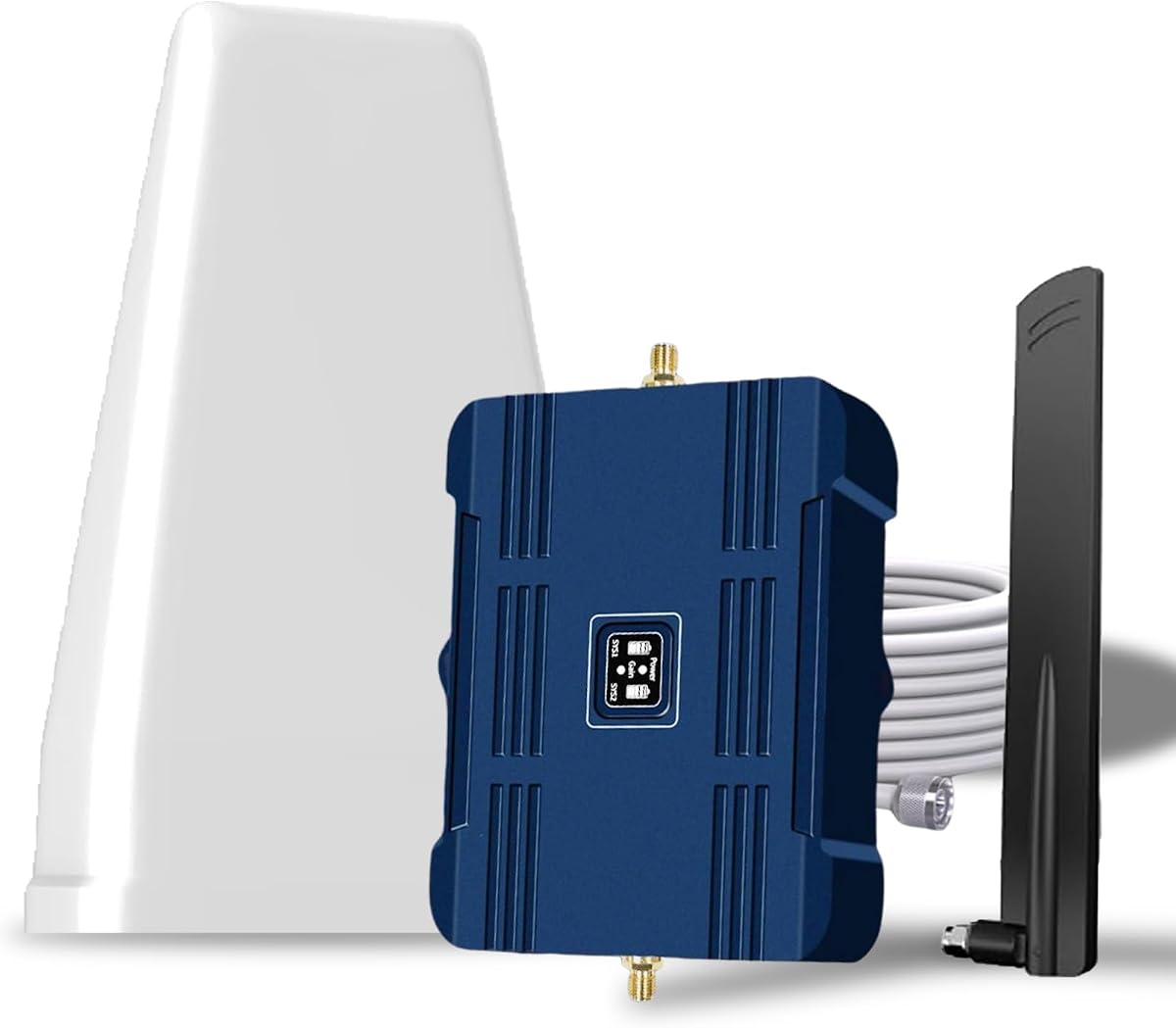


This all-carrier home booster combines a stated coverage capacity of up to 7,000 square feet with up to 70dB of gain and two indoor antennas. Its 4.8 rating and feature set make it a particularly balanced choice for a basement or lower floor where the goal is to improve cellular service throughout several rooms without moving into a vehicle-oriented kit.
We may earn a commission when you buy through this link, at no additional cost to you.
The product supports 3G, 4G LTE, and 5G networks across major U.S. carriers, making it useful for households with different providers. Automatic Gain Control adjusts performance according to the incoming signal, while self-oscillation elimination and low-noise features are intended to maintain stable service. The two indoor antennas offer more placement flexibility than a single compact antenna, which matters when concrete walls divide the basement from the upper floors.
Its headline coverage figure should not be treated as guaranteed area under every condition. A booster needs usable cellular service at the outdoor antenna, and thick masonry, metal doors, furnace equipment, and long cable runs can reduce results. The listing also notes that 5G support depends on services carried over existing 4G bands, so a buyer should verify carrier availability rather than assume every 5G frequency is supported.
This is a strong choice for budget-conscious buyers who want broad compatibility, high gain, and several indoor antennas. It is especially suitable for a basement beneath a home with moderate outdoor reception. Correct antenna placement, adequate separation, and power off during adjustments are the most important conditions for achieving the stated performance.
Two indoor antennas can be positioned on opposite sides of a basement or distributed between the basement and adjacent living areas. This reduces the chance that a single antenna location leaves dead zones behind structural walls.
Automatic Gain Control responds to the available incoming signal and adjusts amplification accordingly. That makes the system more practical in homes where reception varies by time, weather, nearby construction, or outdoor antenna position.
We may earn a commission when you buy through this link, at no additional cost to you.
This HiBoost model is designed for homes, offices, rural properties, and basements where a guided installation process is more valuable than maximum stated floor coverage. It offers up to 2,500 square feet, 62dB of maximum gain, an HD display, app support, and simultaneous use by multiple users, earning a 4.3 rating.
We may earn a commission when you buy through this link, at no additional cost to you.
The SignalSupervisor app provides installation videos, customer support, and a way to inspect outdoor signal strength and identify a better location for the receiving antenna. The main-unit display offers an additional local way to monitor operation, while Automatic Gain Control adjusts amplification without requiring repeated manual balancing. Supported frequencies include 700–750MHz, 800–850MHz, 1900MHz, and 1700–2100MHz.
Although the listing describes compatibility with major U.S. carriers, the listed frequency bands are narrower than those of some all-band alternatives. A buyer should check the frequencies used by the local carrier rather than relying only on the provider's name. The stated 2,500-square-foot range also makes this more appropriate for a focused basement, office, or small lower level than a large property requiring expansive coverage.
This booster is ideal for someone who wants more installation guidance than a basic kit provides and values ongoing visibility into signal performance. Its three-year manufacturer warranty, lifetime technical support, display, and app make it a particularly polished option. Confirm local band support and usable outdoor signal before installation.
The app's outdoor signal detection can help users identify a stronger position for the receiving antenna. That is often more valuable than increasing gain because a booster can only amplify a signal it can first receive.
A local HD display makes routine status checks convenient, while the app adds remote guidance and installation support. Together they simplify setup and make troubleshooting easier than working without any diagnostic interface.
We may earn a commission when you buy through this link, at no additional cost to you.
This HiBoost system offers the largest stated indoor coverage figure in the group, with support for spaces up to 8,000 square feet. It combines 70dB of gain, two indoor antennas, an LCD display, and app support, while its 4.5 rating reflects a strong combination of capacity and home-focused features.
We may earn a commission when you buy through this link, at no additional cost to you.
The stated application areas include homes, offices, metal buildings, cabins, rural cottages, and basements, all of which can benefit when the outdoor antenna has a clear view of usable carrier signal. The product supports 2G, 3G, 4G LTE, and 5G signals across bands 2, 4, 5, 12, 13, 17, and 25, providing broad compatibility with major U.S. carriers.
Automatic Gain Control manages amplification, and both the app and built-in display provide visibility into real-time signal strength, gain settings, and installation progress. Coverage is still not guaranteed: the eight-thousand-square-foot claim requires suitable outdoor reception, favorable antenna placement, and a building that does not contain unusually dense metal or masonry. The two indoor antennas must also be positioned to distribute service rather than create feedback.
This is the most versatile choice for a large home, finished basement, basement suite, or mixed residential and work area. Buyers seeking a single integrated system for several floors will appreciate the stated capacity and monitoring features. The key is to treat the coverage figure as a maximum under favorable conditions and prioritize accurate outdoor signal detection.
A substantial gain ceiling and two indoor antennas can support service across a basement and several adjacent rooms. This makes the system more useful than a compact unit designed around one recreation area or home office.
The package includes a built-in antenna and an additional indoor antenna, offering more distribution options. Positioning can be adjusted after checking the app and display, which helps identify the most useful indoor arrangement.
We may earn a commission when you buy through this link, at no additional cost to you.
This booster is tailored to AT&T and T-Mobile users whose service depends on 700MHz bands 12 and 17. It provides up to 65dB of gain, a stated coverage area of up to 5,500 square feet, and a complete kit containing the amplifier, outdoor Yagi antenna, indoor omnidirectional antenna, coaxial cable, and power adapter.
We may earn a commission when you buy through this link, at no additional cost to you.
The listing says it can improve existing outdoor signal inside homes, offices, cabins, garages, basements, and metal buildings. It also works with Cricket, Straight Talk, and compatible mobile virtual network operators, but not with Verizon, Wi-Fi, or unsupported frequencies. It can improve voice clarity, reduce dropped calls, support texting, and make upload and download activity more reliable for multiple devices.
Because this is a band-specific system, the first step should be confirming that the local carrier actually uses a supported band. A compatible provider name alone does not guarantee that every nearby tower transmits on band 12 or 17. The installation guidance calls for at least 20 feet of vertical or 50 feet of horizontal separation between the indoor and outdoor antennas, a dry and ventilated amplifier location, and verification of usable outside signal before setup.
This is a targeted choice for a household confirmed to use AT&T or T-Mobile 700MHz service. It may be particularly useful in a rural or basement setting where outdoor reception is weak but present. Buyers should not choose it for Verizon compatibility, and the included complete kit plus explicit antenna rules make it a straightforward option once frequency eligibility is established.
Bands 12 and 17 can be useful where lower-frequency 700MHz service provides the available outdoor signal. This focused compatibility also keeps the system simpler for users who do not need every major carrier and frequency.
The amplifier, both antennas, coaxial cable, and power adapter are included. That reduces the need to source separate components before a basement installation, although good placement remains essential.
We may earn a commission when you buy through this link, at no additional cost to you.
The SignalBrick car booster is built for a different application than the fixed home systems in this guide, but it remains relevant to basement reception because a vehicle can be parked near the home while connected to the cellular network. It carries a 4.8 rating, supports major U.S. carriers, and uses a magnetic outdoor antenna with an indoor patch antenna.
We may earn a commission when you buy through this link, at no additional cost to you.
Its omnidirectional external antenna can receive signals without needing to be pointed directly toward a tower. This is convenient during travel through rural zones or remote highways, where tower direction changes quickly. Automatic Gain Control adjusts signal strength and power in real time, while the supported bands allow multiple passengers and devices to use the boosted connection simultaneously for calls, mobile data, and video.
The simplified installation requires no drilling and is designed for one person to complete in less than 30 minutes. However, this is a vehicle kit rather than a fixed booster for distributing service throughout a basement. It will not solve a home's indoor dead zones in the same way as a multi-antenna system with an exterior receiving antenna and dedicated indoor coverage.
This model is best for motorists who frequently encounter weak service, especially around the property where a basement booster is being considered. It may also help a resident test whether cellular problems are network-related or location-specific. Confirm the bands used by the intended carrier and understand that the product is intended for mobile use rather than permanent home distribution.
A magnetic external antenna and adhesive-style internal patch antenna avoid permanent drilling in the vehicle. The system can therefore be moved between cars or taken on a trip without a more involved installation.
A vehicle system can provide a practical way to observe whether service improves in different outdoor locations. That information can help a homeowner identify where to place a receiving antenna for a fixed basement installation.
We may earn a commission when you buy through this link, at no additional cost to you.
This home and office booster earns a 5.0 rating and provides one of the clearest explanations of expected indoor coverage in the group. Its listed estimates range from about 800 square feet with one or two outdoor bars, roughly 3,000 square feet with three or four bars, and up to 7,000 square feet with five bars.
We may earn a commission when you buy through this link, at no additional cost to you.
Maximum gain is listed at 70dB and maximum output at 17dBm. The system supports 5G, 4G LTE, 3G, voice, text, and data across major North American carriers, including low-band 700MHz frequencies identified as bands 5, 12, 13, and 17. It is also described as FCC and IC certified for compliant operation.
Installation guidance recommends keeping the power off while installing or adjusting antennas, placing the outdoor log-periodic antenna where usable signal is available, and maintaining approximately 32 feet between the outdoor and indoor antennas. These details matter because a system cannot boost a signal that is absent at the outdoor location, and inadequate separation can create oscillation or unstable performance.
This model is an attractive choice for buyers who appreciate realistic coverage guidance and want a high-gain system for several rooms. It is well suited to a basement where the outside antenna can capture a strong signal, although it lacks the app-based diagnostics offered by some premium competitors. The most responsible approach is to compare expected outdoor bars with the published area estimates before deciding.
The stated coverage tiers make it easier to set realistic expectations. A weak outdoor signal produces a much smaller usable area than a strong one, preventing the maximum square-foot figure from being treated as a guarantee.
The 70dB gain ceiling and 17dBm output specification indicate a capable amplifier, but the outdoor signal remains the starting point. Accurate placement and proper separation determine whether that capability translates into stable basement service.
We may earn a commission when you buy through this link, at no additional cost to you.
This compact booster focuses on Verizon and Straight Talk service using 700MHz Band 13, with stated downlink and uplink frequency ranges of 746–757MHz and 776–787MHz. It offers 65dB of gain, automatic gain control, an LED indicator, a directional outdoor antenna, and a claimed indoor area of up to 5,000 square feet or roughly two to five rooms.
We may earn a commission when you buy through this link, at no additional cost to you.
The product listing describes use in homes, garages, basements, offices, cabins, hotels, warehouses, metal houses, and rural locations. It is intended to improve voice quality, reduce missed calls, and support faster data for multiple devices, including phones, tablets, and Wi-Fi hotspots. Automatic Gain Control detects the available signal and adjusts operation accordingly.
Its carrier specificity is the central consideration. The booster supports only the listed Band 13 frequencies, so a Verizon customer whose local network is transmitted on other bands will not receive the full benefit. The 5G and 4G LTE language also depends on how the carrier deploys compatible service. No numeric customer rating is available in the supplied listing information, which limits the ability to compare customer feedback directly.
This is a practical option for a home confirmed to receive Verizon or Straight Talk Band 13 coverage. Its directional antenna can capture a specific tower signal well, which is useful when the best outdoor location is known. Buyers should verify tower frequency information, expect a focused rather than universal band solution, and use the included installation guidance carefully.
Targeting Band 13 lets the system concentrate on the relevant 700MHz service rather than spreading support across many frequencies. This is advantageous when local Verizon service consistently uses the targeted band.
A directional outdoor antenna can reject signals from less useful directions when aimed accurately. It is best positioned where the intended tower is clearly visible and the received signal is strongest.
We may earn a commission when you buy through this link, at no additional cost to you.
This all-carrier home and office system combines a 5.0 rating, two indoor antennas, a touchscreen display, and a stated coverage area of up to 6,500 square feet. Its feature set is aimed at users who want straightforward local control without relying entirely on a phone-based application.
We may earn a commission when you buy through this link, at no additional cost to you.
The product supports 5G, 4G LTE, 3G, voice, text, and data across North American cellular providers. Coverage is described in terms of outdoor signal: approximately 800 square feet with one or two bars, 3,000 square feet with three or four bars, and 6,500 square feet with five bars. This framework is useful for setting expectations before installation in a difficult lower level.
The installation instructions call for powering the unit off while positioning or adjusting antennas, installing the outdoor log-periodic antenna, and keeping the indoor and outdoor antennas approximately 32 feet apart. FCC and IC certification is stated, and the product includes two indoor antennas for distributing service among several basement rooms or adjacent areas. As with every booster, no outdoor signal means no indoor signal to amplify.
This is a strong selection for households seeking broad carrier compatibility, multiple indoor antennas, and a convenient touchscreen rather than a dedicated app. It works particularly well when the receiving antenna can be placed in a strong-signal location. Buyers should treat the published area figures as signal-dependent and give antenna separation priority over maximizing the stated coverage number.
The integrated touchscreen gives users immediate access to operating information from the main unit. This can be convenient in a finished basement where a separate phone, account, or software setup is inconvenient.
Two indoor antennas can serve separate zones or be positioned to overcome a structural obstruction. Their value is greatest when coordinated with the outdoor antenna and kept at the recommended separation distance.
We may earn a commission when you buy through this link, at no additional cost to you.
The SureCall Flare 3.0 is an all-in-one home and office kit with a Yagi outdoor antenna, app guidance, and a stated maximum indoor coverage of 3,500 square feet. It supports major U.S. carriers and multiple users, and its 3.6 rating makes customer feedback the main caution when evaluating an otherwise straightforward system.
We may earn a commission when you buy through this link, at no additional cost to you.
The app helps users aim the antenna, optimize the installation, and complete setup without relying entirely on written instructions. Coverage is tied directly to outdoor signal strength: approximately 500 square feet with one or two bars, 1,500 square feet with three or four bars, and 3,500 square feet with five bars. The kit is designed to improve calls, texts, browsing, streaming, and hotspot use across multiple devices.
The Yagi antenna is directional, so accurate positioning toward a useful tower is important. Basement projects also require careful routing of the connection to the indoor unit and adequate separation between receiving and transmitting antennas. Although the product supports 5G and 4G LTE devices, it can only improve services transmitted on the frequencies it receives and can amplify.
This booster is a good match for a small basement suite, home office, cabin, or compact lower level where app-assisted antenna aiming is desirable. The lower customer rating should prompt buyers to consider recent feedback and installation expectations carefully. Its straightforward kit, clear coverage estimates, and three-year warranty make it worth comparing against similarly focused systems.
The mobile app helps identify the direction and strength of available outdoor service. This is particularly useful for a directional Yagi antenna that performs poorly when aimed toward the wrong source.
The three published coverage tiers make the relationship between outdoor reception and usable indoor area clear. Strong outside service is necessary for the 3,500-square-foot maximum to have practical relevance.
We may earn a commission when you buy through this link, at no additional cost to you.
The SureCall Flare focuses on uncomplicated installation for small homes, cabins, offices, and compact basement areas. It has a 72dB maximum gain, an integrated indoor antenna, and a stated coverage capacity of up to 2,500 square feet, making it a focused solution rather than a system designed to blanket an expansive property.
We may earn a commission when you buy through this link, at no additional cost to you.
Its coverage varies with the signal available at the outdoor antenna: about 1,000 square feet with one or two bars, 1,500 square feet with three or four bars, and 2,500 square feet with five bars. It supports multiple simultaneous users and is compatible with 5G phones, improving the voice and 4G LTE data carried by those devices. The listed noise figure is 7dB.
Installation is one of its strongest distinguishing points. The outdoor antenna uses an omnidirectional design, and the indoor antenna is built into the amplifier, avoiding a separate indoor antenna installation and associated drilling. Fifty feet of RG-6 cable and the other installation components are included, allowing the unit to be placed in the room where improved service is needed.
This is a sensible pick for a small finished basement, guest suite, cabin, or single lower-level workspace where simplicity matters more than multi-floor distribution. Its 3.7 rating calls for attention to recent customer feedback, and the 2,500-square-foot maximum should not be confused with guaranteed coverage. The integrated design, high gain, and included cable nevertheless make installation unusually approachable.
Because the receiving and transmitting components are integrated into the base unit, the system can be installed without running a second indoor antenna cable or drilling for an interior antenna. That simplifies projects in finished spaces.
The 72dB maximum gain is substantial, but the product is optimized for a small area. It works best when the outdoor location has strong service and the basement requires a focused improvement rather than property-wide coverage.
We may earn a commission when you buy through this link, at no additional cost to you.
Choosing a basement cellular booster requires balancing outdoor signal availability, carrier frequencies, building construction, desired coverage, and installation flexibility. The most important principle is that a booster amplifies an existing cellular signal; it cannot create service where the receiving antenna receives nothing.
Begin by checking the number of cellular bars and the usable signal strength at several points outside the home. A booster performs best when its outdoor antenna is placed where it can receive the strongest available service. Concrete foundation walls, metal siding, landscaping, and neighboring buildings can make the signal at a basement window much weaker than the signal directly beside the foundation.
A booster that is described as compatible with a carrier may still lack every frequency that carrier uses in a particular location. Pay attention to the listed bands, especially if your property is served by a rural tower, an indoor distributed antenna system, or a mobile virtual network operator. Targeted Band 12, 13, or 17 systems can be effective for eligible customers, while broad-band models offer greater flexibility for mixed-provider homes.
Published square-foot figures are maximum estimates under favorable conditions, not promises. Coverage varies with outdoor signal, antenna location, cable length, room layout, and wall materials. A compact booster may be sufficient for one basement recreation room, while a larger home with several lower-level spaces may benefit from two indoor antennas. Focus on the number of rooms and structural obstructions rather than the largest headline number alone.
Maximum gain indicates how much the amplifier can increase a received signal, while maximum output indicates the upper power level available to the indoor system. A higher number is not automatically better because excessive gain without adequate outdoor signal can create instability. Automatic Gain Control is useful because it adjusts amplification to the available reception and reduces the need for manual fine-tuning.
The outdoor and indoor antennas must have adequate separation to prevent feedback. Different products provide different guidance, including specific vertical or horizontal distances and, in some cases, approximately 32 feet between antennas. A directional Yagi can capture a stronger target signal but requires careful aiming, while an omnidirectional outdoor antenna is easier to position but may receive more competing signals.
One indoor antenna may adequately serve a small, open basement, but concrete walls and divided rooms can create dead zones. Two indoor antennas or a system with a built-in and external antenna offer more flexibility for distributing service across separate areas. Longer cable runs introduce additional loss, so the booster should be positioned where the cable can reach the target zone without unnecessary extension.
App guidance, LED indicators, and local displays can make a meaningful difference when signals are weak or the outdoor antenna requires adjustment. An app may help identify signal direction, while a display can reveal operating status without requiring a phone. Integrated indoor antennas also reduce installation work, especially in finished basements where drilling and long cable runs are inconvenient.
Select a booster that is stated to be FCC approved or certified, and follow the supplied separation, placement, and operating requirements exactly. The amplifier should be installed in a dry, ventilated location away from direct heat and moisture. Accessories should be used as intended, and outdoor components need appropriate weather resistance for their installation position.
Start by confirming usable outdoor cellular service with a phone before installing anything. Check signal strength at the proposed exterior antenna location, then select the highest stable reading rather than a temporary full-bar reading that fluctuates while walking around the property. Keep the amplifier powered off while mounting antennas and adjusting their positions, and review the included manual before routing cables.
Mount the outdoor antenna where it has a clear view of the relevant tower and is safely protected from weather and accidental contact. Connect it to the booster, position the indoor antenna or antennas in the rooms that need service, and maintain the separation specified by the manufacturer. Power on the system, allow time for Automatic Gain Control to settle, and then test calls, texts, mobile data, streaming, and hotspot performance throughout the basement.
For maintenance, keep the amplifier in a dry, ventilated area and inspect connections for corrosion, looseness, cable damage, or water intrusion. Do not move antennas while the unit is powered. If performance changes, first test the outdoor signal, then verify separation and cable connections before changing indoor placement. Periodic checks help distinguish an indoor coverage problem from a weakening or obstructed outdoor signal.
No. A cellular booster must receive a usable carrier signal at its outdoor antenna. It can strengthen that signal and distribute it indoors, but it cannot generate service that is unavailable at the receiving location. If outdoor reception is completely absent, investigate carrier coverage, obstructions, or a different antenna position before purchasing a more powerful unit.
A fixed home system with an outdoor receiving antenna and at least one well-positioned indoor antenna is usually the most appropriate choice. Larger or divided basements benefit from two indoor antennas, while compact rooms may be served by an integrated-antenna design. The best model is ultimately the one that supports the local carrier frequency and receives a strong signal outdoors.
Not necessarily. The booster can improve a compatible 5G signal only when the carrier transmits that service on a frequency it supports. Several listings specifically note support for 5G carried over existing 4G bands rather than every newer frequency. Check the listed bands and local carrier deployment before assuming full 5G compatibility.
Yes. Dense concrete, masonry, metal framing, ductwork, appliances, and furniture can weaken or block cellular signals. These materials also make correct antenna placement more important, since a single indoor antenna may be unable to reach every section of the structure. Two indoor antennas and careful gain adjustment can help, but they cannot remove every physical obstruction.
More usable outdoor signal generally produces a larger and more stable indoor coverage area. Product guidance commonly associates one or two outdoor bars with a modest area, three or four bars with a medium area, and five bars with the maximum stated area. Compare those tiers with the number of basement rooms you need to cover rather than focusing only on the device's maximum gain.
Yes. Every model in this roundup is described as suitable for multiple users, and the boost applies to compatible cellular devices using supported carrier frequencies. Performance still depends on the strength of the distributed indoor signal, antenna placement, and simultaneous demand for data. A two-antenna system generally offers better distribution across separated rooms.
Not always, because most kits are designed for do-it-yourself installation and include guidance. App-based systems can simplify antenna aiming, while models with integrated indoor antennas are particularly straightforward. Complex installations involving long cable routes, multiple floors, weak outdoor service, or uncertain frequencies may benefit from additional technical support.
A properly installed certified booster should operate without interfering with the cellular network. Following the manufacturer's antenna separation, placement, and operating instructions is essential. Poorly separated antennas can create feedback or unstable amplification, while a wet, overheated, or improperly connected unit can also cause problems.
The Cell Phone Booster for Home & Multi-Room stands out as the strongest overall value because it combines 70dB of gain, two indoor antennas, broad carrier support, and a stated capacity of up to 7,000 square feet. The HiBoost Home Office Cell Booster is the premium pick for buyers who value app assistance, an HD display, and a three-year warranty, while the Hiboost Home Multi-Room Booster is the editor's choice for the greatest stated whole-home coverage.
Before choosing any model, prioritize the availability of carrier service at the outdoor antenna, the frequencies used at your address, and the number of rooms that need coverage. Targeted systems can be excellent for compatible users, while broad-band and multi-antenna models offer more flexibility. Correct separation, intentional antenna placement, and realistic outdoor signal are more important than maximum gain alone.
Finally, remember that indoor coverage figures are conditional estimates and current prices and product details can change. Confirm the latest specifications, installation requirements, included accessories, warranty terms, and carrier compatibility on the product listing before making a purchase.