
iLIVING 14-Inch Hybrid Smart Thermostat Fan
4.4Editor score
Adjustable 40-watt solar panel
Smart thermostat from 50°F
15-year warranty coverage
A solar roof vent exhaust fan can remove trapped attic heat without requiring household wiring, making it useful for improving circulation in attics, garages, sheds, warehouses, and similar spaces. The right model depends on airflow needs, available sunlight, roof design, local conditions, and whether automatic controls or nighttime power are important.
We compared the ten models using their stated airflow ratings, solar-panel output, motor and housing construction, power options, temperature controls, installation requirements, and intended applications. The list includes high-output attic fans, compact roof vents, smart hybrid systems, and a shipping-container-specific model.
Each review explains the product's strongest benefits, practical limitations, and ideal installation environment. Ratings and specifications reflect the supplied product information, while availability and prices can change, so readers should confirm current listing details and roof compatibility before purchasing.
4.4Editor score

4.5Editor score

4.8Editor score
As an Amazon Associate we earn from qualifying purchases.
The comparison below highlights the major differences in airflow, solar capacity, controls, backup power, and construction, making it easier to match a fan to a particular roof and ventilation requirement.
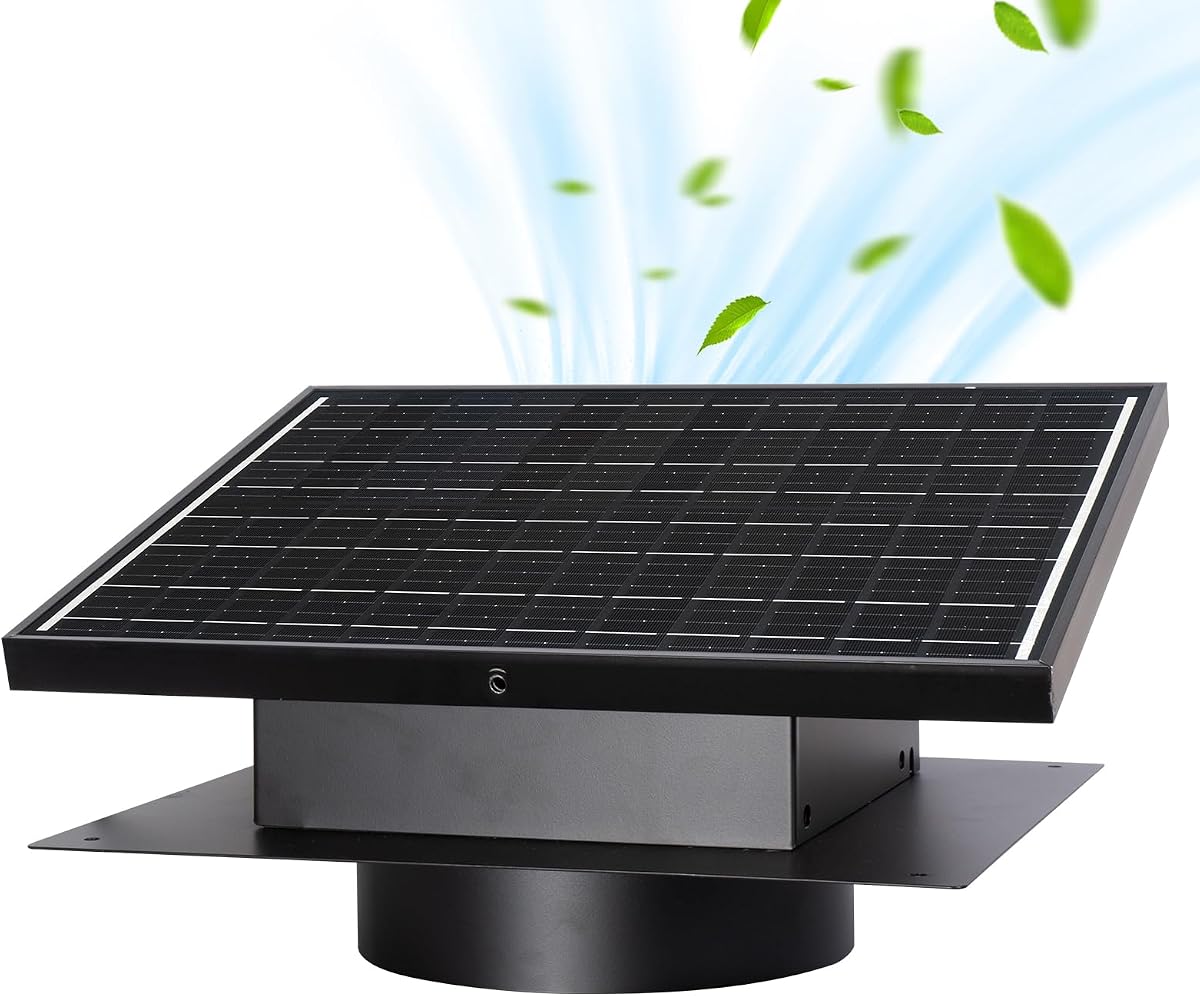


This 40W solar attic fan combines a large 12-inch blade with a stated airflow of 1800–2000 CFM, giving it the strongest high-volume specification in this group. Its 4.5 rating reflects a favorable balance of performance, straightforward operation, and broad intended use. It is especially appealing to homeowners seeking more ventilation than a compact roof vent can provide.
We may earn a commission when you buy through this link, at no additional cost to you.
The controller-free design is the model's main convenience. The fan and panel arrive pre-connected, and operation begins with sunlight rather than through a complex thermostat or wired control. A pure copper motor, metal housing, and IP65 weather-resistant design support outdoor use, while the stated sound level is positioned near a quiet conversation. It also works well as a ventilation source for a garage, greenhouse, shed, or barn.
The main limitation is its dependence on direct solar energy. There is no listed AC adapter, so cloudy periods and nighttime operation may be less effective or stop entirely. Its 2000 CFM claim is also a maximum figure under suitable conditions, not a guarantee that every roof will receive that output. Roof fit, obstruction, panel orientation, and local installation quality remain important.
This is the strongest general recommendation for a larger attic or outbuilding where high airflow and simple solar operation matter more than nighttime operation. Buyers should confirm the roof opening and mounting layout, provide the panel with unobstructed sunlight, and ensure the installation follows applicable building and electrical guidance.
The 1800–2000 CFM range makes this fan better suited to moving substantial volumes of hot air than the smaller 240–320 CFM roof vents. That makes it a more serious option for a hot attic, workshop, garage, or similar space where substantial daytime heat accumulation is the main concern.
The pre-connected panel and fan remove much of the complexity associated with controls and wiring. It is an attractive choice for a straightforward install, although buyers who require consistent airflow after sunset should consider a model with an included AC adapter.
We may earn a commission when you buy through this link, at no additional cost to you.
This 8-inch solar roof vent fan is a compact option for garages, shops, warehouses, sunrooms, and smaller attic areas. It has a 4.0 rating and uses a 25-watt single-crystal panel to power an IP68 brushless DC motor. Its most distinctive feature is the removable roof-vent design rather than a conventional exposed fan housing.
We may earn a commission when you buy through this link, at no additional cost to you.
Galvanized steel construction and polyester powder coating provide corrosion resistance, while aluminum mesh helps keep birds and other small animals from entering. A pipe extension beneath the flange connects to flexible ducting, and four panel holes allow secure attachment. The solar panel clamps to the cover and locks into position with screws.
The stated maximum airflow of 240 CFM is considerably lower than the high-output 12-inch models, so it is better for targeted ventilation than for moving large volumes of air. Because it cannot store electricity, cloud cover, shadows, and weak sunlight can slow the fan or stop it completely. The listing also states that the solar panel must receive sufficient direct exposure.
This model makes sense for a small garage, utility structure, warehouse, or greenhouse where a compact roof-mounted vent and flexible duct connection are more useful than maximum CFM. It is less suitable for a large attic requiring powerful circulation, and prospective buyers should confirm roof dimensions and duct compatibility before ordering.
Because the 8-inch vent is removable and includes a pipe extension, it can fit installation plans that rely on flexible ducting. This differs from a fixed exhaust-fan housing and may be useful where a standard vent opening is already part of the roof design.
The galvanized cover, corrosion-resistant coating, aluminum mesh, and IP68 motor are designed for exposed outdoor use. These features are particularly useful around pests and changing weather, though the solar panel still needs an unshaded mounting position.
We may earn a commission when you buy through this link, at no additional cost to you.
The iLIVING HYBRID Ready fan stands out for its smart thermostat, 14-inch blade, adjustable solar panel, and stated coverage of up to 2900 square feet. It carries a 4.4 rating and offers a more refined control experience than basic solar-only roof vents. The included thermostat can be set from 50°F to 122°F and offers enable and disable controls.
We may earn a commission when you buy through this link, at no additional cost to you.
The 40-watt panel can be adjusted to 0°, 15°, 30°, or 45°, allowing the installer to optimize exposure according to roof pitch and direction. Its 1150 CFM airflow and IP68 brushless motor make it suitable for a substantial attic, while the 15-year warranty adds useful confidence in the overall system.
Continuous day-and-night operation is possible, but the necessary AC/DC adapter is sold separately under model ILG8SF304. That distinction matters because the word hybrid can otherwise suggest that all backup accessories are included. The large fan and adjustable panel also require adequate roof space, sound consideration, and a secure mounting plan.
This is the best fit for a buyer who values smart temperature-based control and a long warranty more than the highest possible airflow. It is particularly appropriate for a large attic where the fan should run only within a selected temperature band or where adding the optional adapter is part of the installation plan.
The thermostat's 50°F–122°F range is unusually broad and allows the fan to be tailored to different seasonal priorities. Enable and disable functions also provide more control than an always-on or purely solar-driven installation.
Four panel angles make it easier to accommodate changing roof geometry. Installation should prioritize a position with strong direct sunlight because solar performance remains central even when optional nonstop operation is added.
We may earn a commission when you buy through this link, at no additional cost to you.
This Hon&Guan model is a smart hybrid fan with a strong 4.8 rating, a 25-watt waterproof panel, an included AC adapter, and up to 320 CFM of airflow. It is designed for spaces up to 1300 square feet and gives users more operating flexibility than a strictly solar-powered compact vent.
We may earn a commission when you buy through this link, at no additional cost to you.
Eco Mode uses solar power while allowing the AC adapter to maintain minimum speed, with fan output increasing as solar input improves. Performance Mode uses the AC adapter and offers four speed levels. A temperature probe detects ambient conditions, starts the fan at the chosen threshold, and shuts it off after the temperature falls below the setting. The adjustable range is 68–113°F.
The tradeoff is that the 320 CFM maximum is modest compared with the 1150–2000 CFM models. Continuous operation also depends on the included AC adapter, meaning 24-hour ventilation is not entirely solar powered. The panel is listed as 17 by 13 inches, so buyers need adequate roof space and a clear mounting direction.
This fan is a good option for a small attic, garage, or similar space where automatic temperature control and a reliable overnight power source are more important than maximum airflow. It is also one of the more approachable choices for users who want both solar savings and predictable control.
Eco Mode prioritizes solar energy and adapts output to available light, while Performance Mode provides stable four-speed mains operation. This makes the fan adaptable to seasonal weather and changing household priorities without replacing the unit.
The external probe starts and stops the fan according to the selected threshold. That automation can reduce unnecessary runtime, though the location of the probe and the accuracy of the selected threshold should be considered during setup.
We may earn a commission when you buy through this link, at no additional cost to you.
This fan is purpose-built for 3.5-inch ribbed shipping-container roofs, giving it a clear advantage over general-purpose models for container offices, workshops, and storage. It has a 5.0 rating, a 12-watt solar system, and a stated brushless fan output of 630 CFM. Its focused compatibility makes it attractive when the roof profile is known in advance.
We may earn a commission when you buy through this link, at no additional cost to you.
The unit is designed for leak-conscious installation on standard ribbed roofs, and the listing specifically advises measuring the roof ribs before ordering. A mounting kit and manual are included. Solar power eliminates electrical wiring at the site and starts daytime ventilation automatically when sufficient sunlight is available.
Its 630 CFM output is useful for a single container but lower than the largest 2000 CFM attic models. It has no listed mains-power option, so operation will depend on daylight and available solar energy. Container roofs may also cast shadows depending on orientation, stacking, and nearby structures, making panel placement critical.
This is the natural recommendation for someone improving a shipping container or similarly ribbed metal structure. It is less versatile for a conventional shingle roof or large residential attic, and it should be chosen only after confirming the roof's rib dimensions, available sun exposure, and intended exhaust opening.
The 3.5-inch rib specification reduces uncertainty when installing on a compatible container. It is a more targeted solution than forcing a general roof vent onto a corrugated metal surface with an unsuitable mounting pattern.
A stated 630 CFM of airflow can help release heat and excess humidity from container offices, workshops, and dry-storage areas. Consistent nighttime ventilation is not addressed, so the fan is best paired with another strategy after dark if humidity remains a concern.
We may earn a commission when you buy through this link, at no additional cost to you.
This 40W model combines a 12-inch fan, up to 2000 CFM of airflow, a thermostat, an MPPT controller, and an included AC adapter. Its 4.4 rating reflects a comprehensive feature set for buyers who want more control than a basic solar roof vent provides. The stated cooling coverage is up to 2500 square feet.
We may earn a commission when you buy through this link, at no additional cost to you.
Its panel adjusts from 0 to 70 degrees in both horizontal and vertical directions. Two modes are offered: Energy Saving mode varies airflow with sunlight, while Performance mode provides four speed settings through the controller. The thermostat can enable or disable automatic starts between 68°F and 113°F. With the adapter connected, the system prioritizes solar power and uses mains electricity when needed.
The installation includes several long cable runs: a 196.9-inch adapter cable, 118.1-inch solar panel cable, and 118.1-inch fan cable. Connector types are specified for compatibility, but planning cable routes is an important part of setup. There is no battery backup, and the listing recommends checking accessory and fan operation before installation.
This is a strong choice for a larger attic or workshop where high airflow, automatic controls, and continuous operation are all priorities. It is more complex than a controller-free model, but that complexity buys meaningful control, especially for owners who want solar-first behavior with reliable fallback power.
The system uses available sunlight as its priority and shifts toward household power when solar support is weak. This can keep ventilation more consistent through changing daylight conditions without requiring a separate battery system.
Four speed levels, two operating modes, and a broad thermostat range offer more granular control than simpler models. The controller and included temperature probe add installation considerations, but they make the fan easier to tailor to daytime and nighttime needs.
We may earn a commission when you buy through this link, at no additional cost to you.
This 55W hybrid fan is the most remote-control-oriented product in the roundup. It has a 4.7 rating, a 12-inch fan, 1300 CFM of stated airflow, and a 55-watt monocrystalline panel. The 65-foot wireless remote allows speed, temperature, and manual power adjustments without climbing onto the roof.
We may earn a commission when you buy through this link, at no additional cost to you.
The thermostat starts the fan at 77°F and stops it when conditions fall to 68°F. AC backup supports operation during cloudy periods and at night, while the housing is described as waterproof, UV protected, and rust resistant. A brushless DC motor supports smooth, quiet operation, and the package includes waterproof flashing.
The stated ability to lower attic temperature by 15–20°F and the remote's useful range are compelling, but actual results depend on insulation, roof design, climate, and airflow paths. The fixed start and stop thresholds provide less adjustment flexibility than models with a broad programmable range, and the remote is a separate control dependency.
This is an attractive recommendation for a larger attic, garage, shed, or greenhouse where users want remote convenience and a large solar panel. It is particularly suitable for installations where climbing to the fan is inconvenient and where occasional mains support is acceptable.
Controlling the unit from up to 65 feet away is especially helpful on a difficult roof. It reduces the need to access the fan for routine speed changes, manual starts, and temperature-related adjustments.
The 55-watt panel and 1300 CFM fan provide meaningful capacity without reaching the largest 2000 CFM specification. AC backup extends operation beyond sunny hours, creating a practical balance of solar operation and reliability.
We may earn a commission when you buy through this link, at no additional cost to you.
The Bghdas 8-inch roof vent is a basic solar-powered option for small to medium spaces, with a 3.6 rating that is the lowest among the ten products reviewed. It uses a 25-watt panel and 12V brushless DC motor to provide 240 CFM of airflow. Its appeal lies in simple construction and direct solar operation rather than advanced controls.
We may earn a commission when you buy through this link, at no additional cost to you.
Galvanized steel and aluminum mesh help with durability and pest exclusion. Pre-drilled holes and included screws simplify mounting, while the plug-and-play connection between the fan and panel removes the need for complex wiring. The intended applications include attics, garages, sheds, sunrooms, and chicken coops.
The 240 CFM airflow is modest, and the absence of controls, thermostat, or AC backup means operation changes with sunlight. Because the model stores no energy, it may slow or stop in low light. The low rating also suggests the supplied customer feedback is less favorable than that of the higher-rated products, so prospective buyers should review recent listing feedback carefully.
This model is most appropriate for a small enclosure where a compact, inexpensive installation is preferable to high capacity or smart behavior. It should not be selected for a large attic unless the goal is limited supplementary ventilation rather than substantial heat removal.
The fan is directly powered rather than dependent on a replaceable battery, which removes battery servicing from the ownership routine. Routine care can focus on panel cleanliness, mounting security, and unrestricted airflow.
At 240 CFM, the unit is better matched to a small shed, garage corner, sunroom, or chicken coop than a broad attic. Choosing the right capacity prevents disappointment when a compact vent is expected to ventilate a much larger volume.
We may earn a commission when you buy through this link, at no additional cost to you.
The HONGUAN 40W model combines a stated 2000 CFM airflow with hybrid solar and AC power, producing a 5.0 rating and a strong feature profile. It is designed for attics, garages, sheds, workshops, greenhouses, and other enclosed spaces, with listed coverage of up to 2500 square feet.
We may earn a commission when you buy through this link, at no additional cost to you.
Its MPPT controller manages the 40-watt monocrystalline panel. Energy Saving mode varies airflow according to available sunlight and allows the AC adapter to supplement operation. Performance mode provides four speed settings through the controller, with the adapter required. An adjustable thermostat ranges from 68°F to 113°F, and the thermostat can be disabled for continuous ventilation.
The panel adjusts from 0 to 70 degrees horizontally and vertically, which is helpful for roof orientation. The IP65 housing supports outdoor use, and the package includes the controller, adapter, mounting template, brackets, screws, manual, and service card. The number of components makes planning more involved than with a plug-and-play solar-only fan.
This is a compelling option for a buyer who wants near-top airflow together with automatic controls and consistent hybrid operation. It is particularly useful in climates where cloudy stretches or nighttime heat make pure solar operation less dependable. As with other high-output systems, a suitable roof opening and secure mounting area are essential.
The MPPT controller is designed to manage energy from the 40-watt panel while Energy Saving mode varies fan output to available sunlight. This makes the system more responsive to changing solar conditions than a simple fixed-output installation.
Four speed levels and a broad thermostat range allow operation to be tailored while preserving up to 2000 CFM potential. The included AC adapter makes Performance mode available, although continuous high-output use will depend on mains electricity.
We may earn a commission when you buy through this link, at no additional cost to you.
This 10W model is the most compact solar option in the list and earns a 4.8 rating for its straightforward construction, large 9.8-inch panel, and easy installation. It is intended for lighter ventilation duties in attics, garages, warehouses, greenhouses, barns, and other enclosed spaces.
We may earn a commission when you buy through this link, at no additional cost to you.
The fan uses a 12V solar system and an aluminum alloy housing described as rust proof and sturdy. Its square panel measures 9.8 by 9.8 inches, providing a broad surface that can be oriented toward direct sunlight. Pre-drilled mounting holes and included hardware help simplify setup, and no complex wiring or electricity connection is required.
The most significant limitation is that the supplied information does not specify a CFM rating, making direct airflow comparison difficult. The 10W panel is also the smallest output in the group, so the unit is less clearly suited to a large or severely hot attic. Direct sunlight remains essential for dependable operation.
This is a sensible budget-oriented choice for a small garage, greenhouse, warehouse, barn, or attic that needs modest daytime circulation. Buyers seeking a major reduction in accumulated attic heat should favor a model with a published airflow figure and larger solar capacity.
Aluminum alloy construction offers a lightweight housing that resists rust during outdoor exposure. Its smaller scale also reduces the visual and structural demands of installing a ventilation unit on many roof types.
The direct solar connection avoids household wiring and provides automatic daytime ventilation when light is sufficient. It is most convincing for smaller spaces where the application does not require the highest published airflow.
We may earn a commission when you buy through this link, at no additional cost to you.
The most important considerations are the volume of air that must be moved, the amount of direct sunlight available, the roof's construction, and whether ventilation must continue after dark.
Airflow is measured in cubic feet per minute, or CFM, and indicates how much air a fan can move. The products in this guide range from 240 CFM compact roof vents to models claiming up to 2000 CFM. A larger fan is generally more appropriate for a broad attic, workshop, or garage, while a smaller unit may adequately serve a shed, greenhouse, container, or compact enclosure. Published airflow figures are maximum outputs and may be influenced by fan speed, panel power, roof configuration, and installation conditions.
In short, match CFM to the size and heat load of the space rather than choosing only by wattage.
A larger solar panel generally supports a larger fan, faster startup, and steadier operation in changing light. The list includes panels from 10W to 55W, plus a 25W system with a 40W counterpart available in a separate model. Panel output must be considered together with motor demand rather than in isolation. A powerful fan paired with an undersized panel may not reach its highest speed, while a large panel on a small vent may be unnecessary.
In short, choose panel capacity to match the motor and the weakest sunlight expected at the installation site.
Solar-only fans stop when available power is insufficient, while hybrid systems can draw from an AC adapter during cloudy periods or at night. The Hon&Guan, 40W thermostat, 55W remote-control, and HONGUAN models include hybrid power support in their stated configurations. The iLIVING model offers optional nonstop operation through a separately sold adapter. Including mains power improves consistency but introduces wiring, operating electricity, and a greater reliance on household electrical infrastructure.
In short, hybrid power is the practical choice when uninterrupted ventilation matters; solar-only operation is simpler and independent of household wiring.
A thermostat can prevent unnecessary fan runtime by starting and stopping according to a selected temperature. The controls differ considerably: the iLIVING model offers a broad 50–122°F range, several hybrid models use 68–113°F, and the 55W remote model has specified 77–68°F switching points. Remote controls add convenience on an inaccessible roof, but wall-mounted or app-based control is not offered across the category. Temperature probes must also be positioned where they can accurately represent the space being ventilated.
In short, prioritize programmable temperature control for automation and a remote only when convenient roof access is a recurring concern.
Roof construction determines whether a standard roof vent, exposed fan housing, or rib-mounted unit is appropriate. The 8-inch removable models suit more conventional roof openings and flexible ducting, while the shipping-container model specifically fits 3.5-inch ribs. Large 12-inch fans require enough clear space for the housing, panel, blade sweep, and maintenance access. Existing flashing, roof pitch, nearby obstructions, and the structural condition of the roof also need evaluation before drilling or mounting.
In short, measure the roof opening and ribs, inspect the mounting area, and confirm that the complete unit can operate without obstruction.
A roof fan is exposed to rain, sunlight, wind, dust, pests, and temperature swings. The group includes IP65 and IP68 motor ratings, galvanized steel covers, polyester coatings, nylon-fiber-aluminum blades, and aluminum alloy housings. A waterproof motor alone does not guarantee that every seam or cable entry is sealed, so flashing, cable routing, and the quality of the roof penetration remain important. Corrosion-resistant components are especially valuable in coastal, humid, or agricultural environments.
In short, prioritize a fully sealed motor, corrosion-resistant housing, quality flashing, and secure cable protection.
Some products arrive with the solar panel and fan pre-connected, while others require panel clamping, controller placement, probe positioning, and multiple extension cables. A pre-connected design is helpful for a simple DIY install, while complex systems reward careful planning and may be better handled by an experienced installer. Roof safety, ladder stability, electrical safety, and the possibility of roof leaks should be considered. No product should be assumed to suit every roof type without checking the manufacturer's instructions and local requirements.
In short, match the product's installation demands to your experience, tools, roof access, and willingness to plan cable routes.
Solar ventilation depends on the panel receiving direct light. Roof direction, nearby trees, buildings, chimneys, and the panel angle can all affect output. Models with adjustable panels provide more installation flexibility, but even an adjustable panel cannot overcome heavy permanent shading. Cloud cover can slow or stop solar-only units and reduce the solar contribution available to hybrid systems. The product's stated performance should therefore be treated as a sunny-condition figure rather than an around-the-clock guarantee.
In short, observe the intended panel location across the day and prioritize an unobstructed, correctly oriented position.
Before installation, identify the fan's intake and exhaust arrangement, verify the roof opening, and place the solar panel where it receives direct sunlight without interference from trees or structures. For hybrid models, route the adapter and control cables through protected, dry paths and install the temperature probe in a location that reflects the space you want to control. Use the supplied template, flashing, brackets, and fasteners, and confirm that the blade has complete clearance.
After mounting, test the fan and controls before covering or finalizing the installation. Check that the panel generates power, the fan starts, the thermostat responds, the remote reaches the unit, and the adapter or MPPT controller displays normal operation. Solar-only fans should be tested under strong daylight. If airflow seems weak, inspect the panel for dust or shadow and verify that no obstruction is restricting the blade or vent.
Routine care is light: wipe the solar panel clean, check the mounting hardware, and look for corrosion, loose flashing, damaged cables, or blocked vents. Keep leaves, nests, and debris away from the opening. Do not spray water into electrical components, and follow the manufacturer's instructions when accessing the motor. Battery-free models avoid battery replacement, but every model still benefits from periodic inspection and careful obstruction control.
Most solar-only models do not run at night because they store no electrical energy. Hybrid models can continue operating after dark by drawing power from an included or optional AC adapter. Check the product listing carefully, since some hybrid systems include the adapter while others sell it separately. Continuous operation therefore generally requires household electricity.
The panel should receive direct sunlight for the strongest performance. Shade, heavy clouds, and late-day obstructions can reduce output, slow the fan, or stop a solar-only unit completely. Roof direction and seasonal sun angles matter, so observe the site before installation and adjust the panel where the product supports that option.
There is no single CFM figure that suits every attic because size, insulation, roof design, and heat gain all affect the result. Compact 240–320 CFM models suit smaller enclosures, while 1150–2000 CFM fans are more appropriate for larger attics and workshops. Match capacity to the space and ensure that adequate intake air can enter the attic.
A thermostat is not required for basic ventilation, but it can prevent the fan from running when heat is not an issue. Smart models may start at a selected temperature and stop after a cooling threshold is reached. It is especially useful in a variable climate or when the fan also serves a space where stable air movement is beneficial.
Installation depends on the roof's profile, the model's mounting pattern, and the correct flashing or sealing method. The 12W shipping-container model is specifically designed for 3.5-inch ribbed roofs, while other products may require adaptation or a suitable roof opening. Metal roofs should not be drilled or penetrated without following the roofing manufacturer's instructions.
A properly placed solar vent can remove accumulated attic heat and moisture, which may reduce the heat entering the living space. The extent of any air-conditioning savings varies with insulation, climate, ductwork, and the size of the attic. No specific savings should be assumed without evaluating the entire building, and the fan should not be used as a substitute for adequate intake and attic insulation.
Noise varies with blade diameter, motor design, airflow, mounting quality, and operating mode. The 40W 2000 CFM model describes its sound as comparable to a quiet conversation, while the 55W model promotes low-noise brushless operation. Larger fans can produce more sound than compact units, especially at maximum speed, so nearby occupants and sleeping areas should be considered.
The products in this guide are described as directly solar powered and battery free. That eliminates battery replacement and reduces maintenance, but it also means output depends on available light. Hybrid models avoid the interruption of solar-only operation by supplementing the panel with AC power rather than by using a listed battery backup.
The 40W 12-inch 2000 CFM model is the strongest all-around option for buyers prioritizing high airflow and simple controller-free operation. The iLIVING 14-inch fan offers the most premium smart-control package, while the compact 10W aluminum model represents a budget-friendly choice for smaller spaces and lighter ventilation duties.
The right decision starts with the size of the space, the required airflow, direct sun exposure, and whether operation after sunset matters. Large attics benefit from higher-output fans and hybrid power, while small sheds, greenhouses, and warehouses may be better served by compact vents. Roof fit, panel placement, flashing, and installation quality are just as important as the headline specification.
Product details, customer feedback, availability, and prices can change, so check the current listing before buying. Compare the included accessories carefully, confirm roof compatibility, and review the manufacturer's installation instructions. These checks help ensure that the selected solar roof vent exhaust fan is suitable for the location and operating conditions.