
KAIWEETS Digital Laser Tachometer
4.8Editor score
10 to 99,999 RPM range
±0.05% claimed accuracy
Backlit digital display
RPM and count modes
Auto shutoff included
Discover the best laser tachometer options by comparing accuracy, measurement range, memory features, display quality, accessories, and portability.
A laser tachometer measures rotational speed without placing a sensor on a moving shaft, fan blade, wheel, or other rotating component. The best models combine accurate readings with a clear display, dependable target detection, useful data recall, and a practical operating range for automotive, HVAC, workshop, and industrial work.
We compared all ten products using the supplied specifications, including laser or photoelectric measurement range, claimed accuracy, resolution, measurement modes, display features, memory functions, power requirements, included accessories, and portability. The list covers dedicated laser tachometers, contact-and-laser combinations, and portable models intended for general diagnostics.
Each review identifies the most useful strengths and the compromises worth considering, so the right choice depends on your range, precision, recording needs, and working environment. Product ratings reflect the supplied marketplace feedback, while prices and availability can change, so confirm current details before purchasing.
4.8Editor score

4.6Editor score

5.0Editor score
This side-by-side comparison highlights the measurement ranges, accuracy, recording functions, display style, and operating considerations that distinguish each laser tachometer. It is designed to make it easier to identify the model that matches your equipment, workflow, and required level of documentation.




The Extech 461920 is a compact, dedicated laser photo tachometer with a supplied rating of 4.6. It offers a broad 2 to 99,999 RPM measurement range, ±0.05% claimed accuracy, and 0.1 RPM resolution. Those specifications make it a strong all-around choice for users who need to check slow rotating parts as well as much faster motors without changing instruments.
We may earn a commission when you buy through this link, at no additional cost to you.
Its principal strengths are the combination of precision, range, and practical recall functions. A large backlit five-digit LCD presents readings clearly in dim workshops, while stored Min, Max, and Last values help users compare repeated checks without writing every result on paper. The laser works with the included reflective tape, making target setup more reliable when the rotating surface itself is dark, reflective, or visually featureless.
The trade-off is that this is a focused tool rather than a universal diagnostic kit. It does not provide the additional contact-wheel measurement or surface-speed functions found in some combination meters, and it runs from a single 9V battery. Its supplied accuracy and resolution claims are still important points to compare carefully, particularly when measurements must satisfy a formal quality process.
This is an excellent choice for automotive repair, HVAC service, fan checks, motor diagnostics, and general machinery inspection. Choose it when you want a portable, purpose-built laser tachometer with a strong accuracy specification and simple memory functions. For users who need a calibration certificate, contact measurement, or extended working distance, one of the specialized alternatives may be a better fit.
Retaining the Min, Max, and Last readings makes this meter more valuable during troubleshooting than a model that only shows the current value. A technician can watch for speed variation, compare repeated tests, and return to a previously observed peak without interrupting the workflow.
The compact double-molded housing and backlit five-digit screen balance portability with readability. The included battery, reflective tape, and manual also reduce the chance that essential setup items will be missing when the tool is needed on site.
We may earn a commission when you buy through this link, at no additional cost to you.
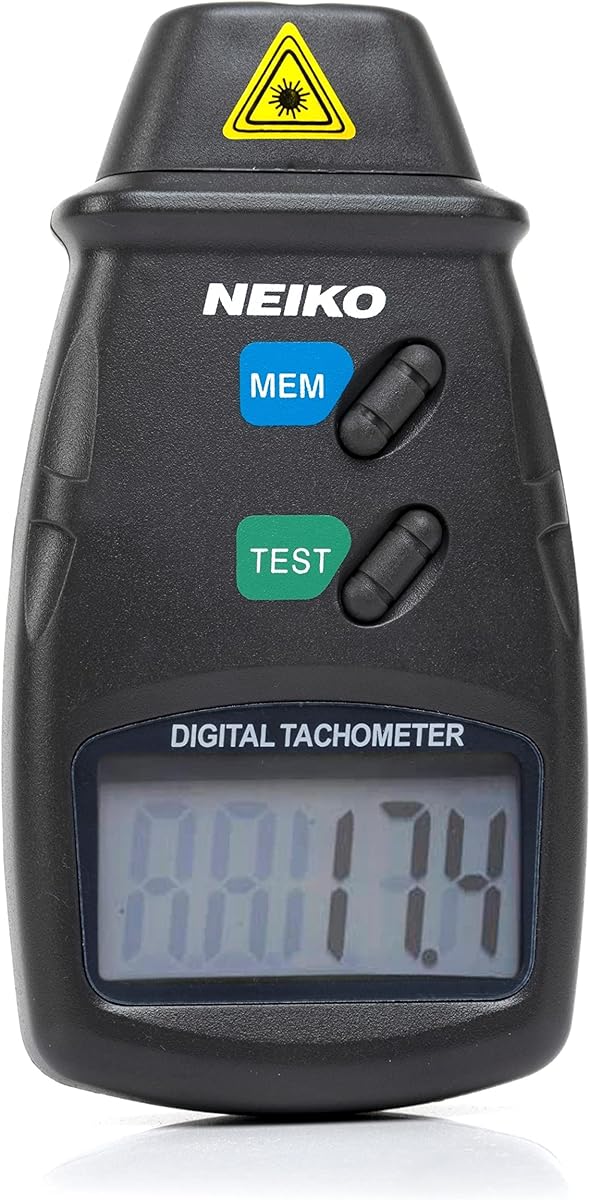
The NEIKO 20713A is a pocket-sized non-contact tachometer rated at 4.2 by users. Its stated measurement range starts at 2.5 RPM and extends to 99,999 RPM, while the listed accuracy is ±0.05%. The instrument also supports revolution counting over a one-second sampling interval, giving it more flexibility than a basic RPM-only meter.
We may earn a commission when you buy through this link, at no additional cost to you.
The large LCD and straightforward handheld format make this model approachable for automotive diagnostics and everyday speed checks. Last, minimum, and maximum readings are stored for quick recall, and the supplied 9V battery means the meter can be put to work without sourcing a separate power source. The 2-inch to 20-inch operating distance is suitable when the target can be approached reasonably closely.
Its primary limitation is the relatively short distance over which the beam can be used. That can be inconvenient when a shaft, fan, or pulley is recessed, elevated, or surrounded by other components. It also lacks the larger, structured data storage available from professional combination meters, so users conducting formal trend analysis may need a different instrument.
Buy the NEIKO 20713A if you want a lightweight digital RPM gauge with excellent range, a useful set of recall functions, and straightforward operation. It is a particularly sensible option for car engines, compact motors, and routine workshop diagnostics where the target can be reached within 20 inches and extensive documentation is not required.
The broad 2.5 to 99,999 RPM range allows one instrument to cover both slow shafts and fast-running rotating assemblies. The clear display and one-second sampling provide immediate feedback during a quick diagnostic session.
Storing three useful result types helps a user compare the latest observation with the highest and lowest values captured. This is enough for basic trend checking without adding the complexity of a full data-logging instrument.
We may earn a commission when you buy through this link, at no additional cost to you.
The Extech RPM33 is a combination contact and laser photo tachometer with a supplied rating of 4.2. It measures from 2 to 99,999 RPM, lists 0.05% accuracy, and expands beyond rotational speed with surface-speed and length functions. It is designed for users who want more than a single-purpose RPM reading.
We may earn a commission when you buy through this link, at no additional cost to you.
Two measurement approaches give it unusual flexibility. The laser can inspect a spinning component from up to 1.6 feet away, while contact accessories support mechanical testing such as linear belt speed. Its microprocessor-based design, quartz crystal oscillator, and ability to store up to 10 data sets are especially useful for maintenance teams that need to compare current, maximum, minimum, and average values.
The included battery, reflective tape, contact accessories, and soft carrying case make the package comprehensive, but that completeness also means it is less minimalist than a pocket laser meter. The combination of modes and records also creates more opportunity for setup errors if an operator has not learned which attachment or sampling method applies.
The RPM33 is a strong choice for conveyors, elevators, HVAC systems, industrial maintenance, and mixed mechanical work. Choose it when one instrument should cover rotating shafts, contact-wheel measurements, surface speed, and documented readings. Users whose work is strictly non-contact and extremely simple may find a dedicated laser meter easier to operate.
Laser measurement supports safer checks near exposed rotating parts, while contact mode expands the tool into belt-speed and linear measurement tasks. This flexibility reduces the need to own several separate handheld instruments.
Up to 10 data sets can preserve the current, maximum, minimum, and average values from a test. That makes the RPM33 more suitable for comparing equipment behavior over time than simpler meters that retain only one or three observations.
We may earn a commission when you buy through this link, at no additional cost to you.
The Monarch PLT200 is a pocket laser tachometer with a supplied rating of 5.0. Its defining advantage is the NIST-traceable calibration certificate with data, which provides documented assurance that the instrument met manufacturer specifications before shipment. That makes it especially relevant to quality systems and professional users who need calibration traceability.
We may earn a commission when you buy through this link, at no additional cost to you.
The non-contact laser works at distances up to 25 feet, the longest stated working distance in this roundup. This gives it exceptional reach for large fans, motors, shafts, and other equipment that cannot be approached directly. The Class 2 laser is specified below 1mW, and the LCD includes on-target and low-battery indicators that help the operator establish a reliable measurement setup.
Unlike the combination meters in this list, the PLT200 is presented as a dedicated non-contact pocket instrument. It does not advertise contact-wheel, surface-speed, or length functions, so it will not replace a full mechanical maintenance kit. Its value comes instead from the calibration documentation, long reach, compact format, and stated conformity with applicable standards and EU directives.
This is the strongest choice for quality assurance, laboratory work, industrial maintenance, or applications where formal calibration evidence matters. It is also attractive when the target is simply too far away for the shorter-distance meters. For casual automotive checks, a less specialized model may provide more visible functionality for less.
The included NIST-traceable certificate is the standout feature for organizations that must show that their measuring equipment has documented calibration. It can support a more disciplined workflow than an uncertified consumer-style meter.
A stated working distance of up to 25 feet reduces the need to access the rotating component directly. The extended reach is particularly useful around large industrial fans, motors, conveyor parts, and elevated machinery.
We may earn a commission when you buy through this link, at no additional cost to you.
The KAIWEETS Digital Laser Tachometer combines a supplied rating of 4.8 with a 10 to 99,999 RPM range and ±0.05% claimed accuracy. It is a straightforward non-contact meter designed for motor diagnostics, engine maintenance, machine inspection, and everyday equipment troubleshooting.
We may earn a commission when you buy through this link, at no additional cost to you.
The backlit LCD keeps readings visible in garages and workshops, while simple controls allow quick switching between RPM measurement and count functions. Auto shutoff and a low-battery indicator make it practical for intermittent use. Its compact, one-hand design is also well suited to users who need to move around a vehicle or work area while checking several components.
Its lower limit of 10 RPM means it is less appropriate than the Extech 461920 or NEIKO 20713A for very slow rotation. The listed specifications also do not mention a calibration certificate, so users subject to formal quality requirements should evaluate documentation needs carefully. As with other photoelectric tachometers, reflective target tape may be needed for dependable results.
For general users seeking an approachable laser RPM meter with a strong rating and wide upper range, this KAIWEETS model is an attractive selection. It is best suited to automotive engines, fans, pulleys, gears, wheels, blades, HVAC components, and typical workshop machinery rather than specialized calibration work.
A large illuminated display is valuable beneath a vehicle, inside a dark mechanical room, or during evening repairs. Clear digits reduce the chance of misreading a value when the operator is working with limited lighting.
The automatic shutoff helps preserve power when the meter is set down during a job. The low-battery indicator adds another layer of awareness, useful for technicians who use the instrument throughout a full workday.
We may earn a commission when you buy through this link, at no additional cost to you.
This KAIWEETS model has a supplied rating of 4.4 and combines a 10 to 99,999 RPM photoelectric range with a counting range of 1 to 99,999 rotations. Its large 40mm five-digit display, backlighting, and automatic ranging make it easy to use across different rotating components.
We may earn a commission when you buy through this link, at no additional cost to you.
Its defining feature set is the combination of Data Hold, Max, Min, and Average functions. These options let an operator freeze a reading or compare the highest, lowest, and average values from a test. Resolution can be as fine as 0.1 RPM, and the stated accuracy is ±(0.05%+1), a formulation worth comparing carefully with instruments expressed solely as ±0.05%.
The meter weighs about 140 grams including batteries and runs on three AAA cells. That is a reasonable portable arrangement, though users who prefer a single replaceable battery may favor another model. It also begins at 10 RPM in photoelectric mode, so it is not the best choice for very slow shafts or rotating equipment below that threshold.
This KAIWEETS is well suited to DIY users, mechanics, and maintenance technicians who want more analysis functions than a basic laser tachometer. Choose it for cars, workshop motors, and industrial machinery where Max, Min, Average, and Hold can add value without requiring a formal data-logging system.
Automatic ranging removes the need to select an RPM range manually. This makes the meter approachable for new users and reduces setup time when moving between equipment that operates at very different speeds.
Data Hold preserves a value for inspection or recording, while the Max, Min, and Average functions provide a compact overview of a test. Together, they offer more insight than a display limited to the current reading.
We may earn a commission when you buy through this link, at no additional cost to you.
The AGPtek Professional is a non-contact laser photo tachometer with a supplied rating of 4.3. Its 2.5 to 99,999 RPM range, selectable 0.1 or 1 RPM resolution, and 50 to 500mm working distance make it a versatile meter for motors, lathes, washing machines, paper-making equipment, and automotive components.
We may earn a commission when you buy through this link, at no additional cost to you.
The clear LCD and lightweight ergonomic body support comfortable extended use. Reflective tape is included, which is important because the product requires a visible target for measurement; reflective paper should be applied when a laser-reflective or otherwise difficult surface is encountered. A 9V battery, manual, three tape strips, and durable storage bag complete the package.
The specifications explicitly state that the model is not suitable for sawmill or lawn mower applications. That limitation matters because rough surfaces, vibration, debris, and reflective material can make photoelectric measurement less reliable in those environments. The 500mm maximum working distance also offers less reach than the Monarch PLT200 or the Extech RPM33.
This AGPtek is a good fit for technicians, HVAC professionals, automotive users, and DIY enthusiasts who need a portable non-contact meter with a low RPM threshold. It is especially suitable for enclosed workshops and controlled industrial tasks where reflective tape can be applied cleanly.
Applying a supplied reflective strip gives the photoelectric sensor a distinct target, improving consistency on surfaces that would otherwise be difficult to read. The method is especially helpful on dark, glossy, or visually uniform rotating parts.
The broad speed range covers everyday motors, lathes, washing-machine assemblies, and automotive parts. Its clear screen, one-hand shape, and storage bag support routine work in shops, service areas, and selected industrial environments.
We may earn a commission when you buy through this link, at no additional cost to you.
The KAIWEETS Max Min Model is a compact non-contact tachometer with a supplied rating of 3.9. It measures 10 to 99,999 RPM and counts from 1 to 99,999 revolutions. Resolution is 0.1 RPM from 10 to 9,999.9 RPM and 1 RPM at 10,000 RPM or above, allowing the instrument to adapt to different speeds.
We may earn a commission when you buy through this link, at no additional cost to you.
Its five-digit, 40mm LCD displays the current result along with maximum and minimum values. Microcontroller technology, photoelectric sensing, and anti-interference algorithms support stable measurement in workshop, industrial, laboratory, and home environments. The unit also includes a low-battery indicator and shuts down after approximately four minutes of inactivity.
The main concern is that the listed specifications do not provide a specific overall accuracy percentage. That makes the meter less straightforward to compare with products advertising ±0.05% accuracy. Its supplied 3.9 rating is also the lowest among the KAIWEETS options, although user feedback can reflect many factors beyond the published specifications.
This model is worth considering for users who value automatic Max and Min tracking, a large display, and a compact 168-gram body. It fits engine, motor, fan, tool, and rotating-machinery checks in controlled environments. Those requiring a documented accuracy specification may prefer a model that states one clearly.
Automatically retaining the highest and lowest readings simplifies trend observation during diagnostics. A user can focus on the equipment instead of manually recording each result while the meter watches the operating range.
Fine 0.1 RPM resolution is useful at lower speeds, while 1 RPM resolution accommodates very fast rotation. The changing resolution provides a practical balance between detail and readability across the full range.
We may earn a commission when you buy through this link, at no additional cost to you.
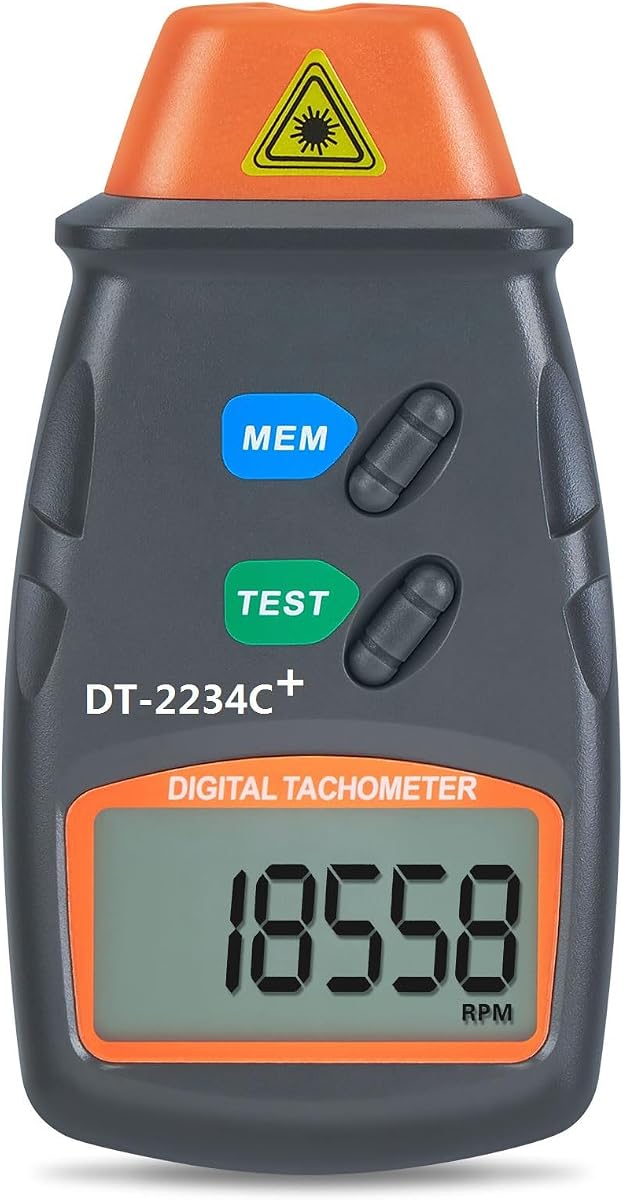
The Digital 2-in-1 Tachometer offers both contact and non-contact measurement with a supplied rating of 4.3. Its laser mode covers 3 to 99,999 RPM, while the contact mode covers 3 to 19,999 RPM. The listed ±0.05% accuracy makes it a versatile alternative to dedicated laser meters.
We may earn a commission when you buy through this link, at no additional cost to you.
A backlight keeps the display visible in changing working conditions, and Data Hold, Max, and Min functions support more complete reading reviews. The effective measuring distance is 50 to 500mm, and speeds above 60 RPM are sampled in 0.8 seconds, providing quick feedback for engines, motors, and industrial machinery.
Its contact range is substantially lower than its laser range, which is expected but important when evaluating suitability for fast mechanical systems. The 500mm maximum laser distance also means the operator must have relatively clear access to the target. Compared with the Extech RPM33, this product offers similar dual-mode convenience but fewer listed records and no detailed surface-speed or length functions.
Choose this model when you want contact flexibility, non-contact measurement, and useful recall features in one handheld unit. It is a practical choice for automotive maintenance, HVAC inspection, and general industrial diagnostics, particularly where a technician already has a suitable contact adapter and needs fast readings rather than extensive data storage.
The ability to select contact or laser measurement broadens the range of components that can be tested. It is helpful when a target is easy to reach with an adapter but also benefits from safer non-contact checks elsewhere.
A 0.8-second sampling time at speeds above 60 RPM gives responsive feedback during engine and motor checks. The short acquisition interval makes it easier to watch a live display while operating conditions change.
We may earn a commission when you buy through this link, at no additional cost to you.
The Triplett TA200 is a handheld tachometer that combines contact measurement with non-contact laser photo measurement. It has a supplied rating of 3.9. Its five-digit backlit LCD provides a readable display for workshop or field use, while the dual-mode design allows the operator to select an approach suited to the component.
We may earn a commission when you buy through this link, at no additional cost to you.
Contact measurement can be useful where a direct adapter makes repeatable readings straightforward, while the photo mode offers a safer option for exposed rotating equipment. The backlit screen is particularly helpful in dim garages and maintenance areas where an unlit display could be difficult to read.
The supplied product information is limited compared with the other entries. It does not state the measurement range, resolution, accuracy, working distance, storage capacity, power source, or included accessories. As a result, it is difficult to compare the TA200 on a feature-by-feature basis without checking the current manufacturer listing and manual.
The TA200 may suit a technician who values the Triplett name, dual measurement modes, and a traditional backlit display. Before buying, confirm that its range covers the equipment you intend to test and verify the necessary accessories are included. A more fully specified alternative is easier to evaluate for high-stakes or repetitive professional use.
Having both contact and photo modes gives users more ways to approach a rotating component. The appropriate method depends on access, surface conditions, and whether direct contact is practical.
The five-digit backlit LCD prioritizes quick recognition of the measurement. This is helpful in garages, equipment rooms, and outdoor service situations where ambient light may be limited.
We may earn a commission when you buy through this link, at no additional cost to you.
Choosing a laser tachometer means balancing range, accuracy, target compatibility, measurement modes, recording functions, and portability. The most highly specified model is not automatically the most appropriate one, so consider how and where each instrument will actually be used before comparing the options.
The full RPM range must cover the slowest and fastest components in your workflow. The Extech 461920 starts at 2 RPM, the NEIKO 20713A and AGPtek Professional at 2.5 RPM, and the Digital 2-in-1 at 3 RPM. The KAIWEETS models begin at 10 RPM, making them less useful for extremely slow rotation. At the upper end, most products reach 99,999 RPM. Low-end coverage matters for turntables, slow shafts, fans, and machinery that idles near a few revolutions per minute.
Accuracy tells you how closely the reading should agree with the true rotational speed, while resolution indicates the smallest increment displayed. Several products claim ±0.05% accuracy, but one KAIWEETS model states ±(0.05%+1), which should not be treated as an identical specification. Resolution of 0.1 RPM is useful for fine comparisons at lower speeds, while 1 RPM is more practical when the display would otherwise show excessive digits at high speeds. Consider both figures together.
Working distance determines how far the meter can sit from the rotating target. The Monarch PLT200 leads this group with an advertised distance of up to 25 feet, followed by the Extech RPM33 at 1.6 feet. Most other models work within approximately 500mm or 20 inches. Longer reach is valuable around large fans, elevated motors, conveyors, and machinery behind guards, but close-range meters can be easier to position accurately in confined workspaces.
Photoelectric tachometers usually require a reflective target or a distinct surface on the rotating part. Most of the listed models include reflective tape, which is the most reliable approach on dark, glossy, or featureless components. The AGPtek explicitly notes that reflective paper should be attached to laser objects. Before using any model, inspect the target and confirm that it will provide a consistent signal under the available lighting and operating conditions.
A laser-only meter is ideal for non-contact checks, while a combination model can also handle mechanical contact testing and tasks such as belt or surface speed. The Extech RPM33, Digital 2-in-1, and Triplett TA200 provide both modes. Their contact ranges are generally lower than their laser ranges, so verify the upper limit of each method. Combination capability is useful for maintenance professionals, but it adds accessories and setup decisions.
Basic meters usually retain the latest value, while more capable models store minimum, maximum, and average readings. The Extech 461920 and NEIKO 20713A retain Last, Min, and Max values. The KAIWEETS Reflection Tape Model adds Average and Hold, and the Extech RPM33 stores up to 10 complete data sets containing current, maximum, minimum, and average figures. More records are useful for maintenance reports and trend analysis, although they do not necessarily constitute formal data logging.
A backlit display improves readability in garages, machinery rooms, and evening work environments. Most models use five-digit screens, while the KAIWEETS models specify a 40mm display. Power arrangements vary between a single 9V battery and three AAA batteries. Battery availability is rarely the deciding factor, but automatic shutoff can improve convenience and battery life. The Monarch PLT200 includes a low-battery indicator, and several KAIWEETS models also provide automatic shutdown or low-battery notifications.
For regulated or quality-controlled work, documented calibration can outweigh other conveniences. The Monarch PLT200 stands apart because it includes a NIST-traceable calibration certificate with data and is stated to conform to NIST standards and applicable EU directives. Other products publish strong accuracy specifications, but the supplied data does not indicate that they include certification. If records must satisfy an external quality system, verify certificate requirements before choosing a model.
Begin by identifying the target and deciding whether non-contact or contact measurement is appropriate. For laser mode, clean the rotating surface and apply reflective tape where the surface lacks a distinct reflective feature. Secure the tape so vibration cannot lift its edge, then position the meter within its specified working distance. Aim the beam at the tape rather than directly at the laser, motor, or reflective metal surrounding it.
Wait for a stable reading before recording the result. For a machine that changes speed, observe the display long enough to identify normal operating speed and meaningful variation. Use Hold when you need to keep a value visible, and use Min, Max, or Average functions according to the diagnostic goal. With a contact adapter, place it securely on the shaft or wheel, avoid forcing the instrument against the component, and use the appropriate RPM range specified for contact mode.
After use, switch off the meter, remove the battery if it will be stored for a long period, and keep the lens and optical window clean and dry. Protect reflective tape from dirt and abrasion, inspect contact adapters for wear, and keep the instrument in its case or bag when possible. Replace batteries as needed, respect the laser safety guidance in the manual, and never point the beam toward eyes or reflective surfaces.
A laser tachometer measures the rotational speed of fans, motors, engines, pumps, shafts, wheels, and other rotating components without direct sensor contact. It is especially useful for checking operating speed during installation, troubleshooting, maintenance, and performance verification. Most models require a reflective target or a surface that produces a clear photoelectric signal.
Reflective tape is usually the most reliable target, although some textured or naturally reflective surfaces may produce a usable signal. The included tape is important for dark, glossy, or visually uniform surfaces. Apply it securely to the rotating component and confirm that the meter locks onto the target before trusting the reading.
The appropriate accuracy depends on how closely the measurement must match the true operating speed. Routine automotive and HVAC checks may be served by accurate general-purpose meters, while laboratory, quality assurance, or formal calibration work may require documented traceability. Compare the complete accuracy expression, including any added digit, rather than considering the percentage alone.
Laser measurement is safer and more convenient around exposed rotating parts because it avoids physical contact. Contact measurement can be useful when a shaft or adapter provides a direct, repeatable connection. Combination meters offer both approaches, allowing the operator to select the method that best fits the component and access.
It depends on the model. The Extech 461920 begins at 2 RPM, the NEIKO 20713A and AGPtek Professional at 2.5 RPM, and the Digital 2-in-1 at 3 RPM. The listed KAIWEETS models start at 10 RPM. Check your slowest expected operating speed and allow some margin before selecting a model.
Min and Max functions reveal the extremes observed during a test, while Average summarizes a run more effectively than a single instantaneous value. Data Hold keeps a reading visible for recording, and multi-set memory helps compare repeated measurements. These features are valuable for checking speed stability, but they should not be confused with a full external data logger.
Distance varies substantially across this roundup. The Monarch PLT200 is specified for up to 25 feet, while the Extech RPM33 reaches 1.6 feet. Most compact models operate within about 500mm or 20 inches. Longer distance helps with large or inaccessible equipment, while a shorter range can make precise target alignment easier.
A calibration certificate is essential when your employer, customer, or quality system requires documented instrument traceability. The Monarch PLT200 includes a NIST-traceable calibration certificate with data. For informal workshop checks, the other products may still be appropriate, but you should verify the stated accuracy and any required compliance documents before purchasing.
The Extech 461920 is the strongest general recommendation because it combines a broad 2 to 99,999 RPM range, ±0.05% claimed accuracy, useful Min, Max, and Last recall, and a portable backlit display. The KAIWEETS Digital Laser Tachometer is the leading budget-oriented option for straightforward high-speed diagnostics, while the Monarch PLT200 is the premium choice for formal calibration traceability and an extended 25-foot working distance.
Prioritize the requirements that cannot change: the range must cover your equipment, the working distance must suit the access, the target must produce a dependable signal, and accuracy or calibration documentation must match the task. Contact modes, structured memory, and backlighting can add convenience, but they are most valuable after the core measurement requirements are satisfied.
Prices, ratings, availability, and product configurations can change, so review the current listing and manufacturer information before buying. Confirm the measurement range, operating distance, included accessories, power requirements, and any calibration documentation against your specific needs to make a confident final selection.