
10Gtek 82576-2T-X1 Network Card
4.4Editor score
Dual gigabit RJ45 ports
Intel 82576 controller
Low-profile bracket included
Our expert Dual RJ45 Port Network Card guide compares 10 dual-port PCIe adapters, covering speed, controllers, OS support, features, and fit.
A dual RJ45 network card adds two wired Ethernet connections to a desktop, workstation, or server without replacing its existing networking hardware. The best model depends on your required link speed, processor space, operating system, cabling, virtualization features, and whether a full-height or low-profile bracket fits your case.
We compared all ten cards by controller, port speed, PCIe lane requirements, supported operating systems, boot and management functions, bracket options, and copper-cable limitations. The list covers gigabit, 2.5-gigabit, and 10-gigabit dual-port models, including adapters intended for servers, NAS systems, hypervisors, and legacy business PCs.
Each review explains the strongest reasons to choose that adapter, along with compatibility cautions that can matter more than headline speed. Ratings reflect the supplied customer feedback, while technical details come from the product information. Current prices and availability can change, so confirm the final listing and hardware requirements before ordering.
4.4Editor score

4.6Editor score

4.6Editor score
The table below places all ten adapters side by side, emphasizing port speed, controller family, PCIe requirements, and the most important compatibility consideration.


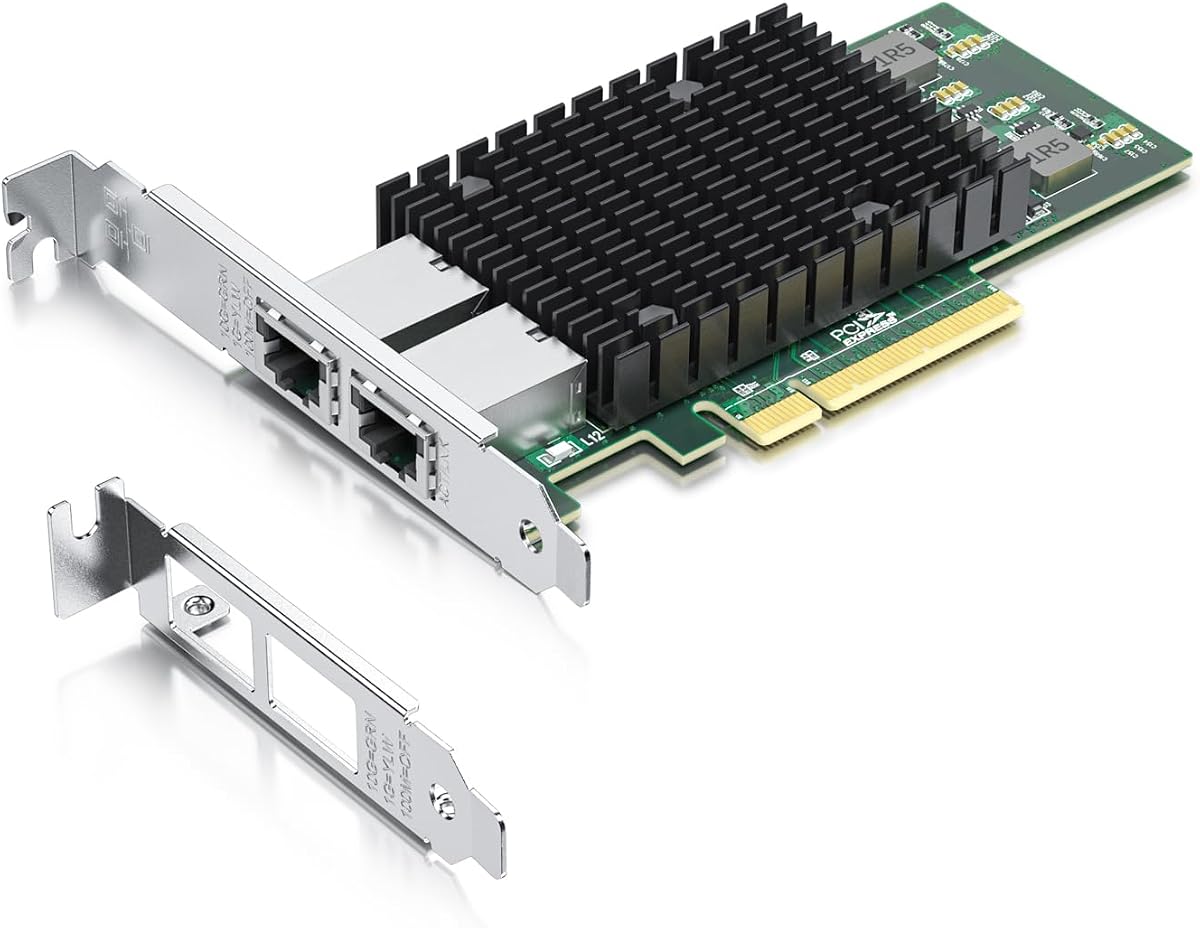

The 10Gtek X540-10G-2T is a dual-port, 10-gigabit copper Ethernet adapter built around an original Intel X540 controller. Its supplied rating is 4.1, but the specification profile makes it a serious option for servers that need two high-bandwidth RJ45 links. It is particularly relevant where optical modules or SFP-based adapters would be inconvenient and Cat6A infrastructure is already available.
We may earn a commission when you buy through this link, at no additional cost to you.
The card uses two copper RJ45 connections and supports Category 6A runs of up to 100 meters, while Category 6 is listed as suitable for up to 55 meters. Its PCIe 2.1 x8 interface operates at 5.0 GT/s and can be used in PCIe x8 or x16 slots. Storage-over-Ethernet functions named in the product information include iSCSI, FCoE, and NFS, making it more than a simple office Ethernet upgrade.
There are important limitations. A 10GbE link is only useful when the connected switch, router, storage system, and peer device can also handle that speed. Hot swapping is expressly unsupported, and Windows 11 requires manual setup. The product information also advises contacting the seller for installation guidance before using the card on Windows 11.
This is a compelling choice for an existing 10GbE copper network, particularly in server or workstation environments. It is less suitable for a home network restricted to 1GbE or for a small-form-factor system without room for a full PCIe card. Confirm the slot dimensions, bracket needs, cable category, operating system, and driver requirements before buying.
Two independent 10GbE connections give servers and high-end workstations useful bandwidth without requiring fiber optics. The stated Cat6A reach of up to 100 meters also makes the card practical for equipment-room and campus-style deployments when the cabling plan is designed for 10GbE.
The supplied low-profile bracket broadens the card's usefulness in compact servers and workstations, while PCIe x8 and x16 compatibility covers many host systems. Operating-system support includes Windows Server, Windows client systems, Linux, and ESX, subject to the detailed version notes.
We may earn a commission when you buy through this link, at no additional cost to you.
The I226-V 2.5GBase-T Dual-Port NIC stands out as the most balanced card in this guide. It carries a supplied rating of 4.6 and uses an Intel I226-V controller with two RJ45 ports capable of 2.5Gbps, 1Gbps, 100Mbps, and 10Mbps operation. That makes it a practical middle ground between basic gigabit adapters and costlier 10GbE hardware.
We may earn a commission when you buy through this link, at no additional cost to you.
The I226-V is described as a successor to the discontinued I225-V, with identical core functionality and improvements in error rates, packet stability over longer cables, transmission accuracy, and active power consumption. The card's PCIe 3.1 x1 interface fits systems with x1, x4, x8, or x16 slots, and a low-profile bracket is included for compact cases.
Compatibility is one of its strongest selling points. Listed systems include Windows 10 and 11, several Linux distributions and kernel versions, FreeBSD, VMware ESXi 7 and 8, DPDK, OpenWrt, Unraid, and Proxmox, with PXE support. Buyers should still check the motherboard and BIOS because the manufacturer explicitly advises verifying I226-V support before purchase.
Choose this card when you want gigabit-class simplicity with meaningful headroom for faster switches, NAS transfers, and small server workloads without moving to a full 10GbE design. It is not the right choice if both connected networks already offer 10GbE, but for many dual-port installations its performance, controller, and broad platform list make it the strongest all-around recommendation.
A 2.5GbE connection can meaningfully improve large file transfers and storage traffic compared with gigabit networking while remaining accessible over ordinary copper wiring. Both ports can support 2.5, 1, 100, and 10Mbps rates, allowing the card to fit mixed network environments.
Support for current client systems, major Linux environments, VMware ESXi, hypervisors, and PXE broadens the potential uses of this adapter. The I226-V also makes a logical choice for workstations, servers, and management systems that need more than one physical copper connection.
We may earn a commission when you buy through this link, at no additional cost to you.
The VIMIN 10G PCI-E Network Card is a dual-RJ45 adapter aimed at servers, high-end devices, and other installations that already have 10GbE infrastructure. It has a supplied rating of 4.5 and uses the Intel X540-T2 chipset controller. Its headline feature is the pair of 10Gbps copper ports, which avoid the need for optical transceiver hardware.
We may earn a commission when you buy through this link, at no additional cost to you.
The card supports Windows and Windows Server, Linux, and VMware environments. Its PCIe design can be installed in x8 or x16 slots, making it straightforward to integrate with many common server and workstation platforms. Both standard and slim brackets are included, and a heat sink is fitted to manage temperatures under heavy use.
The most important caveat is unusually clear in the product data: 2.5Gbps and 5Gbps are not supported. If connected equipment negotiates those rates, the card operates at only 1Gbps. This makes it a less flexible option than the I226-V for mixed-speed copper networks, despite its faster maximum throughput.
This VIMIN model is best for a deliberate 10GbE deployment where both switches and endpoints support 10G, the host has an appropriate PCIe slot, and reliable cooling matters. It gives buyers two high-speed copper connections with useful bracket flexibility, but users should verify that their network devices are designed for 10GbE rather than relying on the adapter alone.
The X540-T2 controller and dual 10Gbps ports are aimed at environments where bandwidth, rather than merely basic connectivity, is the priority. This makes the card more relevant to data-center-style networks and high-speed storage arrangements than to ordinary office networking.
Including both standard and slim brackets improves the chance of a clean fit in servers and workstations of different heights. The integrated heat sink is also useful in sustained-transfer environments where long-running workloads can generate considerable heat around the controller.
We may earn a commission when you buy through this link, at no additional cost to you.
This dual-port Intel 82575/82576 Gigabit NIC is aimed at systems that need reliable 1GbE expansion and a broad collection of server-management features. Its supplied rating is 4.4, and the long operating-system list gives it particular appeal for older business PCs, legacy servers, and specialized appliances.
We may earn a commission when you buy through this link, at no additional cost to you.
The adapter uses PCIe 2.1 x1 and fits x1, x2, x4, x8, or x16 slots, including low-profile configurations. Management and boot features include IPMI pass-through through SMBus or NC-SI, iSCSI boot, Wake-on-LAN, PXE remote boot, VLAN filtering, SNMP, and RMON. An alloy heat sink is included to maintain operating temperature.
Operating-system support extends across multiple generations of Windows and Windows Server, Novell NetWare, Linux, FreeBSD, DOS, SCO Open Server, UnixWare or OpenUnix, Sun Solaris x86, and OS-independent VMware ESX. However, the product information expressly excludes VMware ESXi 7.0 and later, so it should not be chosen for a modern ESXi 7 or 8 host without separate verification.
For a legacy machine that needs two copper ports, PXE deployment, or IPMI pass-through, this card is unusually capable for a gigabit adapter. It is best where 10GbE is unnecessary and where the included management functions matter more than maximum throughput. Confirm the intended hypervisor version before installing it in a virtualized server.
IPMI pass-through, SNMP, RMON, VLAN filtering, and PXE support are more useful in managed infrastructure than in a basic desktop. These features make the card relevant to administrators maintaining older server fleets, although driver and hypervisor support must match the host.
The x1 interface and broad slot compatibility reduce installation constraints on older PCI Express systems. A low-profile bracket and long operating-system coverage help the card fit legacy workstations and servers with well-established driver stacks.
We may earn a commission when you buy through this link, at no additional cost to you.
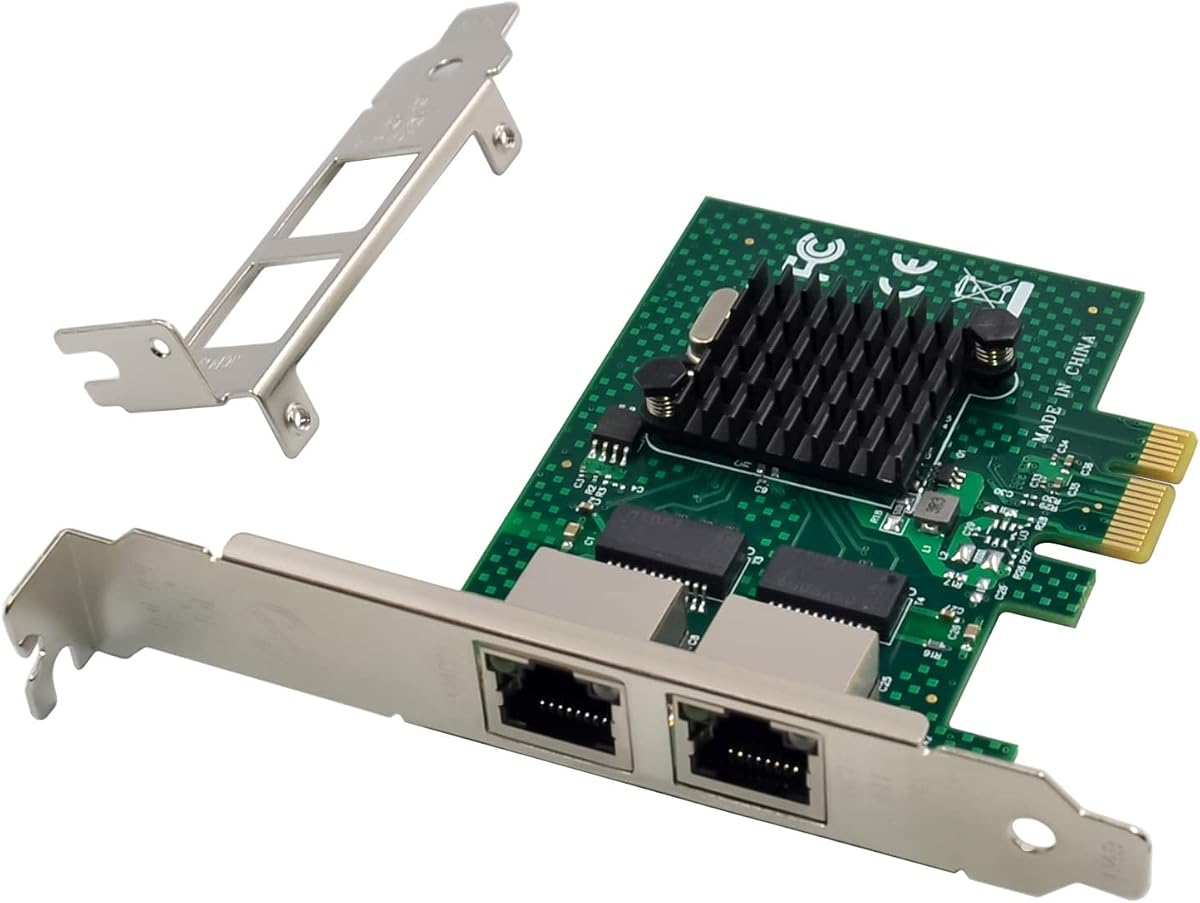
The 10Gtek 82576-2T-X1 is a straightforward dual-gigabit expansion card with a supplied rating of 4.4. It uses an original Intel 82576 controller and offers two copper RJ45 ports through a compact PCIe 2.0 x1 design. For a system that simply needs two reliable 1GbE connections, it is one of the most economical choices in the group.
We may earn a commission when you buy through this link, at no additional cost to you.
Both ports support Category 5 or better cable up to 100 meters. The card includes a low-profile bracket, and its PCIe 2.0 x1 interface can be used in a compatible x1 slot. Compatible environments include Windows Server, Windows 7 through 10, Vista, XP, Linux, and VMware ESX, with the same ESXi 7.0 and later exclusion noted for this controller generation.
Intelligent offloads are cited as a way to reduce processing overhead and improve server stability. Drivers can be obtained from Intel, and the product listing includes a three-year warranty and lifetime technical support. Despite these benefits, there is no faster fallback above 1Gbps, and the card does not support hot swapping.
This is a good pick for a legacy office PC, entry server, or management machine that lacks spare RJ45 ports. It avoids unnecessary 2.5GbE or 10GbE complexity and should work with ordinary copper wiring. It is not appropriate for a modern ESXi 7 or 8 installation or for workloads that need high-bandwidth storage transfers.
The card does one job clearly: adding two independent gigabit connections to a compatible PCIe host. Existing Category 5 or better wiring can usually be reused, which simplifies deployment in offices and small server rooms.
The original Intel 82576 controller and a broad driver-oriented operating-system list make this suitable for established machines that may not support the newest Ethernet hardware. Its x1 interface also makes it less demanding on systems with limited expansion resources.
We may earn a commission when you buy through this link, at no additional cost to you.
The 10Gtek Intel 82576 NIC is a dual-port gigabit adapter that combines a widely recognized controller with extensive platform support. It carries a supplied rating of 4.5 and uses the original Intel 82576 chipset, with Quality-of-Service support cited as a way to improve traffic handling and stability.
We may earn a commission when you buy through this link, at no additional cost to you.
Both RJ45 ports support 10, 100, and 1000Mbps data rates over Cat5e cable up to 100 meters. The card uses PCIe 2.0 x1 and can fit x1, x4, x8, or x16 slots. A low-profile and full-height bracket are both supplied, making it easier to install in a standard desktop, compact workstation, or server.
The operating-system list is extensive: Windows 7 through 11, several Windows Server generations, CentOS and RHEL, multiple Ubuntu releases, Debian, FreeBSD, VMware ESXi 5 and 6, and SLSE 11 and 12. Mac OS and bypass mode are excluded, as is VMware ESXi 7.0 and later, so modern hypervisor users should check for a different controller generation.
This card is a strong general-purpose option for dual gigabit connectivity where cost matters more than 2.5GbE or 10GbE. It works well for server management, conventional office networking, and systems with mixed operating systems. The included brackets and long compatibility list make it particularly adaptable across different host installations.
The extensive operating-system coverage allows one adapter to cover a mixture of Windows, Linux, and older virtualization environments. That makes it useful for administrators maintaining diverse fleets rather than building every system around a single client release.
Both standard and low-profile brackets are included, reducing the chance that chassis height will prevent installation. The x1 interface and Cat5e support also keep requirements modest for systems that need basic copper network expansion.
We may earn a commission when you buy through this link, at no additional cost to you.
The GIGAPLUS X540-T2 NIC combines two 10GbE RJ45 ports with a supplied rating of 4.6, making it one of the strongest premium picks here. The Intel X540 controller is designed to deliver reliable high-speed networking and server stability, with packet loss reduction identified as a notable benefit of the platform.
We may earn a commission when you buy through this link, at no additional cost to you.
This card supports 100Mbps, 1Gbps, and 10Gbps rates across two independent connections. Its PCIe 2.0 x8 interface runs at 5.0 GT/s and fits x8 or x16 slots, although it is designed for PCI Express rather than legacy PCI. A standard bracket and a low-profile bracket are included for different server, desktop, workstation, and mini-tower layouts.
Compatibility includes Windows Server 2003, 2008, and 2012; Windows 7, 8, 10, and 11; Linux; VMware; ESX; and ESXi. A QR code is offered for obtaining drivers, and the product information states that lifetime technical support is provided. The product also claims that each GIGAPLUS 10G NIC has been tested for reliability, quality, and performance.
Choose this card when the surrounding infrastructure already supports 10GbE and you want two high-speed copper links without a modular fiber adapter. It is well suited to servers and premium workstations. Verify PCIe lane availability, OS version, bracket dimensions, and switch support before purchase, because the card cannot make slower network equipment deliver 10Gbps.
The X540 platform and dual 10GbE interfaces provide a substantial bandwidth foundation for demanding transfers and server connectivity. Two independent ports also allow link aggregation, segmented networks, or separate traffic paths when the host, switch, and configuration support them.
Support for multiple operating systems, dual bracket styles, and x8 or x16 slots makes this a versatile premium server card. Driver access through a QR code or Intel's website simplifies the process of matching the adapter to the intended platform.
We may earn a commission when you buy through this link, at no additional cost to you.
The H!Fiber X540-BT2 NIC is a dual-port, 10GbE copper adapter with a supplied rating of 4.5. It uses the original Intel X540-BT2 controller, which is compared in the listing with the X540-T2, and supports Quality-of-Service functionality for traffic management and stability.
We may earn a commission when you buy through this link, at no additional cost to you.
Both RJ45 ports support 10Gbps, 1Gbps, and 100Mbps. Cat6a cabling is specified for the 10GbE transition, while the PCIe 2.1 x8 interface fits x8 and x16 slots. Full-height and low-profile brackets are supplied, helping the card fit standard and slim server or workstation enclosures.
The listed compatibility range includes Windows 7 through 10, Windows Server 2008 through 2019, CentOS and RHEL, Ubuntu, Debian, FreeBSD, VMware ESXi 6 and 7, and SLSE. Mac OS and bypass mode are not supported. Windows 11 can work only when its driver is configured correctly, so users should follow the installation material rather than assuming automatic recognition.
This adapter is a solid high-speed option for servers and workstations connected to Cat6a infrastructure. It combines useful management functions, broad OS support, and two bracket options. It is less suitable for mixed 2.5GbE environments because only 1Gbps is available as a lower fallback, and Windows 11 installations require extra configuration.
The 10GbE ports are designed for Cat6a copper networks, allowing high-speed connectivity without optical transceivers. This can simplify infrastructure where copper patch panels and structured cabling are already in place.
Quality-of-Service support is valuable when multiple flows share a link and traffic prioritization matters. The long operating-system list also makes the card suitable for mixed Windows and Linux deployments, provided administrators follow the version-specific driver notes.
We may earn a commission when you buy through this link, at no additional cost to you.
The 82576 SR-IOV NIC is a dual-port gigabit adapter differentiated by its emphasis on virtualization and infrastructure-management functions. It has a supplied rating of 4.5 and uses an Intel 82576 controller with a PCIe 2.0 x4 interface, fitting x4, x8, and x16 standard or low-profile slots.
We may earn a commission when you buy through this link, at no additional cost to you.
SR-IOV is the central feature, allowing supported environments to share physical network functions with virtualized workloads. Other capabilities include IPMI pass-through through SMBus or NC-SI, iSCSI boot, Wake-on-LAN, PXE remote boot, VLAN filtering, SNMP, and RMON. An alloy heat sink helps maintain a normal operating temperature during sustained use.
The operating-system list includes Windows 7, 8, 2000, XP, Vista, multiple Windows Server releases, Novell NetWare, Linux, FreeBSD, DOS, SCO Open Server, UnixWare or OpenUnix, Sun Solaris x86, and OS-independent VMware ESX. As with several older 82576 products in this roundup, VMware ESXi 7.0 and later are expressly excluded.
Choose this card for a virtualization-oriented legacy environment that values SR-IOV, PXE, and IPMI functions more than multi-gigabit throughput. It is a better fit for established server estates than for new ESXi 7 or 8 deployments, and its x4 interface demands a more capable slot than a simple x1 gigabit adapter.
SR-IOV support can improve how compatible hypervisors and workloads access physical Ethernet functions. That makes this card relevant to administrators who need direct network-function virtualization rather than a conventional dual-NIC bridge configuration.
PXE remote boot, iSCSI boot, IPMI pass-through, VLAN filtering, SNMP, and RMON provide a useful set of features for managed data centers. The included heat sink supports stable operation in the server environments where those features are most relevant.
We may earn a commission when you buy through this link, at no additional cost to you.
The BCM5720-2P is a dual-port gigabit server adapter with a supplied rating of 4.6. It uses the Broadcom NetXtreme BCM5720-2P chipset and is aimed at x86 and x64 servers using PCIe 1.x or 2.x interfaces, offering a familiar alternative to the Intel-based cards in this roundup.
We may earn a commission when you buy through this link, at no additional cost to you.
Its PCIe x1 design can also be used in x2, x4, x8, and x16 slots, and a low-profile bracket is included. The product information lists use cases including cloud and Web 2.0 servers, enterprise data centers, private clouds, machine-learning clusters, high-performance computing, multi-node container platforms, NVMe storage disaggregation, and database servers.
Operating-system support is broad and includes CentOS, Debian, Microsoft Windows, Oracle Linux, Oracle Solaris, Red Hat Enterprise Linux, SUSE Linux Enterprise Server, Ubuntu, VMware, VMware ESX with ESXi 5 through 8, VMware vSphere, Windows Hyper-V, and Windows Server. This is more useful for contemporary server selection than the explicit ESXi exclusions attached to several older 82576 products.
The adapter is a sensible choice when two gigabit ports are sufficient but a modern server, hypervisor, or cross-platform operating system is the priority. It is not a high-throughput option, so it should not be selected for 10GbE or 2.5GbE storage networks. Verify the host's driver support and confirm that a low-profile or alternative bracket arrangement matches the chassis.
The operating-system list spans mainstream Linux distributions, Windows Server, multiple VMware platforms, and Hyper-V. This broad coverage makes the Broadcom adapter a practical consideration for heterogeneous server estates that need consistent gigabit connectivity.
The listed use cases range from private clouds and container platforms to database servers and NVMe-over-Fabric environments. Those applications do not automatically require 10GbE, so dual gigabit links can remain appropriate when the surrounding storage and network design is similarly scaled.
We may earn a commission when you buy through this link, at no additional cost to you.
Choosing a dual RJ45 network card starts with the speed and features of the connected network, followed by host compatibility, physical fit, driver support, and intended operating system. The fastest adapter is not necessarily the best value or the most reliable choice.
Choose a port speed that matches both ends of the connection. A 10GbE card reaches its full rate only when the switch, router, peer device, and cabling also support 10GbE. The 2.5GbE I226-V option offers a useful middle ground for newer networks, while the 82576 and BCM5720 models focus on 1GbE. Consider whether links may change speed as equipment is replaced. The VIMIN, H!Fiber, and other 10GbE cards lack 2.5GbE and 5GbE support, with the VIMIN listing explicitly stating that lower speeds fall back to 1Gbps.
The controller is central to performance, driver availability, power management, and virtualization support. This roundup includes Intel I226-V, Intel X540, Intel 82576, Intel 82575/82576, and Broadcom BCM5720-2P implementations. Older Intel 82576 products are well established but explicitly exclude VMware ESXi 7.0 and later in several listings. The I226-V product asks buyers to confirm motherboard and BIOS support before purchasing. Operating-system version and kernel support matter as much as the family name, so consult the system's driver documentation before buying.
The physical interface must have a suitable lane width and fit the available slot. Several gigabit cards use PCIe x1, which works in a basic x1 slot and in larger x4, x8, or x16 slots. The 82576 SR-IOV model uses x4, while the 10GbE X540 cards generally require x8 and are intended for x8 or x16 slots. Also consider whether the host is limited by a proprietary slot, a bandwidth-sharing arrangement, or a server riser. The adapter's lane requirement should fit without reducing other essential devices below their required lane width.
A full-height card may not fit in a compact workstation, mini-tower, or rack server. Low-profile brackets solve that problem, but not every listing includes both standard and low-profile hardware. The 10Gtek X540-10G-2T, the 82576-2T-X1, and the I226-V model include a low-profile bracket. The VIMIN, 10Gtek Intel 82576, GIGAPLUS, and H!Fiber cards explicitly include both standard and slim or low-profile options. Measure the available bracket clearance and check the server's airflow requirements before installation.
RJ45 copper standards impose different cabling rules at different speeds. The gigabit cards generally accept Cat5e or Category 5 and up to 100 meters, while the 10GbE options require higher-grade copper, generally Cat6A for the full 100-meter distance stated by the 10Gtek X540-10G-2T. Category 6 is listed as suitable for shorter 10GbE runs. Poor terminations, mixed cable grades, and long improvised runs can cause errors or negotiated downgrades. Existing infrastructure should therefore be inventoried before choosing a faster card.
Features such as PXE boot, iSCSI boot, IPMI pass-through, SR-IOV, VLAN filtering, SNMP, RMON, Wake-on-LAN, QoS, and link aggregation can determine which card is suitable for a managed deployment. The 82575/82576 and 82576 SR-IOV adapters offer a broad management set, while the GIGAPLUS and H!Fiber X540 models emphasize QoS and high-speed server use. Extra functions still depend on driver, firmware, switch, and hypervisor support, so a feature printed on the package is not the same as end-to-end functionality.
The operating-system lists in this guide are extensive but not interchangeable. Some cards support Windows 11 directly, while the H!Fiber X540-BT2 requires correct Windows 10 driver setup for Windows 11, and the 10Gtek X540-10G-2T requires manual configuration. ESXi support also varies, with several 82576 cards limited to older ESX environments while the BCM5720-2P lists ESXi 5 through 8. Check kernel versions for Linux, BIOS settings for newer Intel chips, and the exact hypervisor release before ordering.
A high-speed card used for continuous transfers can generate substantial heat. Models with an explicit heat sink, including the VIMIN X540-T2, the 82575/82576 card, and the SR-IOV model, may be better suited to sustained server workloads. Airflow around the slot, the location of the card near hot components, and the expected transfer volume all affect thermal behavior. For occasional client use, gigabit models with lower heat output may be entirely adequate. In a densely populated server, a cooling-oriented design and a free lane position can be more important than small differences in advertised transfer speed.
Before installation, power down the computer, disconnect the power cable, and open the case only after consulting the system or server manual. Identify a compatible PCIe slot, check whether the chosen bracket matches the chassis, and review any lane-sharing or slot-order instructions on the motherboard. Observe electrostatic precautions by grounding yourself and avoiding contact between the card's gold contacts and metal surfaces.
Install the card in the selected PCIe slot, secure the appropriate bracket, and connect only the necessary RJ45 cables. For 10GbE links, use appropriately rated copper cabling and verify that the switch and peer devices support the intended speed. Power the host back on, enter the BIOS or UEFI if needed to confirm that the network interface is enabled, and install the exact driver recommended for the controller and operating system.
After installation, use the operating system's network utility to confirm that both ports are detected and negotiating at the expected rate. Test each link independently, review link statistics for repeated errors, and configure port labels, VLANs, remote-boot functions, or aggregation only when the connected switch and host configuration support them. Keep the bracket secured, maintain airflow around the card, and inspect cabling periodically for loose connectors or physical damage.
The number indicates the maximum theoretical rate available on each physical port. Gigabit models support up to 1Gbps per port, the I226-V model supports up to 2.5Gbps, and the X540-based cards support up to 10Gbps. Actual throughput also depends on the switch, connected device, network load, and cabling.
Yes, when the card and switch support common lower speeds, the connection normally negotiates at the highest mutually supported rate. The VIMIN listing specifically states that a network offering 2.5Gbps or 5Gbps will operate at 1Gbps with that card. It will not create a 10Gbps link by itself.
They work only when the laptop has an accessible PCI Express slot and enough internal space for the card and bracket. Many thin laptops do not support full PCI Express expansion cards, and compact systems may require a low-profile bracket or an external enclosure instead. Check the laptop service manual before purchasing.
The controller determines supported link speeds, driver availability, operating-system compatibility, and features such as SR-IOV or QoS. It also affects hypervisor support and whether newer operating systems work correctly. The I226-V listing specifically advises checking motherboard and BIOS compatibility, while several 82576 products exclude newer ESXi releases.
Cat6 can support 10GbE over shorter runs, while Cat6A is the safer choice for the full 100-meter distance. The 10Gtek X540-10G-2T states support for Category 6A up to 100 meters and Category 6 up to 55 meters. Cable quality, installation methods, and terminations also affect whether a link remains stable.
A low-profile bracket is shorter and fits compact servers, small-form-factor PCs, and some rack or mini-tower cases. A full-height bracket fits standard desktop cases with more clearance. Several cards include both, while others provide only a low-profile bracket, so confirm the chassis dimensions and included hardware before ordering.
They can be used together in configurations such as link aggregation or bonded networking, but support must exist across the adapter, operating system, driver, and switch. For ordinary independent networks, each RJ45 port can connect to a different device or network segment. Do not assume that two 1GbE ports automatically behave as one 2GbE connection.
Most current systems need the driver associated with the exact controller, while older operating systems may rely on built-in support. The product information for several cards points to Intel downloads or a QR code, and some newer systems require BIOS configuration or manual Windows 11 setup. Verify the exact controller and operating-system version before installation.
The I226-V 2.5GBase-T card is the best overall option because it combines two moderately fast copper ports, a modern controller, a compact PCIe interface, broad operating-system support, and a supplied rating of 4.6. The GIGAPLUS X540-T2 is the premium selection for established 10GbE copper networks, while the 10Gtek 82576-2T-X1 is the best budget pick for straightforward dual-gigabit expansion.
The remaining choices serve more specific requirements. The VIMIN and H!Fiber X540 cards suit 10GbE server deployments, the 10Gtek X540-10G-2T offers another capable 10GbE configuration, and the older Intel 82576 models provide extensive legacy and management support. The SR-IOV version adds virtualization functionality, while the Broadcom BCM5720-2P provides broad server and hypervisor coverage for 1GbE installations.
Prioritize the speed your network can actually deliver, then confirm controller support, operating-system version, PCIe lanes, bracket style, and cabling. These cards cannot overcome incompatible switches, outdated drivers, or unsuitable chassis designs. Current prices, shipping terms, and availability may change, so review the live listing and manufacturer compatibility information before making a final purchase.