
Yamaha MG10
4.6Editor score
Ten analog input channels
Three-band channel equalization
One-knob channel compressors
Plus-48V phantom power
Our Mixer for Live Performance guide compares 10 mixers for channel count, audio quality, effects, connectivity, recording, portability, and stage control.
A mixer for live performance is the central control point for microphones, instruments, backing tracks, monitoring, and effects. The right model depends on venue size, input count, source compatibility, portability, and whether you also need multitrack recording or show control. Good live mixers make these tasks faster without complicating the stage workflow.
We compared all ten products by their supplied channel layouts, preamp and EQ features, effects, connectivity, recording functions, monitoring options, and physical design. The guide includes analog mixers, digital performance systems, compact recorders, and a vocal processor, with each review explaining where that particular product fits most naturally.
The first three recommendations represent the strongest balance for different needs: a conventional value pick, a premium all-in-one show system, and a flexible mixer-recorder. Features and availability can change, so verify the current specifications, included accessories, and compatibility requirements before purchasing for a specific performance setup.
4.6Editor score

4.5Editor score
5.0Editor score
This side-by-side comparison highlights each mixer’s channel capacity, sound-shaping tools, modern connectivity, and performance-oriented features, helping you identify the right balance for rehearsals, small gigs, karaoke, recording, or fully managed live shows.


The Yamaha MG10 is a straightforward analog mixer built around ten input channels, studio-grade discrete class-A D-PRE preamps, and familiar channel controls. Its 4.6 rating reflects a well-balanced design for rehearsals, small performances, rehearsals, and straightforward live mixing. It does not try to be an all-in-one media hub; instead, it concentrates on producing a clear, manageable analog mix.
We may earn a commission when you buy through this link, at no additional cost to you.
Each channel includes three-band EQ and a high-pass filter, giving you direct control over low-end buildup, presence, brightness, and unwanted noise. The one-knob compressors are especially useful during a live set because they make it easier to add consistent level control to vocals, guitars, bass, or drums without repeatedly reaching for a separate dynamics processor. Plus-48V phantom power supports compatible condenser microphones.
The main limitation is deliberate: the MG10 has no USB interface, onboard effects, Bluetooth, or integrated recorder. It also remains limited by its ten-channel capacity when a large ensemble requires many dedicated mic and instrument lines. For those seeking modern file playback or multitrack capture, one of the digital alternatives will be more convenient, though it will also demand a more involved setup.
This is our best budget recommendation because it offers an uncomplicated, durable way to mix a small live ensemble. It is ideal for singer-songwriters, acoustic duos, club bands that do not need extensive effects, rehearsal rooms, and venues where dependable analog controls matter more than playback features. For those needs, the MG10 is a focused and highly practical choice.
Three-band EQ, high-pass filters, and one-knob compressors give the MG10 more sound control than a basic four-channel mixer. The result is a streamlined workflow in which a performer or engineer can make deliberate adjustments without navigating complicated menus.
The impact-resistant, powder-coated metal chassis suits rehearsal spaces, classrooms, and touring bags. With ten channels and phantom power, it covers many common live configurations without requiring a computer or network connection.
We may earn a commission when you buy through this link, at no additional cost to you.
The Depusheng DX8 combines an eight-channel analog mixer with USB, flash-reader, MP3, and Bluetooth connectivity. Its 4.2 rating reflects a feature-oriented design aimed at musicians, karaoke hosts, DJs, and mobile performers. The mixer's appeal comes from letting a performer connect a phone, computer, or stored media while retaining conventional gain, EQ, and fader controls.
We may earn a commission when you buy through this link, at no additional cost to you.
Bluetooth supports convenient wireless streaming, while USB and flash-reader connections provide alternatives for background music or playback. The built-in transport controls allow play, pause, track skipping, and mode changes from the console. A 10-segment stereo output meter, LED peak indicators, three-band EQ on every channel, XLR and quarter-inch inputs, and 48V phantom power make it more versatile than a simple karaoke unit.
Its slim 1.4-inch enclosure is useful for performers who value portability and a relatively small footprint. That compactness also means eight channels, which can become restrictive for a full band using separate microphones for multiple instruments. The broad device support may also require more attention to source selection and operating instructions than the Yamaha's direct analog layout.
The DX8 works well for soloists, mobile bands, karaoke events, rehearsal sessions, and mixed live and recorded content. Choose it when wireless playback and computer connectivity are priorities. If your setup depends on many simultaneous microphones or instruments, a 10-, 12-, or 16-channel model will provide more room to grow.
Bluetooth, USB, flash-reader, and MP3 support reduce dependence on a single playback device. The onboard transport buttons also help performers manage tracks without returning to a phone or computer, although source changes still require practice.
The thin chassis packs eight inputs, three-band EQ, phantom power, and a stereo level meter into a portable format. It is especially suitable for performers moving between rehearsal rooms, small venues, and karaoke setups.
We may earn a commission when you buy through this link, at no additional cost to you.
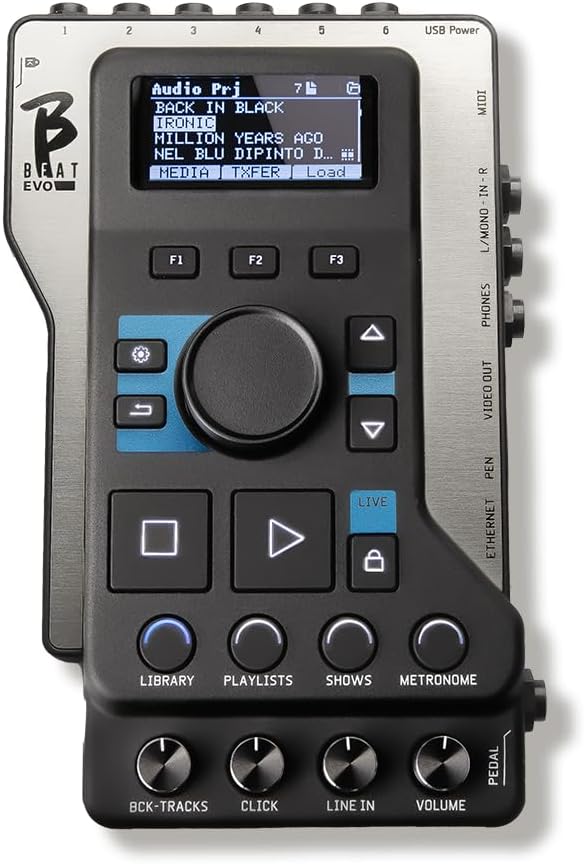
The M-Live B.Beat Evo 256GB is a dedicated backing-track and show-control device rather than a conventional live mixing console. Its 5.0 rating and extensive feature set target musicians who want one stage system to handle tracks, video, click, lyrics, and output mixing. The included 256GB storage makes it a complete-oriented solution for performers building repeatable live shows.
We may earn a commission when you buy through this link, at no additional cost to you.
Playback reaches up to 16 mono or eight stereo tracks in WAV, MP3, OGG, AAC, or Stems formats, with 24-bit processing and a stated 107 dB signal-to-noise ratio. Six balanced outputs, two line inputs, and independent headphone monitoring provide routing flexibility, while dedicated click detection helps the performer monitor timing. MP4, MOV, and AVI video can play in sync with music and images, with HDMI output supporting up to 1920×1080.
The trade-off is that this is not a drop-in replacement for a conventional multi-microphone mixer. Its strength comes from a planned show workflow using the included PC and Mac app, playlists, displays, wireless lyric or score control, and optional footswitch operation. That makes setup more involved than plugging microphones into a basic analog board, but it reduces the number of separate devices a solo artist or fixed production may need.
Choose the B.Beat Evo for singer-songwriters, show producers, worship leaders, theater performers, and musicians who rely on synchronized backing tracks. It is our best premium pick because it consolidates several show tasks into a single dedicated device. It is less appropriate for a band that primarily needs a broad, immediate collection of analog input controls.
Tracks, click, video, lyrics, scores, and stage outputs are managed within one show-oriented platform. That consolidation can simplify rehearsals and make recurring performances more repeatable once the show file is properly prepared.
Six balanced outputs and independent headphone monitoring provide more routing options than a basic live board. Dedicated click detection gives performers a separate timing reference without requiring every audience-facing output to carry the click track.
We may earn a commission when you buy through this link, at no additional cost to you.
The Zoom LiveTrak L6max is a compact mixer-recorder that combines live mixing with capture of up to 14 tracks simultaneously. Its 4.5 rating makes it a versatile choice for musicians who want a repeatable performance mix and clean, separate recordings without carrying two larger devices. Four combo inputs accept instruments through Hi-Z, while eight additional line inputs bring the mixer to 12 channels.
We may earn a commission when you buy through this link, at no additional cost to you.
The four Hi-Z inputs are especially relevant for electric guitars, making this product practical for rehearsal, compact live sessions, and musicians producing their own tracks. Dual AD converters on channels one through four are designed to capture wide dynamics without clipping. Real-time AI reduction can suppress hum, hiss, and background noise, while the recording system writes to SD cards up to 2TB.
Built-in sound pads add another layer of live utility. Samples, jingles, and effects can be triggered on demand and locked to a MIDI clock, which is valuable for electronic performers and sound effects-heavy shows. The trade-off is that these capabilities require more setup and operating knowledge than a straightforward analog mixer, and carrying enough recording storage becomes the performer's responsibility.
Battery, USB bus, and mobile battery-pack power make the L6max suitable for mobile performance and recording. It is our editor's choice for performers who want equalization, playback, live capture, Hi-Z instrument support, and portability in one box. Choose it for rehearsals, podcast-style musical sessions, small gigs, and content creation where separate tracks are as important as the live mix.
Up to 14 tracks can be captured at once, giving each performer an independent file for editing later. This is a major advantage over two-channel recording because instruments can be balanced, comped, and processed after the performance.
AA batteries, USB bus power, and mobile battery-pack support remove the need for a mains connection at every session. That flexibility makes the unit practical for a rehearsal, a courtyard performance, or a mobile recording setup.
We may earn a commission when you buy through this link, at no additional cost to you.
The 16-Channel 99 DSP Mixer offers the largest conventional input count in this guide, making it a practical option for bands, rehearsals, karaoke events, and small venues that need many dedicated channels. Its 4.6 rating reflects a broad feature set combining 16 input channels, modern playback options, per-channel tone controls, and a substantial master processing section.
We may earn a commission when you buy through this link, at no additional cost to you.
Every channel has independent gain, three-band EQ, a dedicated fader, and an individual mute button. Those mutes are particularly useful for quick transitions between performers, backing tracks, or instruments. The master section adds a seven-band graphic EQ, master output, monitor, and effect-level controls. A digital display player, USB playback, and Bluetooth streaming expand the sources that can enter the mix.
The board includes 99 DSP effects such as reverb, delay, and ambience, allowing performers to shape vocals or instruments without carrying a separate effects unit. A hybrid input jack and 48V phantom power support condenser microphones, dynamic microphones, wireless systems, guitars, and DI boxes. Its wide feature count can also make the surface feel busy, and the 16-channel format may be excessive for a solo act.
This mixer is best for musicians who value channel count and flexible onboard effects more than pristine simplicity. It suits rehearsal rooms, community stages, karaoke, and band performances where separate control of several sources is essential. Users should confirm their cable and microphone requirements, particularly for balanced and unbalanced connections.
Sixteen channels create room for a full ensemble, several wireless microphones, keyboard returns, playback, and effects returns. Individual mute buttons make it easier to isolate sources during a performance without disturbing the position of neighboring faders.
A seven-band graphic equalizer provides broad control over the final stereo image, while 99 DSP effects cover common reverb, delay, and ambience needs. These tools reduce reliance on outboard processors, though selecting sensible settings remains important.
We may earn a commission when you buy through this link, at no additional cost to you.
The AVE-100 is a dedicated vocal effects processor for singers, streamers, and recording artists rather than a general-purpose multi-channel mixer. Its 4.2 rating reflects a specialized feature set centered on pitch correction, harmony, reverb, delay, loop recording, and anti-feedback processing. It can give a solo vocalist a fuller, more controlled sound without requiring a large rack of outboard gear.
We may earn a commission when you buy through this link, at no additional cost to you.
Harmony modes include Unison, a third above, and a sixth above. The KeyLearn function detects the key of a backing track to help pitch correction and harmony fit the song more accurately. Effect pads provide convenient access during a performance, while adjustable vocal processing lets performers dial in different amounts of correction, depth, and delay. A loop recorder can capture and layer multiple vocal performances.
Anti-feedback processing is valuable in rooms with strong stage monitors, though it should be treated as a useful tool rather than a guarantee against every feedback condition. The unit also lacks the multi-input channel controls, per-channel EQ, and broad routing of a conventional live console. A full band would therefore still need another method for balancing instruments.
The AVE-100 is best for soloists, duets, acoustic performers, karaoke singers, and content creators who want a dedicated vocal chain. It works especially well for a performer using a backing track and needing harmony, pitch support, or looped layers. For complete live mix control, use it as a vocal processor alongside a conventional mixer rather than as the only console.
Automatic key detection reduces the work required to place added vocal voices in a compatible key. The performer can select Unison, third, or sixth intervals and adjust the underlying correction rather than manually matching every note.
The XLR input with 48V phantom power supports condenser microphones, while 6.35mm connections cover instruments and line-level sources. Anti-feedback and loop recording help performance and practice, but the unit remains a vocal specialist rather than a full band mixer.
We may earn a commission when you buy through this link, at no additional cost to you.
The FULUODE CT-80S is an eight-channel mixer designed for karaoke, bands, campus events, conferences, and other mobile performance situations. Its 4.4 rating reflects a practical balance of a thin 1.57-inch enclosure, familiar three-band channel control, and several convenient playback methods. It is less of a studio centerpiece than a portable tool for moving audio from several sources into one output.
We may earn a commission when you buy through this link, at no additional cost to you.
MP3 and USB playback, a song-name display, LED indicators, and 5.0 Bluetooth connectivity allow performers to use stored tracks or stream from a phone. The large LED display can also connect to digital effector peripherals, while 48V phantom power supports compatible condenser microphones. Wired microphones, wireless microphones, capacitive microphones, and instruments can be accommodated depending on the appropriate input and connection.
The primary limitation is channel count. Eight inputs may be enough for a singer, a guitarist, a small acoustic ensemble, or a presenter with a few microphones, but it can be restrictive for a full band. The listed 110V configuration and American plug also require attention for use in locations with a different supply. The supplied information does not describe the full effect library, so buyers should not assume extensive onboard processing.
Choose the CT-80S when portability, wireless playback, and basic live mixing are more important than advanced routing or multitrack capture. It is well suited to karaoke hosts, acoustic performers, classroom events, and small traveling shows. Confirm local power compatibility and map every source to the correct input before the performance.
The slim chassis is easier to pack and carry than a deep console. It suits performers who move between rehearsal spaces, community halls, karaoke venues, and small events without requiring a separate playback device.
Bluetooth, MP3, USB, a song-name display, and LED indicators make source status easier to see on stage. These conveniences are valuable when the operator cannot easily watch a computer screen while handling a live mix.
We may earn a commission when you buy through this link, at no additional cost to you.
The 6-Channel Bluetooth Mixer is a compact analog console aimed at karaoke, streaming, recording, and small live performance. Its 4.3 rating reflects a capable entry-level layout with four XLR inputs, 48V phantom power, three-band EQ, and 16 DSP effects. It is a sensible option for performers who need a limited number of well-defined microphone and instrument inputs without carrying a larger board.
We may earn a commission when you buy through this link, at no additional cost to you.
Four XLR channels can accept condenser or dynamic microphones and instruments through the supplied connection options, while channels five and six are stereo quarter-inch inputs. Channels one through four can use the +48V control for compatible condenser microphones. Each channel has gain, three-band EQ, and fader control, with separate master output and effect-level adjustment available in the output section.
Bluetooth allows phone or tablet streaming, and the USB interface supports flash-drive and MP3 playback. Built-in controls handle play, pause, track skipping, and mode switching after the menu button is pressed. The unit is described as a traditional analog mixer, so it is not a computer-recording interface in the digital sense. That limitation should be considered if multitrack files are central to the project.
This mixer is best for soloists, duos, mobile DJs, karaoke hosts, and small rehearsal groups. It offers more XLR capacity than a four-input consumer mixer while remaining compact and straightforward. Those needing a full band mix, extensive digital recording, or more advanced routing should move to a larger console or dedicated recorder.
Four XLR inputs provide enough microphone connections for several singers, a presenter, or a compact ensemble. Phantom power on the first four channels supports the common live-performance combination of dynamic and condenser microphones.
Sixteen DSP effects include practical choices such as reverb and delay for vocals and instruments. These can improve depth without external hardware, although keeping effects subtle is usually preferable in a full live mix.
We may earn a commission when you buy through this link, at no additional cost to you.
The MD-10 is a feature-rich ten-channel stage mixer with a 5.0 rating and a focus on detailed live sound control. It combines independent three-band channel equalization, 99 DSP effects, wireless and USB playback, a large LED display, 48V phantom power, and a nine-band equalizer with real-time monitoring. The result is well suited to stages, churches, clubs, rehearsal rooms, and speaking events.
We may earn a commission when you buy through this link, at no additional cost to you.
The large display shows effect parameters, making it easier to see and adjust settings than on a mixer with minimal feedback. Effects include hall, plate, room, delay, chorus, pitch shifting, and distortion. A high-fidelity processing chip and intelligent noise-reduction technology are intended to reduce floor noise and hum, while the extended fader travel provides finer physical control during a live mix.
This amount of functionality is a strength for users who want to shape a complete show from one console, but it can be excessive for a simple acoustic performance. Digital effects and display-based operation require more deliberate programming, and the supplied information does not indicate a dedicated multitrack recorder. Users should therefore not treat it as a direct substitute for a separate track recorder.
The MD-10 suits experienced performers who value visual feedback, a broad effect catalog, and a substantial master EQ. It is particularly attractive for venues that alternate between music, speech, and karaoke. For a smaller setup, its ten-channel layout is appropriate; for a larger ensemble, a 12- or 16-channel model offers safer expansion.
The large LED display presents effect parameters in a more visible way than a simple knob-only console. This is useful for live operators who need to confirm the selected effect and related values without navigating an unreadable menu.
Independent three-band EQ on every input is paired with a nine-band master equalizer and real-time monitoring. This two-level control structure supports both detailed source adjustments and broader corrections to the final stereo output.
We may earn a commission when you buy through this link, at no additional cost to you.
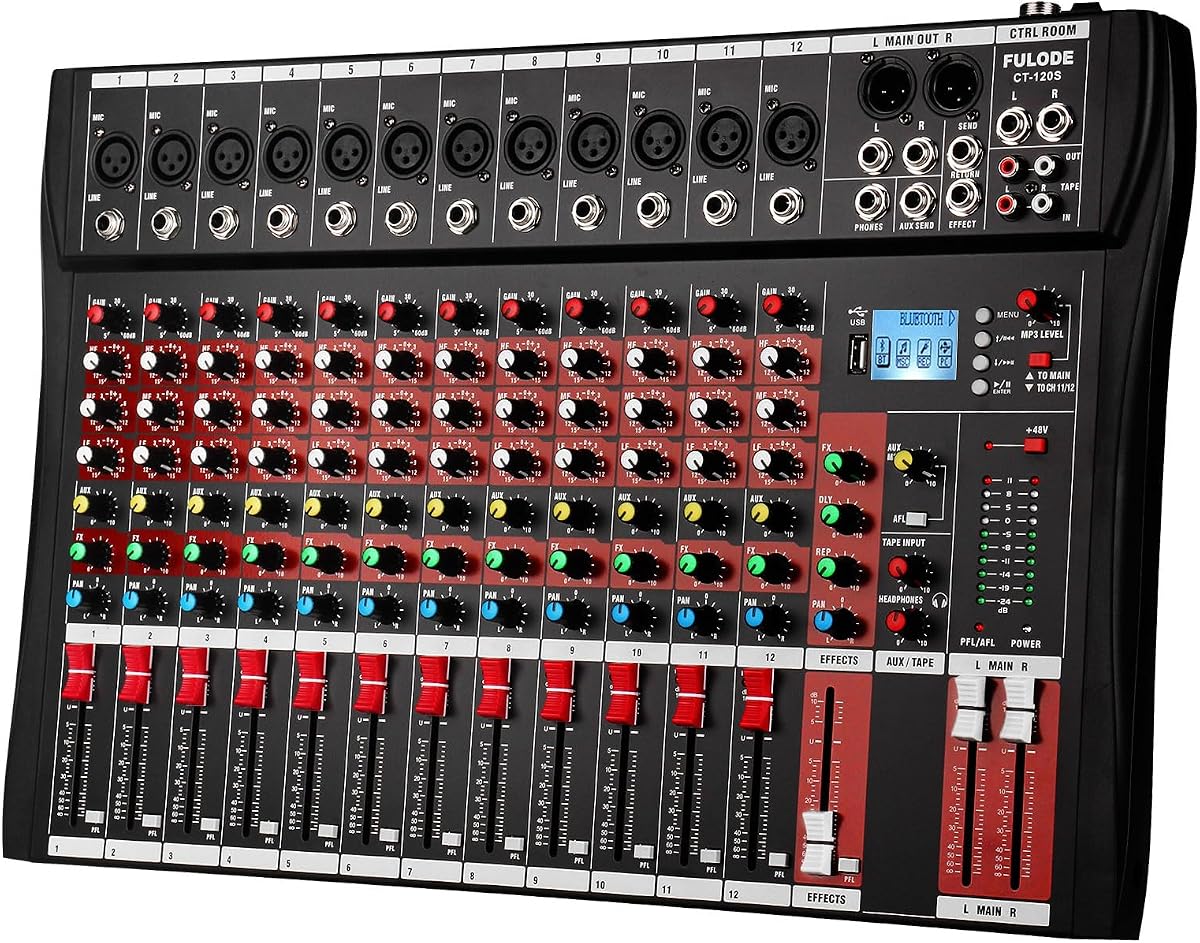
The FULUODE CT-120S expands the CT-80S concept to 12 input channels while retaining a slim chassis, three-band channel control, wireless playback, and phantom power. Its 4.4 rating makes it a useful middle ground for small bands, karaoke events, family entertainment, conferences, and rehearsal sessions where eight inputs may be too restrictive.
We may earn a commission when you buy through this link, at no additional cost to you.
MP3 and USB input, 5.0 Bluetooth, a song-name display, and a large LED panel make playback easier to manage on stage. The mixer can connect with digital effector peripherals, while its input section supports wired and wireless microphones, capacitive microphones, and instruments. As with the smaller CT-80S, the product information identifies a 110V configuration and American plug, which should be checked before use abroad.
Twelve single inputs offer more room for a band than compact six- or eight-channel options, but there is no mention of separate multitrack recording, digital routing, or sophisticated bus processing. Consequently, it is best viewed as a capable analog-style live console with modern playback rather than a complete recording solution. Menu navigation and exact effect behavior are also less documented than those of established specialist brands.
Choose the CT-120S for rehearsal rooms, community stages, karaoke, and small ensembles that need a balance of channel capacity and transportability. It is particularly helpful when phone playback is part of the show. Verify the power configuration, input types, and included accessories before committing it to a regular touring setup.
Twelve channels accommodate more microphones and instruments without moving to a large desktop console. The 1.57-inch body remains manageable for mobile use, making the mixer practical for events that are set up and packed away quickly.
Bluetooth, MP3, and USB options support several ways to deliver background music or accompaniment. The large LED display and song-name readout give the operator useful visual feedback directly on the mixer.
We may earn a commission when you buy through this link, at no additional cost to you.
The right live mixer is determined by your sources, output routing, performance environment, and recording needs. Compare channel count, preamp and EQ quality, connectivity, effects, portability, and power requirements before making a final choice.
Summary: Choose enough channels for the full source list, including growth and stereo sources.
Summary: Match every playback method you will use, then assess how easily the operator can control it live.
Summary: Prioritize clean preamps, usable EQ, and high-pass filtering over unnecessary processing.
Summary: Verify isolated track capture, storage support, and instrument-level inputs before buying for recording.
Summary: Choose effects that solve a real stage problem, and avoid assuming more presets automatically means a better mix.
Summary: Count speaker, monitor, headphone, and recording connections before finalizing the purchase.
Summary: Balance channel capacity and control size against the need to transport the mixer frequently.
Summary: Confirm voltage, plug type, power supply, and battery options for the intended performance location.
Begin by listing every source and assigning it to an appropriate input before the performance. Connect microphones and instruments, check polarity where applicable, set reasonable starting levels, and engage phantom power only for compatible condenser microphones. Arrange faders and gain controls so the mix can be balanced quickly, then create a baseline mix before adding effects or unusual routing.
Build the mix from the front of the room outward. Bring voices and essential instruments into balance, establish enough level without excessive headroom use, and set overall levels well below the point of distortion. Use EQ to correct clear problems rather than dramatically reshaping every source. When using Bluetooth or file playback, test the connection, verify the correct source is selected, and keep a local fallback file available.
Care for the console by keeping it dry, stable, and away from direct impact. Clean knobs and connectors gently, remove batteries when storing a battery-powered unit for an extended period, and protect USB flash drives from unnecessary removal. Transport the mixer in a suitable case, coil cables without creating sharp stress points, and periodically confirm that inputs, outputs, phantom power, playback, and recording functions remain reliable.
Count each independent microphone or mono instrument source, then add channels for stereo backing tracks and any effects returns. A solo singer with guitar and stereo playback may need only a few channels, while a full band can require considerably more. Leave some expansion room if new sources are likely, and remember that a stereo source normally occupies two input channels on a conventional mixer.
It depends on the performance. Analog mixers often provide immediate, physical control and can be simpler for a basic live mix. Digital systems can add accurate recall, integrated effects, multitrack recording, synchronized playback, and sophisticated routing. Consider the operator's comfort as well as the feature set, because a complex system is only useful if it can be configured and controlled reliably under pressure.
Phantom power is generally required by condenser microphones that expect 48 volts, while most dynamic microphones do not need it. Some ribbon microphones have specific power requirements, so check the microphone documentation. Connect phantom power only to compatible inputs, and never assume it should be enabled for every microphone in the mix.
Several mixers support Bluetooth, including the Depusheng DX8, FULUODE CT-80S, MD-10, 6-Channel Bluetooth Mixer, and 16-Channel 99 DSP Mixer. Wireless playback is convenient, but the signal can be affected by interference, device notifications, or range. Test the connection thoroughly and keep a second copy of the required audio on a local storage device or separate playback system.
A conventional mixer combines microphones and instruments, controls their levels and tone, and sends a mix to outputs. A backing-track player focuses on prearranged tracks, cues, click, video, and show control. The M-Live B.Beat Evo performs the latter role, although its multiple outputs and inputs allow some live routing. A performer with microphones and changing live mixes may still need a conventional mixer.
The Zoom LiveTrak L6max is the clearest dedicated option in this group, with simultaneous capture of up to 14 tracks and four Hi-Z instrument inputs. Other products mention USB recording or computer connection, but that alone does not confirm independent channel capture. Check the documentation for the exact model to determine whether each source is saved separately or mixed down to stereo.
Onboard reverb, delay, harmony, and pitch effects can make a compact setup more versatile and reduce the need for outboard processors. They are most useful when they serve a clear purpose, such as adding depth to a vocal or making harmonies in a solo show. Poorly selected effects can obscure the mix, so start with subtle settings and adjust them in the room where the performance will happen.
Choose based on the number of sources, transportation method, available power, and how quickly you need to operate the board. Slim mixers such as the DX8, CT-80S, and CT-120S are easier to pack, while broader consoles may offer more channels and controls. A touring setup should also account for a protective case, cable management, and a dependable power source.
The Yamaha MG10 is the most straightforward choice for small ensembles that want dependable analog mixing, clean preamps, channel EQ, high-pass filters, and compressors without digital complexity. The M-Live B.Beat Evo 256GB is the premium all-in-one show system for performers who need synchronized tracks, video, click, lyrics, balanced outputs, and repeatable show control.
The Zoom LiveTrak L6max is the most versatile option for musicians who want to mix and capture separate tracks from one portable device. Beyond those picks, prioritize the number of real source inputs, required playback methods, output routing, power compatibility, and recording format. A mixer with fewer features but the right connections, readable controls, and dependable signal handling is usually more valuable than a crowded console that cannot be configured properly.
Before purchasing, verify the current specifications, included accessories, local power requirements, software compatibility, and exact recording or playback behavior. Product configurations and availability can change, and retailer listings may evolve. For the most reliable result, test every microphone, instrument, playback source, and output connection at rehearsal volume before relying on the system in front of an audience.