
Kind Water Systems E-3000UV
4.7Editor score
Adds UV microorganism treatment
Comprehensive four-stage filtration
Chemical-free UV purification
Our guide compares the best salt free water softeners by filtration, scale prevention, capacity, installation, and ongoing maintenance needs.
Salt free water softeners offer an alternative to conventional ion-exchange systems by reducing scale without exchanging calcium and magnesium for sodium. The right unit can help protect plumbing and appliances while avoiding salt, brine discharge, and routine regeneration cycles.
We compared ten whole-house options across filtration stages, contaminant reduction, scale-control technology, flow capacity, installation requirements, maintenance, environmental impact, and warranty coverage. The list includes media-based systems, filter combinations, and electronic descalers with different operating principles.
Each review identifies the standout benefits and realistic limitations so you can choose according to your plumbing, hardness level, filtration priorities, and tolerance for cartridge changes. Product features and availability can change, so compare current listings and confirm fit before purchasing.
4.7Editor score

4.5Editor score
5.0Editor score
The table below compares all ten systems by treatment method, filtration scope, installation needs, and maintenance. It is intended to make the differences between compact filter assemblies, integrated whole-house systems, and electronic descalers easy to understand.




The Kind Water Systems E-3000 is a well-rounded whole-house treatment system with a 4.5 rating. It combines sediment filtration, carbon block filtration, and salt-free softening in one compact assembly designed for city water. That combination makes it a strong choice for households wanting cleaner, better-tasting water and scale reduction from a single point-of-entry unit.
We may earn a commission when you buy through this link, at no additional cost to you.
Its most impressive feature is the breadth of filtration. The manufacturer states that the system targets up to 95% of sediment and more than 155 chemical contaminants, including chlorine, chloramine, volatile organic compounds, and pesticides. The carbon block stage also addresses taste, odor, chlorine, and VOCs, while the scale-control media helps protect pipes, water heaters, and household appliances.
Operation is straightforward because the system does not require salt, electricity, brine discharge, or a drain line. Unlike a conventional softener, it does not regenerate resin with salty water. It also retains beneficial natural minerals, which is important for people who want to avoid the sodium exchange associated with traditional ion-exchange softening.
This is the most balanced choice for city-water households that want more than scale control without moving to a salt-based system. The tradeoff is that UV treatment is not included, and the product is specifically positioned for city water rather than private wells or untreated groundwater. Even so, its filtration breadth, simple operation, and appliance-protection focus make it the strongest all-around pick in this guide.
Combining sediment and carbon filtration with salt-free scale control gives the E-3000 a broader purpose than a basic descaler. It is designed to improve water used for drinking, cooking, bathing, laundry, and cleaning while helping limit deposits inside household plumbing.
No salt replenishment, electricity, regeneration schedule, or wastewater connection simplifies ownership considerably. The result is especially relevant for homeowners who want scale protection without introducing a brine drain or recurring salt handling into their utility space.
We may earn a commission when you buy through this link, at no additional cost to you.
The NU Aqua 4-Stage Salt Free Water Softener Whole House Water Filter System combines scale prevention with several filtration functions and carries a 4.5 rating. It is designed for point-of-entry installation, delivering treated water to bathrooms, kitchens, laundry rooms, and outdoor spigots rather than concentrating on a single faucet.
We may earn a commission when you buy through this link, at no additional cost to you.
Its scale-control media is intended to reduce hard-water buildup while retaining calcium and magnesium. The multi-stage design adds sediment removal and carbon filtration, with the listed targets including chlorine, volatile organic compounds, unpleasant odors, and bad taste. The product information also identifies reduction of heavy-metal particles such as lead, mercury, and arsenic.
Operation remains environmentally straightforward. The system uses no electricity, does not backflush, and produces no brine discharge. That makes it appealing for households seeking whole-house treatment without a salt reservoir, control valve, drain line, or electrical outlet. It also avoids the water-softening effect associated with exchanging calcium and magnesium for sodium.
The NU Aqua is a good match for buyers who want comprehensive filtration and scale prevention in one point-of-entry format. Its limitations are that it does not include UV treatment and cartridge maintenance is still part of ownership. Buyers should also understand that a salt-free conditioner is not equivalent to a conventional softener, particularly if their primary goal is measurable hardness reduction.
The combination of sediment, carbon, heavy-metal particle reduction, and scale media makes this system more versatile than a simple electronic descaler. It is intended to improve both water quality and the condition of plumbing throughout the home.
The absence of electricity, backflushing, and brine discharge eliminates several common objections to conventional softeners. It also makes the unit relatively straightforward to operate, although replacement of filtration components must still be planned.
We may earn a commission when you buy through this link, at no additional cost to you.
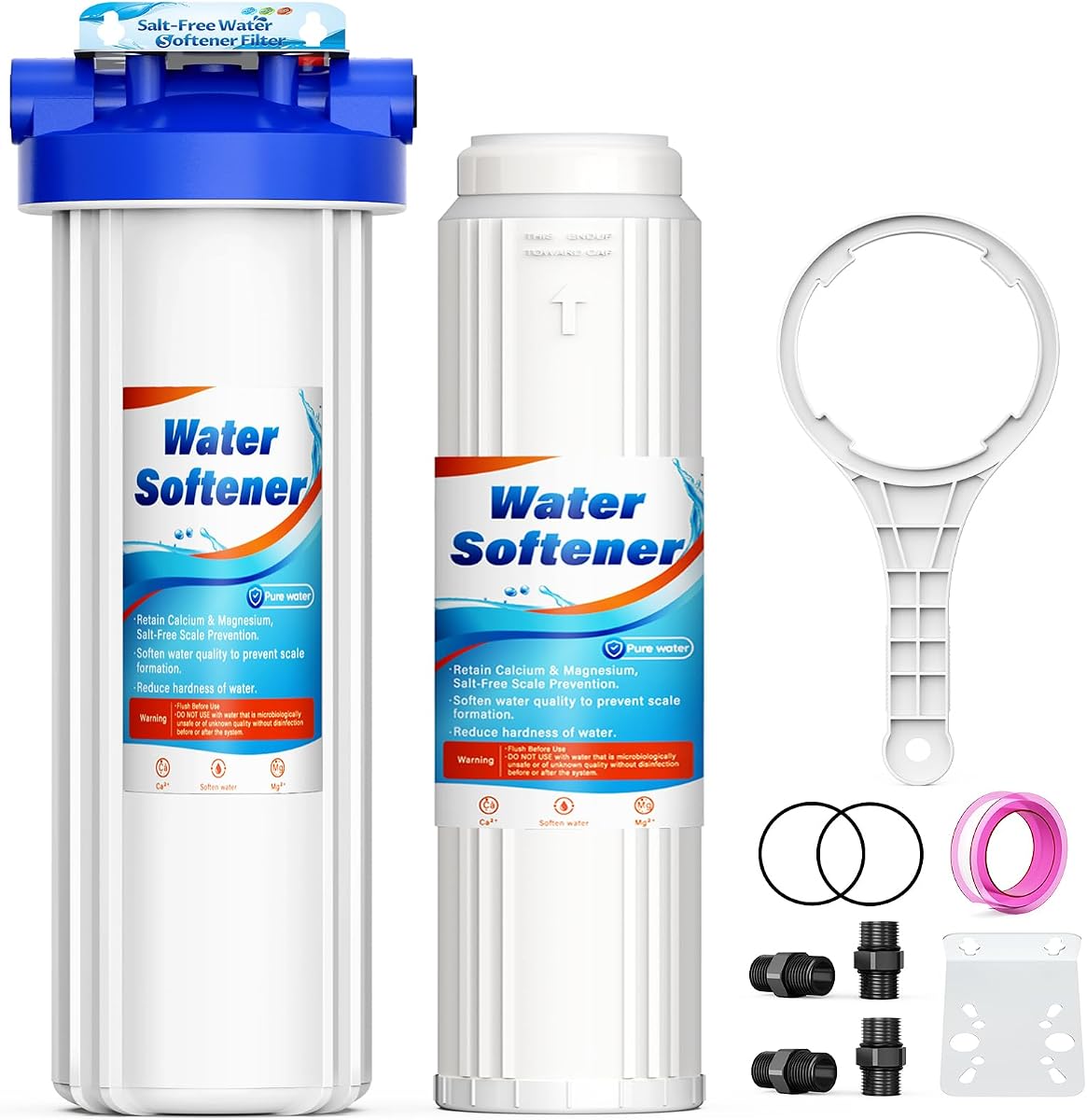
This 3/4-inch FNPT whole-house scale prevention system is a 5.0-rated option distinguished by a stated flow rate of 15 gallons per minute. It combines salt-free scale treatment with filtration for impurities, chlorine, odor, and limescale, making it a capable budget-oriented choice for homes with multiple fixtures and appliances.
We may earn a commission when you buy through this link, at no additional cost to you.
The filtration cartridge is described as 0.5-micron high-efficiency filtration, and the package includes a filter housing, softener filter, wrench, tape, two 3/4-inch connectors, two 1/2-inch connectors, and a user manual. Double O-rings are included in the housing design to help create a leak-resistant seal, while the supplied fittings make it adaptable to common residential pipe sizes.
Like other salt-free media systems, it retains calcium and magnesium rather than replacing them with sodium. The manufacturer also clarifies that total dissolved solids will remain unchanged, so a TDS meter should not be used to judge whether the scale media is working. Scale control and actual dissolved-solids reduction are different functions, and distinguishing them avoids a misleading evaluation.
This product suits buyers who want substantial flow and fine sediment filtration without introducing salt or electricity. Its primary disadvantage is the cartridge replacement interval of four to six months. It also offers fewer contaminant-treatment functions than the Kind Water Systems models. Even so, the stated flow, connector assortment, and focused scale-control package make it an appealing budget choice.
A stated 15-gallon-per-minute flow rate supports simultaneous use across multiple bathrooms, kitchens, and laundry applications. Buyers should still verify their household demand and available pipe space before assuming a nominal flow rating will translate perfectly to their installation.
The included 3/4-inch and 1/2-inch connectors, faucet fittings, tape, and wrench reduce the need for separate parts. That convenience is especially useful for DIY-oriented buyers, provided local plumbing codes and shutoff access are properly addressed.
We may earn a commission when you buy through this link, at no additional cost to you.
The Whole House Salt Free Water Softener, Prevent Water Scale, uses advanced ion-exchange resin to inhibit scale formation while retaining calcium and magnesium. Its 5.0 rating and whole-house positioning make it a strong option for households that prioritize plumbing and appliance protection over sodium-based water softening.
We may earn a commission when you buy through this link, at no additional cost to you.
The system is designed to serve every household tap for bathing, cleaning, and cooking. It also combines a CTO filter with the scale-prevention cartridge, and the product information says it can remove chlorine and chemicals at the point of entry. The package includes a filter housing, softener filter, CTO filter, wrench, tape, and adapters for several 1-inch and 3/4-inch connections.
Its operating advantages are substantial for consumers who dislike the routine of traditional softeners. There is no electricity, no wastewater, no salt to purchase, and no brine drain. Maintenance is limited to replacing the resin filter every six to twelve months, according to the listing, making the system substantially less demanding than a regenerating softener.
This is a good choice for a large home seeking whole-property scale prevention and modest filtration in one package. The honest limitation is that it does not lower total dissolved solids, and some buyers may want more information about contaminant certification than the listing provides. It is best understood as a scale-prevention and filtration product rather than a true hardness-reducing softener.
By reducing mineral deposition, the system targets the scale that commonly collects in water heaters, dishwashers, faucets, and shower components. Its value is therefore connected to extending equipment life and reducing the frequency of descale cleaning.
A stated six-to-twelve-month replacement interval is less demanding than the four-to-six-month schedule listed for the compact 0.5-micron system. Consumers should still follow the manufacturer's instructions and replace components according to actual water conditions.
We may earn a commission when you buy through this link, at no additional cost to you.
The Kind Water Systems E-3000UV is the most feature-rich option in this guide, earning a 4.7 rating. It adds UV treatment to the salt-free scale prevention, sediment filtration, and carbon block filtration found in the E-3000, creating a four-stage whole-house system intended for city water.
We may earn a commission when you buy through this link, at no additional cost to you.
The system states that it targets up to 95% of sediment and more than 155 chemical contaminants, including chlorine, chloramine, VOCs, and pesticides. Its chemical-free UV stage is advertised to neutralize up to 99.9% of common waterborne microorganisms. Together, these capabilities make it well suited to buyers who want more than scale control and general taste-and-odor improvement from a single point-of-entry device.
Its salt-free scale media helps limit hard-water deposits without salt, brine discharge, electricity, or bulky tanks. It retains natural minerals, requires no drain line, and is supported by a 120-day satisfaction guarantee. These features preserve the convenience associated with the standard E-3000 while adding a distinct microorganism-treatment stage.
The E-3000UV is the best premium selection for city-water households seeking a broad filtration package. It is less appropriate for buyers who need only basic scale conditioning or who do not want the expense and installation complexity of a more comprehensive system. It is also not positioned for untreated well water, where a properly selected well treatment plan would be more appropriate.
UV treatment provides a separate approach to reducing common waterborne microorganisms without relying on chemical additives in this system. It is the key feature that distinguishes this model from the standard E-3000 and makes the combination attractive to buyers with broader water-quality concerns.
The combination of sediment, carbon, salt-free scale media, and UV addresses several different concerns in one assembly. It is particularly useful for households seeking broad whole-house treatment without managing a salt reservoir, electrical control valve, or wastewater line.
We may earn a commission when you buy through this link, at no additional cost to you.
The Compact Scale Prevention System is a 5.0-rated whole-house unit built around advanced ion-exchange resin. It is designed to inhibit scale formation across the home while keeping calcium and magnesium in the water, offering a straightforward alternative for consumers primarily concerned with hard-water deposits.
We may earn a commission when you buy through this link, at no additional cost to you.
The listing emphasizes a single-unit arrangement intended to meet the needs of an entire household. It applies to taps used for bathing, cleaning, and cooking, with particular attention to water heaters, dishwashers, faucets, and showers. Operation requires no electricity and creates no wastewater, which simplifies installation and avoids the need for a floor drain.
Another meaningful benefit is the elimination of ongoing salt purchasing. Instead of replenishing a salt reservoir and managing regeneration, users replace the resin filter on the stated six-to-twelve-month schedule. That makes ownership more predictable for households that want the scale-oriented benefits of softener media without sodium exchange or brine.
This system is best for buyers seeking a focused, uncomplicated scale solution rather than a comprehensive contaminant filtration package. The trade-off is that the available feature information is less extensive than for the multi-stage Kind, NU Aqua, and NuvoH2O products. It also does not lower dissolved solids or independently provide UV treatment.
The system avoids the three operational requirements that many homeowners dislike in conventional softeners: salt replenishment, a wastewater connection, and electricity. That simplicity can be a decisive advantage in tight utility spaces or homes without a suitable drain.
The resin media is intended to inhibit deposits while retaining calcium and magnesium. This differentiates the system from a conventional ion-exchange softener and makes it relevant to households that do not want sodium added to their water.
We may earn a commission when you buy through this link, at no additional cost to you.
The Kind Water Systems Whole House Salt Free Water Softener Alternative has a 4.4 rating and focuses on two primary needs: reducing hard-water scale and filtering sediment from the whole-house water supply. It is a relatively direct option for homeowners who want straightforward plumbing protection without a salt-based system.
We may earn a commission when you buy through this link, at no additional cost to you.
Its reusable sediment filter cartridge is designed to capture dirt, sand, silt, clay, rust, and other debris. That physical filtration role helps keep particles from circulating through the entire plumbing system. The product is also advertised as a salt-free alternative that protects pipes and appliances from scale while using zero wastewater.
Installation and maintenance are presented as simple. The system is intended for easy installation and low upkeep, and Kind Water Systems backs it with a 120-day satisfaction guarantee. These attributes make it appealing for consumers who want a practical whole-house solution without managing salt, drainage, or electrical controls.
This product is a good fit for buyers whose main concern is sediment and scale rather than broad chemical contaminant removal. It has a less expansive feature set than the E-3000 and E-3000UV, and users should not expect the same carbon filtration or UV capabilities. Its appeal lies in a focused, low-complexity approach with a reusable sediment component.
The reusable cartridge provides a practical way to address dirt, sand, silt, clay, rust, and debris at the point of entry. It may be particularly appealing to owners who prefer routine cleaning over frequent disposal of filter cartridges.
By combining scale mitigation with sediment capture, the system addresses both mineral deposits and visible particulate matter. Its salt-free, zero-wastewater operation keeps the installation relatively uncomplicated compared with a regenerating softener.
We may earn a commission when you buy through this link, at no additional cost to you.
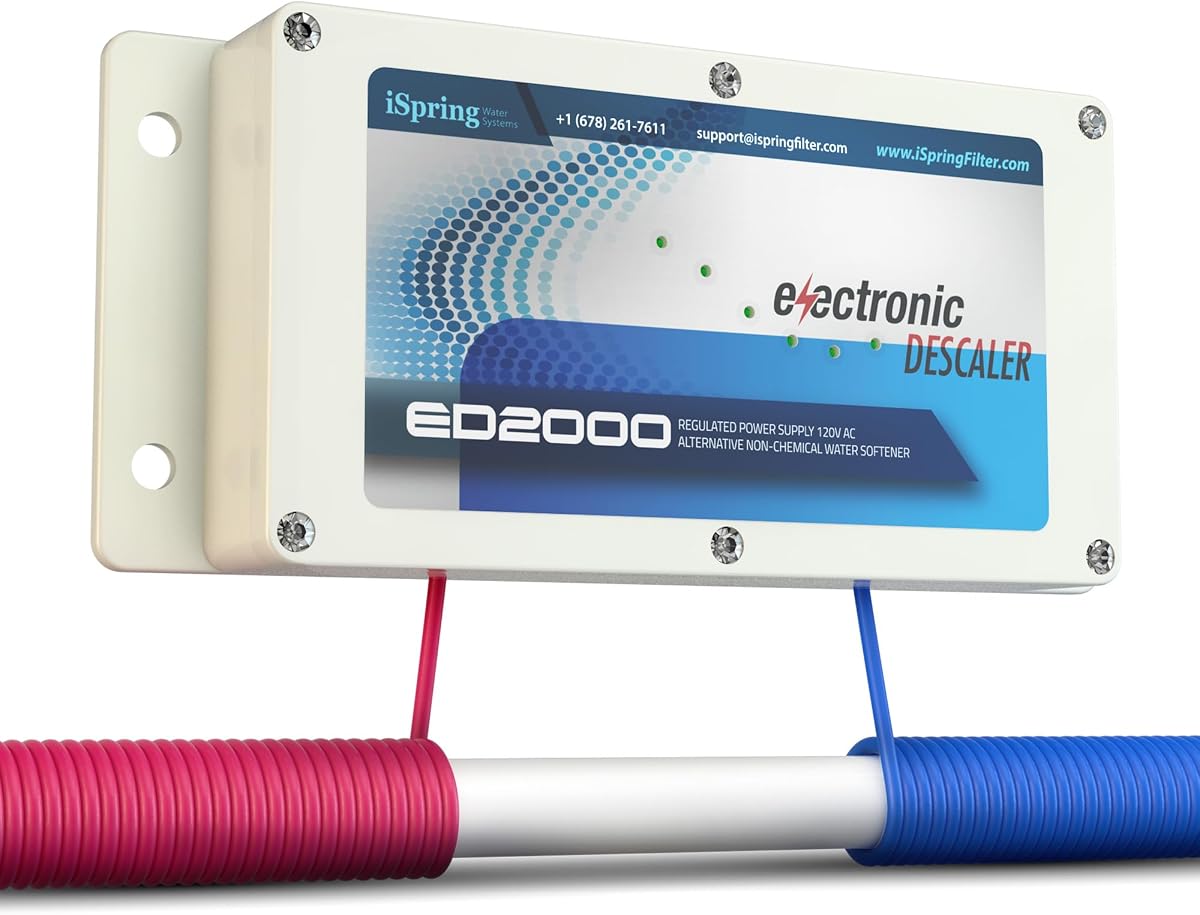
The iSpring ED2000 is an electronic whole-house descaler with a 4.1 rating. Instead of filtering or exchanging ions, it conditions water to discourage scale deposits and is explicitly described as different from a water softener. That makes it a specialized option for people who mainly want scale management and convenient installation.
We may earn a commission when you buy through this link, at no additional cost to you.
According to the product information, the ED2000 prevents scale buildup without chemicals, salt, or maintenance while retaining healthy minerals. It is also described as able to break down existing scale. The system is intended for very hard-water areas measuring 10 to 19 grains per gallon and is marketed as helping reduce energy consumption and extend appliance life.
Installation is one of its strongest advantages. No plumbing modifications are required, it works on PEX and PVC, and no routine maintenance is expected. iSpring also lists a one-year money-back guarantee and lifetime technical support. Since the unit does not exchange calcium and magnesium for sodium, it preserves the chemistry of the water.
The ED2000 is a good fit for owners who want a simple electronic approach and do not need sediment or chemical filtration. It should not be mistaken for a purifier, and the lower 4.1 rating reflects a different proposition from the more comprehensive media systems. For scale control alone, its ease of installation and maintenance-free operation are compelling advantages.
The electronic approach avoids replacement sediment cartridges, salt deliveries, and wastewater discharge. This can make ownership more convenient, particularly for households whose water is already low in sediment and does not require comprehensive filtration.
Compatibility with PEX and PVC and the claim that no plumbing modifications are required simplify installation. Homeowners should still locate an appropriate point of entry, follow the manual, and confirm that the electrical supply meets the manufacturer's instructions.
We may earn a commission when you buy through this link, at no additional cost to you.
The iSpring EDV2 is a 4.1-rated electronic descaler distinguished from simpler conditioning devices by a stated power output of up to 12 watts. Its product information claims this is nearly ten times the power of basic electronic descalers, although real-world results will still depend on installation, hardness, pipe materials, and water-use patterns.
We may earn a commission when you buy through this link, at no additional cost to you.
The unit uses an aluminum alloy housing intended to provide durability and corrosion resistance. It is designed to prevent scale throughout the water system, descale pipes, and support longer appliance life without salt, chemicals, or routine maintenance. Like conventional salt-free alternatives, it leaves the water chemistry unchanged and retains its natural composition.
Installation is presented as straightforward and compatible with all pipe types, including PEX and PVC, without plumbing modifications. A one-year limited manufacturer warranty is available upon registration, according to the listing, along with lifetime personalized support. Those support and warranty terms are useful additions to a specialized electronic product.
The EDV2 is best for buyers who want whole-house scale prevention with minimal upkeep and do not need filtration. It does not remove sediment, chlorine, metals, or other contaminants, so those concerns require a different treatment strategy. Its 4.1 rating is lower than that of the leading filter-based systems, but its construction and power specification set it apart from basic electronic descalers.
The stated 12-watt output is the model's defining technical feature. It is intended to provide stronger conditioning than entry-level electronic devices, though buyers should evaluate the system as a scale-management tool rather than as a substitute for sediment or chemical filtration.
Aluminum alloy construction offers a more robust enclosure than many simple plastic-bodied descalers. With no salt, cartridge changes, drain line, or continuous maintenance, the unit can be attractive for straightforward whole-house scale management.
We may earn a commission when you buy through this link, at no additional cost to you.
The NuvoH2O Citrus-Based Salt-Free Water Filter System and Water Softener is a 3.9-rated home system built around CitraCharge technology. It offers salt-free softening that retains calcium and magnesium, aims to improve taste, and is designed to prevent and remove hard-water scale without introducing the sodium exchange associated with conventional softeners.
We may earn a commission when you buy through this link, at no additional cost to you.
Its compact cartridge system uses quick-connect connections and is advertised as requiring no salt, phosphates, wastewater, or electricity. The product information says the self-contained cartridges can last up to six months, helping make replacement manageable. It is particularly suited to users who want a relatively compact treatment setup rather than a large regeneration tank or control assembly.
The filtration side is intended to remove harsh chemicals and provide fresher, better-tasting water. Scale protection extends to water heaters, plumbing, and appliances, and the citrus-based approach is presented as avoiding the slick-feeling water sometimes associated with salt-based systems.
This system offers an interesting balance of compactness, filtration, and mineral retention, but its 3.9 rating is the lowest in the guide. It also requires more frequent cartridge attention than systems listing six-to-twelve-month replacement intervals. Buyers should verify their plumbing space, point-of-entry location, and cartridge availability before selecting this option.
CitraCharge technology is intended to reduce scale without replacing calcium and magnesium with sodium or potassium. The approach is designed for households that want mineral retention and salt-free operation in a compact, cartridge-based package.
Quick-connect, self-contained cartridges make the system comparatively compact and simplify replacement. Up to six months of cartridge life is convenient, but owners should establish a realistic maintenance routine rather than waiting for visible taste or performance changes.
We may earn a commission when you buy through this link, at no additional cost to you.
A useful salt-free softener must match your water quality, plumbing configuration, and desired level of maintenance. Compare treatment mechanisms and installation needs before focusing on any single feature.
Salt-free systems do not all use the same method. Filter-based and ion-exchange-style media can capture sediment or inhibit mineral deposits while retaining calcium and magnesium. Electronic descalers condition water to discourage scale without filtering it, while the NuvoH2O model uses citrus-based CitraCharge technology. Each approach addresses a different part of the hard-water problem, so decide whether your priority is scale reduction, sediment capture, contaminant filtration, or a combination of those goals.
A point-of-entry system must handle normal household demand without restricting showers, laundry, dishwashing, or simultaneous fixture use. The 3/4-inch FNPT model lists a particularly strong 15-gallon-per-minute flow rate, while other products do not provide an equally prominent figure. Consider the number of occupants, bathrooms, appliances, and any outdoor spigots served by the system. Pipe diameter, filter pressure loss, and local restrictions can also affect real-world performance.
Sediment filtration captures dirt, sand, silt, clay, rust, and debris, while carbon block filtration targets chlorine, chloramine, odors, taste, and some chemical contaminants. The E-3000 combines sediment, carbon, and salt-free scale media; the NU Aqua adds a more extensive multi-stage format; and the E-3000UV adds UV treatment. Review every stated contaminant target carefully and avoid assuming that generic descriptions guarantee removal of a particular substance.
Salt-free products generally preserve calcium and magnesium rather than replacing them with sodium. They may inhibit scale or alter how deposits form, but they do not necessarily reduce total dissolved solids or produce water with the same low-hardness reading as an ion-exchange softener. Several listings explicitly warn that unchanged TDS readings do not indicate failure. If you require genuinely lower hardness, consult a water-treatment professional rather than relying on a salt-free conditioner as a substitute.
Whole-house systems need a suitable point of entry, adequate vertical clearance, shutoff access, and room for routine cartridge changes. Electronic descalers generally require less physical space but need an appropriate electrical connection. Filter-based systems can involve more housing components and larger fittings, while the NuvoH2O option emphasizes compact quick-connect cartridges. Measure the available space and inspect the main shutoff and drain area before ordering.
Salt-free does not mean maintenance-free for every model. The 0.5-micron system lists cartridge replacement every four to six months, the NuvoH2O cartridges can last up to six months, and two other media systems specify six-to-twelve-month replacements. The Kind scale alternative uses a reusable sediment cartridge, while both iSpring electronic models are presented as requiring no routine maintenance. Include replacement availability and your comfort with periodic servicing in the decision.
The E-3000 and E-3000UV are specifically designed for city water, so they may be poor choices for untreated private-well water that requires a well-specific treatment plan. For municipal water, identify whether your concerns are hardness, sediment, chlorine, taste and odor, metals, or microorganisms. UV can add microorganism treatment, but it does not replace sediment filtration because particles can shield organisms from UV light. Professional testing is valuable when the source or symptoms are uncertain.
Kind Water Systems offers a 120-day satisfaction guarantee on the E-3000, E-3000UV, and scale alternative. The ED2000 lists a one-year money-back guarantee and lifetime technical support, while the EDV2 includes a one-year limited manufacturer warranty upon registration and lifetime personalized support. Warranty duration can indicate manufacturer confidence, but it should complement rather than replace careful review of certification claims, included parts, and installation requirements.
Begin by identifying the correct point of entry, usually after the main shutoff and before the first branch supplying the home. Confirm pipe diameter, available clearance, pressure conditions, and whether the selected model requires electricity or a drain. Install a suitable shutoff and follow the manufacturer's instructions carefully; a whole-house system should generally be sized and connected to serve the entire property.
Flush the new system according to its manual, check every fitting for leaks, and observe several fixtures for changes in flow, taste, odor, and visible scale. Do not judge performance solely with a TDS meter because salt-free systems intentionally retain dissolved minerals. Instead, track appliance deposits, soap use, water spotting, shower residue, and the condition of faucets and heating equipment over time.
Create a maintenance reminder based on the product's specified cartridge schedule. Filter-based systems should be replaced according to the stated interval and inspected for bypass, damage, or signs of clogging. Electronic descalers require no routine cartridge service, but their batteries, connections, and operating indicators should still be checked. Keep replacement parts available and contact the manufacturer or a qualified plumber when leaks, unusual flow changes, or installation questions arise.
Usually not. Conventional ion-exchange softeners replace calcium and magnesium with sodium, which can measurably lower hardness. Salt-free alternatives generally retain those minerals while attempting to inhibit scale formation, so their purpose is often better described as scale prevention or conditioning. If truly soft water with a lower hardness reading is essential, a conventional softener or professional treatment plan is usually more appropriate.
Most of the media-based systems in this guide operate without electricity, salt, brine discharge, or a wastewater drain. That simplicity makes them convenient compared with regenerating softeners. Electronic iSpring models also avoid salt and wastewater but require an electrical supply, while electronic conditioners do not filter sediment or chemical contaminants.
Some products in this guide are marketed to address existing deposits as well as prevent new buildup, particularly the electronic descalers and NuvoH2O system. Actual results depend on hardness, pipe materials, duration of treatment, and the severity of the deposits. Severe scaling may require descaling or plumbing service before a new treatment system is installed.
The schedule varies by product. The 0.5-micron compact system lists replacement every four to six months, the NuvoH2O cartridges can last up to six months, and two whole-house resin systems list six-to-twelve months. The Kind scale alternative uses a reusable sediment cartridge, while the iSpring electronic units have no routine cartridge replacement requirement.
That depends on the product. The Kind E-3000, E-3000UV, and NU Aqua models include carbon and sediment filtration and state broader contaminant-reduction targets. The NuvoH2O system also emphasizes chemical filtration. By contrast, electronic descalers focus on scale conditioning and are not substitutes for sediment, carbon, or mineral-removal filtration.
It depends on the treatment design and the water analysis. The two premium Kind E-3000 models are specifically designed for city water. A private well may require treatment for sediment, iron, manganese, bacteria, nitrates, or other issues that are best addressed through testing and a system designed for the source. Do not choose a city-water unit solely because it is advertised for whole-house use.
A higher rating can help if several fixtures and appliances operate simultaneously, but it is not the only consideration. A correctly sized unit should meet household demand without unnecessary pressure loss, and all components must be compatible with the available pipe size. Listings may not disclose every flow-related variable, so the manufacturer's installation guidance should take priority.
Installation difficulty depends on the model and your plumbing experience. Point-of-entry work may require cutting and joining pipes, installing a bypass, and understanding local plumbing requirements. Electronic systems may be simpler mechanically but still need proper electrical placement. If you are uncertain, have a qualified plumber evaluate the installation before buying or operating the unit.
The Kind Water Systems E-3000 is the most balanced overall choice because it combines sediment filtration, carbon block filtration, and salt-free scale protection without requiring salt, electricity, or brine discharge. The E-3000UV earns the premium recommendation for city-water households that also want a dedicated UV stage, while the 3/4-inch FNPT system stands out as the budget pick because of its strong stated flow and fine sediment filtration.
Before buying, identify the exact problem you want to solve. Choose a comprehensive filter combination for broad water-quality concerns, a focused media system for scale and sediment, or an electronic descaler for low-maintenance conditioning with no filtration expectations. Measure installation space, verify flow and pipe compatibility, and understand the cartridge replacement schedule before finalizing your choice.
Product features, certifications, component availability, and current pricing can change over time, so review the latest listing and manufacturer documentation before ordering. Comparing current offerings also helps confirm warranty terms, included connectors, dimensions, and installation requirements. Use the guide as a starting point, then select the system that best matches your water source and household priorities.